Contact@prince2training.co.uk
 01344203999




 Back
Back


Table of Content

07-Sep-2026

David Walter
Professional certifications are a testament to your expertise, offering a platform to showcase your proficiency and potentially open doors to new career paths. For Project Managers, various certifications are available, each catering to different skills and interests. The decision as to which certification you should take is not easy. If you want a comparison of " PRINCE2 vs PMP", keep reading.
PRINCE2 is a methodology that concentrates on control and aims to provide detailed guidance on project processes. PMP, which is sanctioned by the Project Management Institute (PMI), is a professional certification covering broad Project Management knowledge and practices, including concepts from the Project Management Body of Knowledge (PMBOK) Guide. In this blog, we have drawn a detailed comparison of PRINCE2 vs PMP, which will help you make your own decisions.
What is a PRINCE2® Certification?
PRINCE2 is a Project Management Certification that stands for PRojects IN Controlled Environments. It proves your understanding of how to guide projects to the appropriate course of success within structured processes, phases, and guides.
They focus on general theories and best practices to bring consistency in project handling and examine the allocation of tasks and responsibilities within project teams.
What is a PMP® Certification?
The PMP is an acronym for Project Management Professional, an industry-recognised certification offered by the Project Management Institute (PMI). It measures your competence in generic Project Management practices and principles commonly used globally.
While providing information on various strategies and skills necessary for managing projects, it also demonstrates your familiarity with the PMBOK Guide.
Major differences between PRINCE2 vs PMP Certifications
Let's look at this table of differences between PRINCE2 and PMP Certifications:
Aspect |
PRINCE2 |
PMP |
Project Management Methodology |
Process-based methodology focusing on clearly defined stages, roles, and responsibilities within a project. |
Based on the PMBOK Guide, providing a broader framework encompassing various Project Management techniques and best practices. |
Framework |
Detailed and prescriptive, outlining specific processes, themes, and principles. Includes seven principles, seven themes, and seven processes. |
Covers predictive, Agile and hybrid approaches, allowing Project Managers to adapt their approach. |
Level of Certification |
Two levels: Foundation (basic knowledge) and Practitioner (application in real-world scenarios). |
Single comprehensive certification covering the entire PMBOK framework, requiring a deep understanding of Project Management concepts. |
Eligibility |
No prerequisites for Foundation; Practitioner requires passing Foundation, PMP or CAPM. |
Eligibility varies by education level, generally requiring 2–5 years of project leadership experience and 35 hours of Project Management education or training. |
Estimated Preparation Time |
20-30 hours for Foundation, additional 40-60 hours for Practitioner. |
60-180 hours on average, including studying the PMBOK Guide, training sessions, and practice exams. |
Exam Format |
Foundation: 60 multiple-choice questions in 60 minutes; Practitioner: 56 questions and sub-questions worth 70 marks in 150 minutes. |
180 questions in 240 minutes, testing a wide range of knowledge including situational and scenario-based questions. |
Recertification |
Certification should be renewed within three years to remain current. |
Requires 60 PDUs every three years, involving Project Management education and professional contributions. |
Gain knowledge of Project Management methodologies with the
Introduction to Project Management Course
– Join Now!
PRINCE2 vs PMP: Career and Salary Prospects
These are some of the career and salary prospects that you can gain after completing PRINCE2 or PMP:
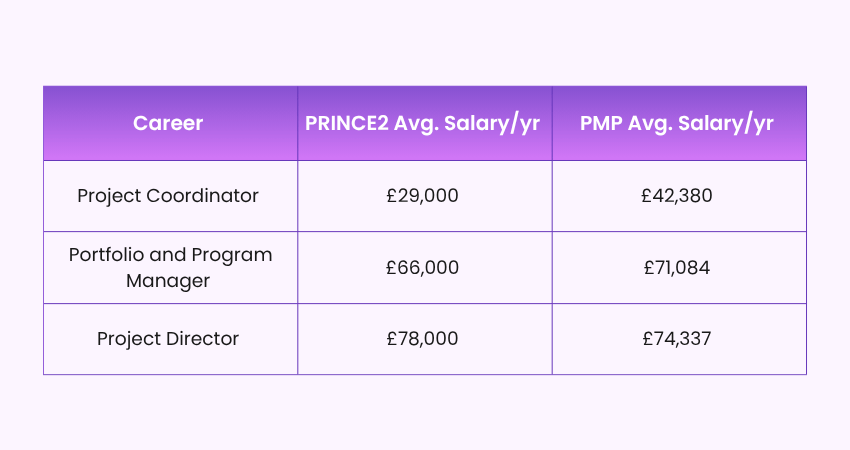
Source:
Glassdoor
PRINCE2 vs PMP Certifications: Benefits
Here are some of the most important benefits of PRINCE2 and PMP:
Benefits of PRINCE2® Certification
a) Outlines reasonable procedures for managing projects in a way that is clear and easy to follow.
b) Identifies and maintains order and structure from project initiation to completion.
c) It can be easily tailored to suit the needs of a project of any scale and complexity.
d) It increases career opportunities and, therefore, professional recognition.
e) Supports open and proper communication with the stakeholders through clear duties and responsibilities.
f) Cultivates the values of change, learning, and reflection.
g) Enhances organisational practices in Project Management, thus improving the probability of accomplishing the objectives and goals of such projects.
Benefits of PMP® Certification
a) Being highly regarded in the Project Management discipline.
b) Reflects the overall knowledge about what is going on in the field of Project Management.
c) Prepare professionals to manage projects across all sectors successfully.
d) A highly versatile system that can be used to apply risk management to multiple different types of projects.
e) It is an internationally recognised certification that opens up more employment opportunities and increases income.
f) Stresses on the practical approaches and skills to manage and deliver the Project.
g) Encourages continuous professional development by requiring 60 PDUs every three years to maintain the certification.
h) Aids the professionals in accessing the trends and techniques of Project Management in the current world.
Gain in-depth knowledge about PRINCE2® principles, themes, and processes with
PRINCE2 Agile® Foundation and Practitioner Course!
Tips to Choose Between PRINCE2 vs PMP Certifications
Comparing PRINCE2 and PMP can be a challenge as both Project Management Certification programs are sought by many globally. Here are some tips to help you decide:
a) Career Goals: Consider your future work goals. If you plan to work in an environment that requires precise adherence to rules, formulas, and structures, PRINCE2 could be more appropriate. PMP will suit you if you want to gain general knowledge and acquire skills that you can apply in predictive, Agile and hybrid environments.
b) Industry Requirements:
Check what certification is commonly used in your industry. Government and public service organisations gravitate more toward PRINCE2 than PMP, whereas the IT, financial, and construction industries tend more toward PMP.
c) Experience level:
Self-assess your Project Management Experience. PMP entails both experience and education, making it suitable for experienced Project Managers. PRINCE2 requires fewer preconditions than PMP and is, therefore, more ideal for people just starting in Project Management.
d) Cost and Time Investment:
Assess the cost and time incurred in a certification process. PMP is typically costlier and longer than the other methods because of its coverage and comprehensive approach. PRINCE2 might be even cheaper and faster to implement.
e) Geographic Preference:
Consider the locations and organisations where you plan to work. Both PRINCE2 and PMP have international recognition. PRINCE2 is used in more than 200 countries, while PMP is a globally recognised certification applicable across industries and geographies.
Enhance your knowledge of Agile with the
PRINCE2® Foundation Course!
Conclusion
PRINCE2 and PMP are globally recognised methodologies that you must choose depending on the organisation and region of your choice, career goal, and market trends. They both provide ample value, so the best option depends on your goals, workplace, and projects you want to lead. We hope that after reading this comparison of PRINCE2 vs. PMP, you can choose the best Certification for you.
Build strong foundations for project success with the
PRINCE2® Training
– Join now!
Frequently Asked Questions
Is PMP More Difficult Than PRINCE2?
PMP is often considered more challenging than PRINCE2 due to its experience requirements, broad coverage of predictive, Agile and hybrid approaches and scenario-based exam. However, difficulty depends on your experience, knowledge and preparation.
Is PRINCE2 Better for Agile Project Management than PMP?
PRINCE2 is not necessarily better than PMP for Agile Project Management. PRINCE2 Agile combines PRINCE2 governance with Agile ways of working, while PMP covers predictive, Agile and hybrid approaches. The better choice depends on your role and project environment.
Can I Take the PMP Exam Without Project Management Experience?
No, you cannot take the PMP exam without relevant project experience. PMI requires candidates to meet specific project leadership experience and education requirements before applying.



 Continue Browsing