Contact@prince2training.co.uk
 01344203999



 Back
Back


Table of Content

24-Sep-2026

Veronica Davis
Want to make sprint planning more collaborative and less stressful? Many Agile teams struggle with estimating tasks accurately, which often leads to confusion, missed deadlines and overloaded sprints. When team members have different opinions about the effort required for a task, planning can quickly become difficult. This is where Planning Poker helps.
It is a simple Agile estimation technique that helps in the project planning process. Instead of relying on one person's judgment, the entire team is involved in the estimation process. In this blog, we will explore what is Planning Poker, how it works and why it has become an important part of Agile Project Management. Let's dive in!
What is Planning Poker?
Planning Poker or Scrum Poker is an Agile estimation technique used to estimate the effort required to complete a task or user story. It uses numbered cards that represent estimation values, usually based on story points. These cards help teams compare the complexity and effort of different tasks during sprint planning sessions.
The values on the cards often follow the Fibonacci sequence such as 1, 2, 3, 5, 8, 13 and 21. These numbers reflect increasing uncertainty as tasks become larger and more complex.
How Does Planning Poker Work?
Planning Poker follows a structured process that allows teams to estimate work in a collaborative manner. Each team member participates by selecting cards that represent their estimate for a specific task or user story. Below are the typical steps involved in it:
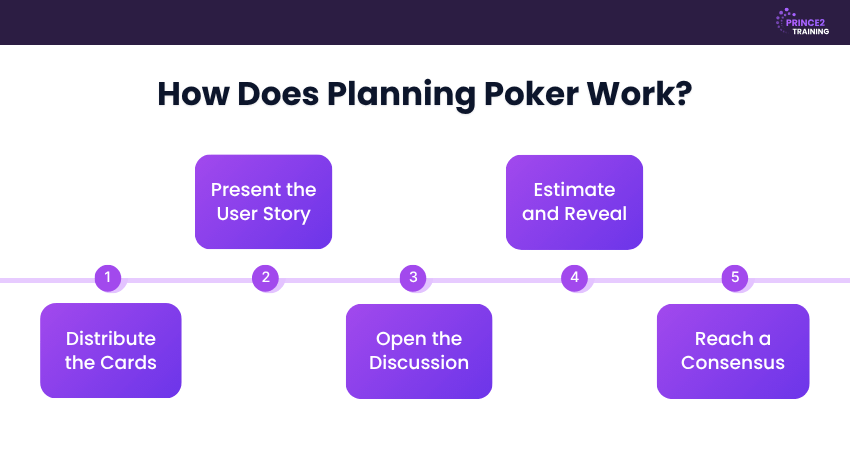
a) Step 1: Distribute the Cards
At the beginning of the session, every participant receives a set of Planning Poker cards. These cards contain estimation values, often using the Fibonacci sequence. Each participant keeps their selected card hidden until everyone reveals their estimate simultaneously. Teams may use physical cards or digital Planning Poker tools during remote meetings.
b) Step 2: Present the User Story
The Product Owner or Scrum Master presents the user story or task that needs to be estimated. The story should include clear project requirements, objectives and acceptance criteria. Team members are encouraged to ask questions if any part of the story is unclear. This discussion helps ensure that everyone understands the scope of the task before estimation begins.
c) Step 3: Open the Discussion
Before voting, the team discusses the complexity, risks, dependencies and technical challenges associated with the task. Developers, Testers, Designers and other stakeholders share their perspectives based on their expertise. This collaborative discussion helps uncover hidden complexities that may affect the estimate.
d) Step 4: Estimate and Reveal
Once the discussion is complete, each participant secretly selects a card that represents their estimate for the effort required. After everyone has chosen a card, all estimates are revealed simultaneously. If all estimates are similar, the team can quickly move forward. However, if there is a significant difference between estimates, additional discussion takes place.
e) Step 5: Reach a Consensus
When estimates vary greatly, the team discusses the reasons behind the differences. Usually, the people with the highest and lowest estimates explain their reasoning. The team then repeats the voting process until a consensus is reached. The final agreed estimate becomes the official story point value for the task.
Combine flexibility and control in Project Management with PRINCE2 Agile® Foundation and Practitioner Training – Register today!
When Do Teams Use Planning Poker?
Teams use Planning Poker at different stages of Agile Project Management. It is primarily used to improve estimation accuracy and encourage team collaboration during planning activities. Let's check when it is used:
1) During Sprint Planning
Teams use Planning Poker during sprint planning sessions to estimate user stories before selecting tasks for the sprint. This helps teams decide how much work they can realistically complete within the sprint timeline.
2) During Backlog Refinement
Planning Poker is often used during backlog refinement meetings to review and estimate upcoming tasks. It helps the team prepare the product backlog before sprint planning begins. This preparation improves the quality of backlog items and reduces delays during sprint planning sessions.
3) When Estimating New User Stories
Teams use Planning Poker whenever new user stories are added to the backlog. It allows team members to understand the requirements and estimate the effort needed for development. It also encourages discussion and ensures that all assumptions are clarified before development begins.
4) When Tasks are Complex
If a task involves uncertainty, technical difficulty, or multiple dependencies, Planning Poker helps teams discuss the challenges and create more accurate estimates. This collaborative discussion reduces ambiguity and improves estimation of reliability.
5) Before Prioritising Work
Teams may use Planning Poker before prioritising backlog items. Estimation helps Product Owners understand the effort involved and make better planning decisions. This ensures that prioritisation is based on both value and effort, leading to more balanced planning.
6) During Agile and Scrum Projects
Planning Poker is mainly used in Agile and Scrum environments where teams need collaborative estimation methods for sprint planning and Project Management. Its interactive approach makes it one of the most effective techniques for team-based estimation in Agile frameworks.
What are the Benefits of Planning Poker?
Planning Poker offers several benefits for Agile and Scrum teams and below are some of them:
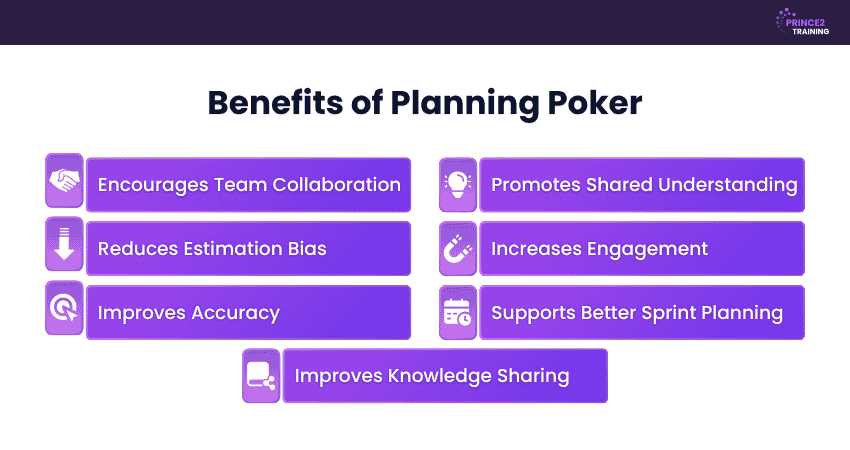
a) Encourages Team Collaboration:
Every team member participates in the estimation process. This creates an inclusive environment where everyone can share their insights and opinions.
b) Reduces Estimation Bias:
Because estimates are revealed simultaneously, participants are less likely to be influenced by senior team members or dominant personalities.
c) Improves Accuracy:
The discussion surrounding each estimate helps uncover hidden risks and technical complexities. This usually results in more realistic estimates.
d) Promotes Shared Understanding:
Planning Poker ensures that all team members understand the requirements, dependencies and goals of each task before work begins.
e) Increases Engagement:
The card-based approach makes estimation sessions more interactive and engaging compared to traditional estimation methods.
f) Supports Better Sprint Planning:
Accurate estimates help teams commit to achievable sprint goals and reduce the risk of overloading the sprint backlog.
g) Improves Knowledge Sharing:
Discussions during estimation sessions allow experienced and less experienced team members to learn from one another.
Enhance your ability to manage Agile projects with PRINCE2 Agile® Practitioner Training – Sign up soon!
What are the Limitations of Planning Poker?
Although Planning Poker is highly effective, it also has certain limitations that teams should consider. Here are such limitations:
a) Time-consuming for Large Backlogs:
Estimating a large number of user stories can take considerable time, especially when discussions become lengthy.
b) Depends on Team Experience: Inexperienced teams may struggle to provide accurate estimates because they lack historical knowledge or technical understanding.
c) Risk of Over-discussion:
Some estimation sessions can become overly detailed, which slows down decision-making and reduces productivity.
d) Difficult for Distributed Teams:
Although online tools exist, remote estimation sessions may still face communication challenges or reduced participation.
e) May Create Pressure:
Some team members may feel uncomfortable defending their estimates, especially in highly opinionated teams.
What is the Goal of Planning Poker?
The primary goal of Planning Poker is to create accurate and collaborative estimates for Agile tasks and user stories. Rather than focusing only on time, it evaluates effort, complexity, uncertainty and risk. This helps teams make more informed planning decisions. Its key goals include:
a) Building a shared understanding of requirements
b) Improving communication within the team
c) Reducing estimation bias
d) Supporting realistic sprint planning
e) Encouraging team participation in decision-making
Ultimately, Planning Poker helps Agile teams deliver work more predictably by improving estimation quality and collaboration.
Who Participates in Planning Poker?
Planning Poker sessions usually involve the entire Agile or Scrum team. Each participant contributes valuable insights during estimation discussions. The following roles commonly participate:
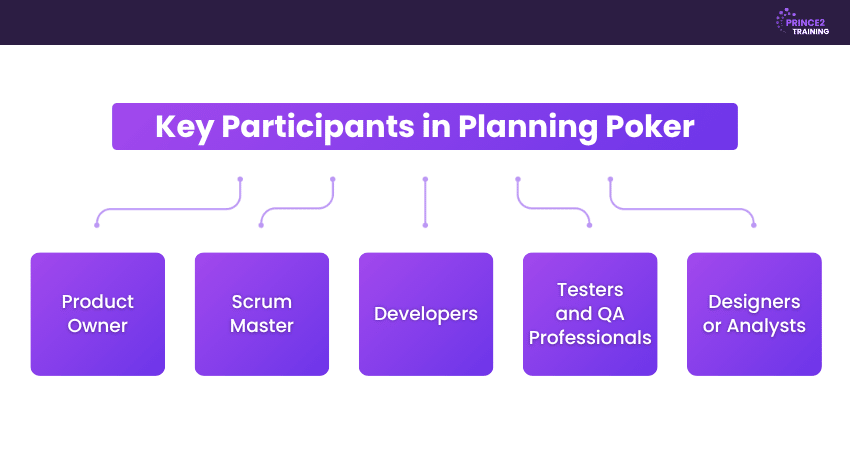
1) Product Owner
The Product Owner explains the user story, clarifies requirements and answers business-related questions. Their input ensures that the team fully understands the business value and objectives behind each task.
2) Scrum Master
The Scrum Master facilitates the session, ensures productive discussions and keeps the estimation process organised. They also help maintain focus, manage time effectively, and resolve any blockers during the session.
3) Developers
Developers estimate the technical effort required to build the feature or complete the task. Their expertise helps ensure that estimates reflect real technical complexity and development effort.
4) Testers and QA Professionals
Testing teams provide insights into Quality Assurance (QA) effort, testing complexity and potential risks. Their perspective ensures that testing requirements and potential defects are considered during estimation.
5) Designers or Analysts
In some teams, UX Designers, Business Analysts or Architects also participate to contribute specialised knowledge. Their involvement improves estimation accuracy by addressing design, usability, and system-level considerations.
Conclusion
Planning Poker is one of the most effective Agile estimation techniques used by Scrum teams worldwide. It combines collaboration and consensus-building to create accurate estimates of project tasks. Whether used during sprint planning or backlog refinement, it helps teams build a better understanding of workload, risks and task complexity. For organisations looking to make Agile planning more structured, it remains a reliable estimation technique.
Prepare for successful project delivery with PRINCE2 Training – Join now!
Frequently Asked Questions
How to Play Planning Poker Cards?
To play Planning Poker, team members receive estimation cards with numerical values. A user story is presented, discussed and then each participant selects a card representing their estimate. All cards are revealed simultaneously, followed by discussion and re-voting until the team reaches a consensus on the estimate.
What is Planning Poker Agile?
Planning Poker in Agile is a collaborative estimation technique used by Scrum and Agile teams to understand the effort required for tasks or user stories. It promotes team discussion, reduces estimation bias and helps teams plan sprints more accurately.
What is Sprint Planning Poker?
Sprint Planning Poker refers to using Planning Poker during sprint planning sessions. Agile teams estimate backlog items before selecting work for the sprint. This helps teams determine how much work they can realistically complete within the sprint duration.



 Continue Browsing