Contact@prince2training.co.uk
 01344203999




 Back
Back


Table of Content

13-Oct-2026

Veronica Davis
Have you ever started a Sprint only to realise the team is confused about priorities, requirements, or what should actually be delivered first? A messy Product Backlog can quickly lead to delays, unclear goals, and last-minute planning problems. This is why Backlog Refinement plays an important role in Agile Project Management.
It helps Agile teams review, organise, and prioritise backlog items before Sprint Planning begins. This keeps tasks clear, manageable, and aligned with business goals so teams can deliver value more effectively. In this blog, you will learn about its process, techniques, benefits, and best practices. Let's get started!
What is Backlog Refinement?
Backlog Refinement is an ongoing Agile activity where teams review, update, and organise Product Backlog items to prepare them for future Sprints. During this process, the team clarifies requirements, prioritises tasks, estimates effort, and removes outdated or unnecessary items from the backlog.
The main purpose of Backlog Refinement is to ensure backlog items are clear, detailed, and ready for Sprint Planning. It helps Agile teams improve collaboration, reduce misunderstandings, and maintain a steady flow of valuable work throughout the project lifecycle.

Backlog Refinement vs Backlog Grooming
Backlog Refinement and Backlog Grooming are closely related terms used in Agile and Scrum environments. Both refer to the process of reviewing, updating, prioritising, and improving Product Backlog items to prepare them for future Sprints. These activities help throughout the project lifecycle and support effective Agile testing by ensuring requirements are clear and testable.
Although the two terms are often used interchangeably, "Backlog Refinement" is more commonly used in modern Scrum practices because it better reflects continuous collaboration and improvement.
Who is Involved in Backlog Refinement?
Backlog Refinement involves the Product Owner, Development Team, and Scrum Master working together to prepare backlog items for future Sprints. Each role contributes differently to ensure backlog items are clear, prioritised, and ready for development:
1) Product Owner
The Product Owner is mainly responsible for managing and prioritising the Product Backlog. During Backlog Refinement sessions, they explain the purpose, business value, and goals of each backlog item to ensure the team understands what needs to be delivered and why it matters.
The Product Owner also clearly clarifies requirements, answers team questions, and updates backlog priorities based on customer needs or changing business objectives. Their involvement helps significantly reduce confusion and ensures backlog items are properly prepared before Sprint Planning sessions begin.
2) Development Team
The Development Team provides valuable technical expertise during Backlog Refinement. Team members review backlog items carefully to understand requirements, estimate effort, identify dependencies, and discuss possible technical challenges that may affect implementation activities.
Developers may also split large user stories into smaller, manageable tasks and ask questions to remove uncertainty before development starts successfully. This collaboration helps create realistic and achievable backlog items that the team can complete effectively within a Sprint cycle.
3) Scrum Master
The Scrum Master supports and facilitates the Backlog Refinement process to ensure discussions remain productive and focused. They encourage collaboration between team members, help remove obstacles, and ensure Agile principles are followed throughout the session.
The Scrum Master may also guide the team in using estimation methods, prioritisation techniques such as the Kano Model, and backlog management practices. By maintaining structure and improving communication, they help teams conduct effective refinement meetings and prepare work efficiently for upcoming Sprints.
Learn to manage Agile projects with confidence and greater control through the PRINCE2 Agile® Foundation and Practitioner (Version 2) Training – Join now!
How to Conduct a Backlog Refinement Meeting?
A Backlog Refinement meeting helps Agile teams review and prepare backlog items for future Sprints. The following steps explain how teams conduct an effective Backlog Refinement meeting:
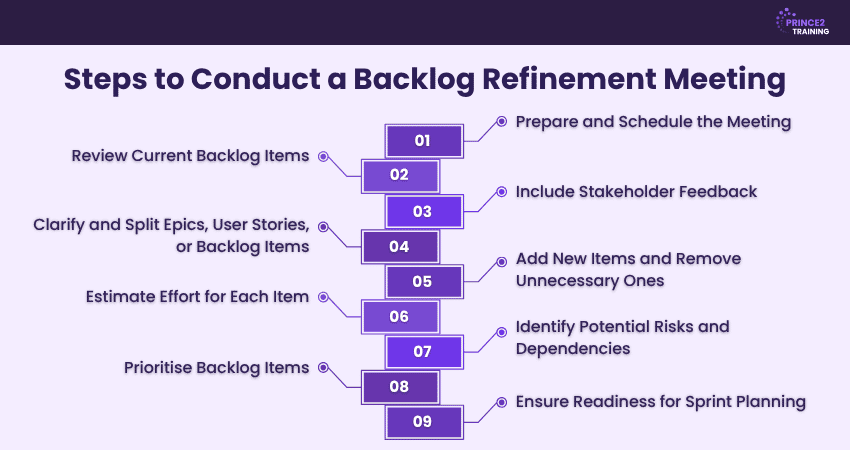
1) Prepare and Schedule the Meeting
Start by scheduling the meeting with the right participants, including the Product Owner, Scrum Master, Developers, and relevant stakeholders if required. Share the agenda, backlog items, and supporting details in advance so everyone can review them and join the discussion prepared.
2) Review Current Backlog Items
The team reviews existing backlog items to check whether they are still relevant, clear, and aligned with project goals. This step helps identify outdated, incomplete, duplicate, or low-value items that may need updating, removal, or further discussion before Sprint Planning.
3) Include Stakeholder Feedback
Stakeholder feedback helps the team understand business needs, customer expectations, and changing priorities. The Product Owner can use this feedback to refine requirements, adjust priorities, and ensure that planned work continues to deliver value to users and the organisation.
4) Clarify and Split Epics, User Stories, or Backlog Items
Large or unclear backlog items should be discussed and broken into smaller, manageable pieces. The team clarifies requirements, acceptance criteria, expected outcomes, and user needs. This makes each item easier to understand, estimate, and complete within a sprint.
5) Add New Items and Remove Unnecessary Ones
New backlog items may be added when fresh requirements, defects, risks, or stakeholder needs are identified. At the same time, the team removes items that are outdated, duplicated, irrelevant, or no longer valuable. This keeps the backlog organised and manageable.
6) Estimate Effort for Each Item
The team estimates the effort needed to complete each refined backlog item using methods such as story points, planning poker, or relative sizing. Estimation helps the team understand complexity, workload, uncertainty, and delivery capacity before selecting items for future sprints.
7) Identify Potential Risks and Dependencies
The team identifies risks, blockers, technical limitations, and Project dependencies that may affect delivery. These may include unclear requirements, resource constraints, integration issues, or reliance on another team. Addressing these early helps prevent delays during sprint execution.
8) Prioritise Backlog Items
Backlog items are prioritised based on business value, urgency, risk, dependencies, effort, and stakeholder expectations. The Product Owner usually leads this step, while the team provides technical input. Clear prioritisation ensures the most valuable items move forward first.
9) Ensure Readiness for Sprint Planning
Finally, the team confirms that high-priority backlog items are clear, estimated, prioritised, and supported by acceptance criteria. This ensures the backlog is ready for Sprint Planning and helps the team select work with confidence.
Build confidence managing complex projects with the PRINCE2® Practitioner Training – Register today!
How Often Should Backlog Refinement Happen?
Backlog Refinement is an ongoing activity that takes place throughout the project lifecycle to keep backlog items updated and ready for future Sprints. Most Agile teams conduct formal refinement sessions once or twice during each Sprint, depending on project complexity, backlog size, and changing business requirements.
Many Agile experts recommend spending no more than 10% of the team's Sprint capacity on Backlog Refinement activities. For example, in a two-week Sprint, teams may spend around 3 to 4 hours refining backlog items. Regular refinement sessions help teams improve prioritisation, maintain backlog quality, and reduce uncertainty during Sprint Planning.
Main Activities in Backlog Refinement
Backlog Refinement involves key activities that help Agile teams prepare backlog items for future Sprints. These activities improve clarity, reduce uncertainty, and ensure tasks are properly organised before development begins.
The main activities include:
1) Story Breakdown:
Splitting large epics into smaller, manageable user stories
2) Acceptance Criteria Definition:
Setting clear conditions for successful task completion
3) Effort Estimation:
Estimating the work required for backlog items
4) Dependency Identification:
Recognising blockers, risks, or task dependencies
5) Priority Alignment: Ensuring backlog items match current business priorities and goals
Benefits of Backlog Refinement
Backlog Refinement helps Agile teams maintain a clear and organised Product Backlog for future Sprints. It improves collaboration, reduces uncertainty, and supports better Sprint Planning and value delivery. These benefits can be seen in several ways, including:
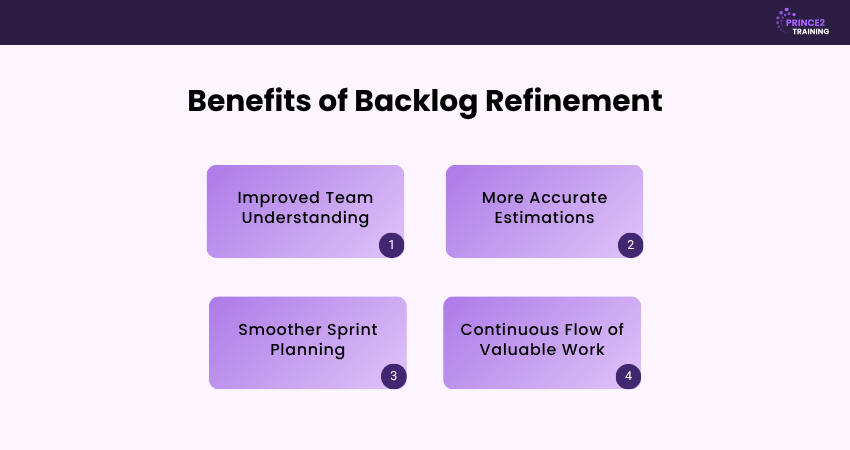
1) Improved Team Understanding
Backlog Refinement helps team members clearly understand backlog items, requirements, and project expectations before development begins. Regular discussions reduce confusion and improve collaboration across the Agile team.
2) More Accurate Estimations
Refinement sessions allow teams to estimate effort more accurately by discussing task complexity, dependencies, and technical challenges in advance. Better estimations help teams plan Sprints more effectively and avoid overcommitting work.
3) Smoother Sprint Planning
Well-refined backlog items make Sprint Planning sessions faster and more organised because requirements, priorities, and acceptance criteria are already clarified. This helps teams focus on selecting achievable work for the Sprint.
4) Continuous Flow of Valuable Work
Regular Backlog Refinement ensures there is always a pipeline of prioritised and ready backlog items for future Sprints. This helps teams maintain productivity and continuously deliver value to customers and stakeholders.
Build strong Project Management basics through the PRINCE2® Foundation Training – Register now!
Popular Backlog Refinement Techniques
Agile teams use different techniques during Backlog Refinement to organise and prioritise backlog items effectively. Some commonly used techniques are:
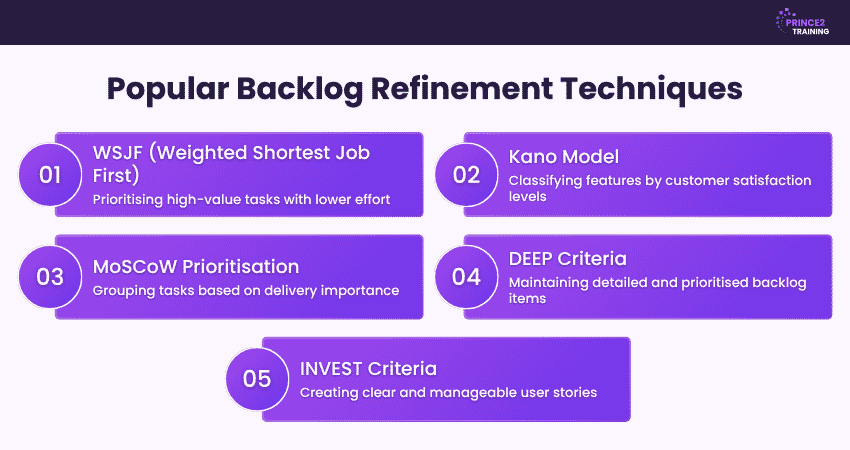
1) WSJF (Weighted Shortest Job First)
WSJF is a prioritisation technique used to identify backlog items that can deliver high value relative to the effort required. It compares the cost of delay with job size, helping teams decide which items should be addressed first to maximise value and improve decision-making.
2) Kano Model
The Kano Model helps teams prioritise features based on customer satisfaction and business value. It categorises features into different groups, such as basic needs, performance features, and exciting features, allowing Product Owners to focus on features that provide the greatest customer impact.
3) MoSCoW Prioritisation
MoSCoW Prioritisation is a method used to categorise backlog items into four groups: Must Have, Should Have, Could Have, and Won't Have requirements. This technique helps teams focus on critical tasks first while managing resources and stakeholder expectations more effectively throughout the project lifecycle.
4) DEEP Criteria
DEEP is a backlog quality framework used to maintain a healthy and organised Product Backlog. It stands for Detailed Appropriately, Estimated, Emergent, and Prioritised. These criteria help teams ensure backlog items remain clear, flexible, properly estimated, and aligned with project priorities and business goals.
5) INVEST Criteria
INVEST is a user story quality checklist used to evaluate whether backlog items are well-written and ready for Sprint execution. It stands for Independent, Negotiable, Valuable, Estimable, Small, and Testable. Using INVEST helps teams prepare backlog items that are easier to understand, estimate, discuss, and complete during a Sprint.
Best Practices for Effective Backlog Refinement
Following best practices during Backlog Refinement helps Agile teams maintain a clear and Sprint-ready Product Backlog. These practices improve collaboration and support smoother Sprint Planning. Key best practices include:
1) Regular Refinement Sessions:
Keep backlog items updated
2) Clear Backlog Items:
Reduce confusion during development
3) Smaller User Stories:
Improve estimation and task management
4) Business-based Prioritisation:
Focus on high-value work first
5) Defined Acceptance Criteria:
Clarify task expectations
6) Team Collaboration:
Improve shared understanding
7) Early Risk Identification:
Prevent Sprint delays
8) Stakeholder Feedback:
Align backlog with business needs
Conclusion
Backlog Refinement plays an important role in keeping Agile projects organised, prioritised, and ready for successful Sprint execution. By regularly refining backlog items, teams can improve collaboration, reduce uncertainty, and deliver greater value consistently. Using the right refinement techniques and best practices also helps Agile teams adapt quickly to changing business and customer needs.
Build stronger Project Management expertise with the PRINCE2® Training – Join today!
Frequently Asked Questions
How Much Time Should Teams Dedicate to Backlog Refinement?
Teams usually dedicate around 10% of their Sprint capacity to Backlog Refinement activities. In a two-week Sprint, this often equals 3 to 4 hours per developer, including formal refinement meetings, asynchronous reviews, and quick discussions to prepare backlog items effectively.
Can Backlog Refinement Take Place During a Sprint?
Yes, Backlog Refinement can take place during a Sprint and is commonly performed as an ongoing Agile activity. Teams usually conduct refinement sessions once or twice during a Sprint to review, clarify, estimate, and prioritise backlog items before the next Sprint Planning meeting begins.
What Makes a Backlog Item Ready for Sprint Planning?
A backlog item is considered ready for Sprint Planning when it is clearly defined, prioritised, and properly estimated for development. It should include clear requirements, acceptance criteria, dependencies, and enough detail for the Agile team to confidently understand and complete the work within a Sprint.



 Continue Browsing