Contact@prince2training.co.uk
 01344203999



 Back
Back


Table of Content

05-Oct-2026

David Walter
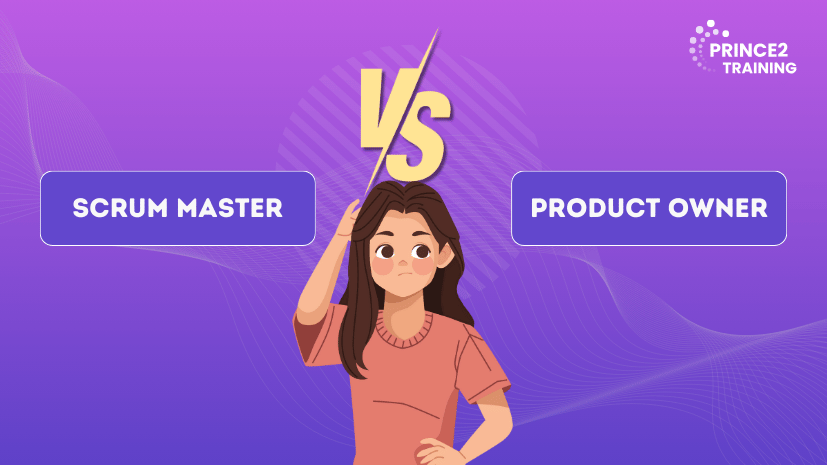
Ever sat in an Agile meeting and wondered, who’s really steering this ship in the Scrum Master vs Product Owner dynamic? Is the Scrum Master keeping the team on track, or is the Product Owner defining the course? Both roles are at the heart of Agile success but operate on very different wavelengths.
In this blog, we’ll unpack the differences in the Scrum Master vs Product Owner comparison, showing how their unique strengths create the perfect balance between process and product. Let’s dive in and understand why their synergy is the key to unlocking true project success.
Table of Contents
1) What is a Scrum Master?
2) What is a Product Owner?
3) Difference Between Scrum Master and Product Owner
4) Scrum Master vs Product Owner: Which Career Path is Right for You?
5) Conclusion
What is a Scrum Master?
A Scrum Master acts as a servant-leader for the Scrum team. They’re not a traditional manager or project lead but a coach who effectively helps the team follow Agile principles. Their main responsibility is to support the team by eliminating obstacles, facilitating key Scrum events, and ensuring that Agile processes are followed smoothly.
Imagine a sports coach. They don’t score the goals but are instrumental in the team’s success. A Scrum Master works similarly, guiding, motivating, and enabling the team to deliver high-value results.
Their influence is subtle yet powerful. When done right, a Scrum Master builds a culture of trust, self-organisation, and continuous improvement. The role is ideal for individuals who love fostering collaboration, problem-solving, and nurturing a high-performance environment.
What is a Product Owner?
The Product Owner is the product's visionary. They define what the team should build and why it matters. Acting as the link between business stakeholders and the development team, they ensure that the work delivered real value to customers and is aligned with business strategy.
They own the product backlog, the dynamic to-do list of features, fixes, and updates. But it’s not just about ticking boxes. A good Product Owner understands market needs, prioritises work for maximum impact, and communicates requirements to the development team.
Unlike the Scrum Master, the Product Owner makes key decisions about the product. They decide what goes into the sprint, what can wait, and what might be scrapped entirely. This role balances customer empathy with business logic.
Boost your career with the power of the PRINCE2® Practitioner Course.
Difference Between Scrum Master and Product Owner
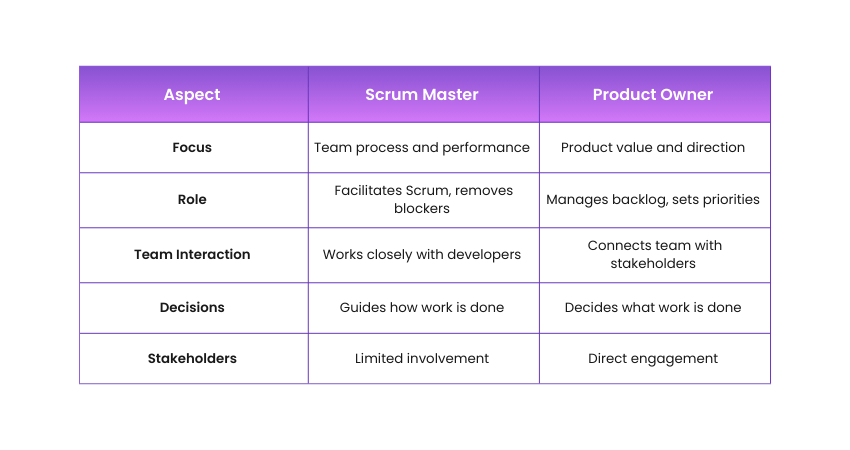
While both roles are essential to an Agile team, they serve different purposes. The Scrum Master enables the team’s how, while the Product Owner directs what and why. Here’s a deep dive into their differences across various dimensions:
Skills
The skill sets required for these two roles reflect their core responsibilities.
Scrum Master:
a) Deep understanding of Agile and Scrum methodologies
b) Excellent facilitation and coaching abilities
c) Strong interpersonal and communication skills
d) Conflict resolution and problem-solving mindset
e) Ability to foster a culture of self-organisation and transparency
Product Owner:
a) Business acumen and market awareness
b) Stakeholder management and negotiation skills
c) Sharp prioritisation and decision-making abilities
d) Strong written and verbal communication
e) Technical awareness to liaise effectively with development teams
Both roles require great communication skills, but a Scrum Master focuses more on team dynamics, while a Product Owner excels in strategic planning and product delivery.
Role Distinctions
Let’s simplify this:
The Scrum Master acts as a facilitator. They ensure that Agile principles are followed, obstacles are removed, and meetings are effective.
The Product Owner acts as a decision-maker. They manage the product backlog, set priorities, and define the vision.
One nurtures the team’s productivity; the other channels productivity into customer value.
Responsibilities
Scrum Master Responsibilities:
a) Guide the team through Scrum events (sprint planning, reviews, retrospectives)
b) Remove roadblocks and protect the team from distractions
c) Coach the team on Agile best practices
d) Encourage continuous improvement
e) Promote collaboration and transparency
Product Owner Responsibilities:
a) Define and communicate the product vision
b) Create and manage the product backlog
c) Prioritise features based on business value
d) Clarify requirements for the development team
e) Accept or reject deliverables based on predefined acceptance criteria
Their duties are non-overlapping but highly collaborative; both roles must sync to keep projects efficient and valuable.
Collaboration and Interaction
In a well-functioning Scrum team, these two roles are constantly in communication. Their relationship can make or break a project.
The Scrum Master ensures that the Product Owner can communicate the product vision and priorities to the team without disruptions.
The Product Owner provides clarity and direction on what needs to be built, while the Scrum Master ensures the team has what it needs.
They interact during sprint planning sessions, backlog grooming, and reviews. Each role supports the other to ensure smooth delivery and may also coordinate through a Scrum of Scrums Structure when multiple Scrum teams need to align their work.
Role-based Time Commitments
A Scrum Master is usually full-time and dedicated to one team. They’re involved daily, facilitating meetings, helping the team self-organise, and monitoring progress.
Depending on the organisation, a product owner may be responsible for one or multiple products. However, best practice recommends a full-time Product Owner per team for optimal results.
Both roles require constant availability but differ in focus; the Scrum Master supports team processes, and the Product Owner drives product decisions.
Be the Agile leader everyone trusts – Start PRINCE2 Agile® Practitioner Course today!
Communication Approaches
A Scrum Master communicates internally with the team, encouraging open dialogue, feedback, and collaborative problem-solving.
A Product Owner balances internal and external communication. They translate customer needs into technical requirements and ensure alignment between stakeholders and the development team.
One speaks the language of process, the other speaks the language of value.
Levels of Authority
The Product Owner holds decision-making authority regarding the product backlog. They have the final say on what gets built and when.
The Scrum Master has no formal authority but wields influence through coaching, persuasion, and trust. Their authority is earned, not assigned.
Both need leadership qualities, one formal, the other facilitative.
Relevant Certifications
Scrum Master Certifications:
a) Scrum Master
b) Professional Scrum Master (PSM)
c) SAFe Scrum Master
d) Scrum Professional
Product Owner Certifications:
a) PMI Agile Certified Practitioner
b) Product Owner
c) Product Manager Logo
These certifications add credibility and deepen your understanding of Agile principles and tools.
Salary Insights
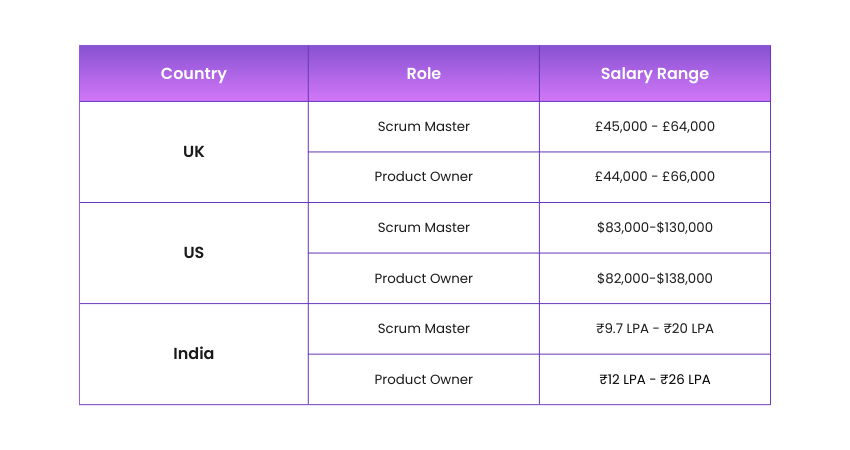
Here are the salary differences in different countries:
Source: Glassdoor
Future Job Prospects
Both roles are in high demand, and this trend is growing.
Scrum Masters are crucial wherever Agile is implemented, in tech, finance, manufacturing, and healthcare. As Agile adoption grows, so does the need for strong facilitators.
Product Owners, on the other hand, are central to customer-focused industries. Their ability to deliver user-driven value makes them indispensable in product-centric organisations.
If job security is your concern, both roles offer strong long-term prospects.
Career Advancement Paths
Where do these roles lead?
Scrum Master Career Paths:
a) Senior Scrum Master
b) Agile Coach
c) Product Owner
d) Senior Management
Product Owner Career Paths:
a) Senior Product Manager
b) Head of Product
c) Director of Product Strategy
d) Chief Product Officer (CPO)
While Scrum Masters tend to grow into broader Agile leadership roles, Product Owners often evolve into business and product strategy positions.
Advantages of Being a Scrum Master
a) Opportunity to improve team performance and morale
b) Play a key role in delivering quality results
c) Great for those who love people management and facilitation
d) Flexible career progression into Agile or delivery leadership roles
e) Strong presence in large Agile transformations
f) It’s a role that suits empathic communicators who enjoy improving teams daily.
Learn the Basics, Lead with Confidence – Start with the Introduction to Project Management Course today!
Advantages of Being a Product Owner
a) Direct impact on product direction and customer satisfaction
b) Opportunity to align business strategy with product development
c) Authority and ownership of the product backlog
d) High visibility within organisations
e) Excellent progression into executive roles
This role suits visionaries who can balance customer insight with commercial strategy.
Scrum Master vs Product Owner: Which Career Path is Right for You?
Not sure which Agile role fits you best? Here's a quick side-by-side to help you decide:
1) Team Support vs Product Strategy
Scrum Masters guide teams and remove blockers; Product Owners focus on product goals and customer value.
2) Process Champion vs Visionary
Scrum Masters uphold Agile practices; Product Owners shape the product roadmap and set priorities.
3) People-focused vs Product-focused
Scrum Masters improve team dynamics; Product Owners drive features and functionality.
4) Facilitator vs Decision-Maker
Scrum Masters keep communication flowing; Product Owners make key sprint decisions.
5) Internal Guide vs External Link
Scrum Masters work closely with teams; Product Owners engage with customers and stakeholders.
Conclusion
Understanding the Scrum Master vs Product Owner dynamic is key to building successful Agile teams. While the Scrum Master focuses on guiding processes, the Product Owner drives product vision and priorities. Together, they create the balance that delivers real value. Choosing your path means deciding where you want to make the biggest impact.
Where Agile meets control – Begin with PRINCE2 Agile® Foundation Course!
Frequently Asked Questions
What Pays More, Scrum Master or Product Owner?
Generally, Product Owners tend to earn slightly more than Scrum Masters due to their strategic responsibilities in managing product vision and stakeholder expectations. However, salaries vary by industry, experience, and location.
What are the Five Levels of Product Owner?
The five levels of product owner are:
a) The Scribe
b) The Proxy
c) The Business Representative
d) The Sponsor
e) The Entrepreneur
Is Product Owner a Difficult job?
Yes, being a Product Owner can be challenging. It requires balancing stakeholder needs, setting clear priorities, managing backlogs, and making tough decisions that align with both user value and business goals.



 Continue Browsing