Contact@prince2training.co.uk
 01344203999




 Back
Back


Table of Content

17-Sep-2026

David Walter
Imagine leading a project with the confidence of an expert captain armed with a map and compass. That's the essence of Projects IN Controlled Environments (PRINCE2), a globally recognised Project Management framework. But what exactly is PRINCE2? It's a system that transforms seemingly chaotic project environments into manageable entities through rigorous planning methods and clearly defined roles and processes, a framework you can be proud to be associated with.
Whether steering a straightforward project or navigating a complex, large-scale endeavour, PRINCE2 is a versatile companion tailored to your project's unique needs. With its unwavering focus on timely, budget-friendly, and quality-driven project delivery, PRINCE2 empowers you to guide your projects to successful completion confidently.
What is PRINCE2?
PRINCE2 is a structured approach to
Project Management
that accurately manages projects within controlled environments. It highlights the flexibility of utilising Project Management in breaking projects into implementable and measurable phases. It is constructed using seven principles, themes, and processes to keep projects on the right track and running like a well-oiled machine.
Due to its flexibility, PRINCE2 can be applied to any form and size of project and industry. Thus, it has been widely used in various organisations due to its ability to be applied to any organisational level and its specific framework. Being more prescriptive about what a project should deliver, PRINCE2 assists teams in staying goal-oriented in their work, thus guaranteeing that various project deliverables will correspond to defined quality requirements.
Implementing PRINCE2 results in high project success rates, proper resource management, and enhanced stakeholder satisfaction. It helps establish a standard set of terms for all the parties involved, ensuring efficient communication in all project stages.

History of PRINCE2
PRINCE2 can be traced back to the 1980s when the UK government identified the necessity of having a standard Project Management framework. Project Resource Organisation Management Planning Techniques (PROMPT) was created by Simpact Systems Ltd in 1975. Fascinated by PROMPT, the CCTA adopted and enhanced it in 1989 and developed the first variant of PRINCE.
Originally, PRINCE was designed for application in IT projects. However, due to its effectiveness and applicability in other activities, it was expanded more and more. PRINCE2 was initiated in 1996 and brought significant changes, making the methodology more generic and appropriate for any kind of project. This update involved consultation with global Project Management professionals and organisations to ensure PRINCE2 aligned with business, industry and government best practices.
PRINCE2 has been under revision several times to adapt to modern Project Management tendencies. The current one, published in 2017, focuses on agility, adaptability, and customisation according to project characteristics. PRINCE2 is today one of the most popular Project Management frameworks used by governments, businesses, and non-profit organisations worldwide to guarantee project success.
PRINCE2 benefits
These are some of the benefits of using PRINCE2 in Project Management:
a) Flexibility: Suitable for businesses of all scales and any kind of activity.
b) Structured approach: It divides projects into understandable parts to facilitate planning and implementation.
c) Clear roles and responsibilities: Some positive effects can be achieved on accountability and communication concerning responsibilities and duties.
d) Quality focus: Checks that the project outcomes are of the specified quality.
e) Risk Management: It also highlights potential risks, estimated their impact, and develops ways of addressing them.
f) Continuous Improvement: Stresses the aspect of reviewing previous work in a bid to avert similar issues arising from the projects.
g) Enhanced stakeholder satisfaction: It directs the results of a project to the goals established for the commercial organisation.
h) Higher success rates: A structured framework enhances the possibility of a project’s success.
i) Efficient resource management: Minimised resource wastage since they enhance the best utilisation of available resources.
j) Common language: Promotes unity and effective communication channels with all the other project players.
Enhance your understanding of the core principles of PRINCE2® Foundation & Practitioner Training – Register now!
PRINCE2 project roles and responsibilities
The PRINCE2 framework is beneficial because the roles and responsibilities are well defined so that responsibilities can be assigned, and accountability and communication can be effective. The key roles include:
a) Project Board: Made up of the Executive, Senior User, and Senior Supplier, the Project Board oversees the decision-making and governance of the project. The executive represents the business side, the senior user represents the user perspective, and the senior supplier offers resources and expertise.
b) Project Manager: The Project Manager is in charge of Project Management responsibilities, which include planning, implementation, and evaluation. They help ensure the project remains on schedule and budget while meeting the required scope.
c) Team Manager: The Team Manager works under the Project Manager and is expected to produce specific project deliverables or components. They organise the team members, assign responsibilities, and ensure that quality work is created.
d) Project Assurance: This role ensures the project stays sustainable and follows the set processes and standards. The Project Board members or representatives do it.
e) Project Support: Project Support offers general assistance in paperwork and other organisational aspects of project advancement.
f) Stakeholders: Stakeholders are those interested in the project, and this may not necessarily be in a professional role.
7 principles of a PRINCE2 project
PRINCE2 is built on seven core principles that guide its methodology and ensure its effectiveness across various projects:
a) Continued business justification: A project must have a business case throughout its life cycle to ensure it remains profitable and worthy of support.
b) Learn from experience: It also encourages using lessons learned from previous projects and within the current project to improve on the negative attributes encountered.
c) Defined roles and responsibilities: Well-coordinated roles and responsibilities prevent conflicts and bring about order in a project, which speeds up the project and communication.
d) Manage by stages: These are sub-divisions of project work in a way that makes it easy to plan, control and evaluate an undertaking at a certain point before moving to the next level.
e) Manage by exception: Acceptable ranges are provided for time, cost, scope, quality, risk, and benefits for each project objective. The Project Board is only alerted when any of these tolerances is breached; otherwise, it is left to the Project Manager to conduct daily management.
f) Focus on products: PRINCE2 also establishes management product requirements and aims to deliver products that meet these requirements while completing all management products.
g) Tailor to suit the project environment: The methodology is very adaptive and can be used in any project context, size, complexity, or industry, depending on the project's needs, and can be implemented effectively.
6 aspects of a PRINCE2 project
PRINCE2 projects are managed by focusing on six key aspects, ensuring comprehensive control and successful delivery:
a) Cost: Day-to-day project control is essential, focusing on controlling costs and keeping the project within its spending allowance.
b) Timescales: Estimating the time needed for a particular task and creating a framework for executing the project to meet specific deadlines.
c) Quality: Maintaining the quality standards and specifications regarding the project deliverables is crucial for the stakeholders and the project's success.
d) Scope: These elements help to avoid scope creep and keep the project on track regarding its goals and outcomes.
e) Risks: Risk identification, evaluation, and mitigation address possible dangers to achieving project objectives and provide for contingencies.
f) Benefits: The project must provide the outlined benefit in the business case to justify its investment and effort.
Attain in-depth knowledge about PRINCE2® principles, themes, and processes with our PRINCE2® Foundation Course!
7 processes of PRINCE2 project
PRINCE2 has seven processes that guide a project from start to finish, ensuring a structured and controlled approach:
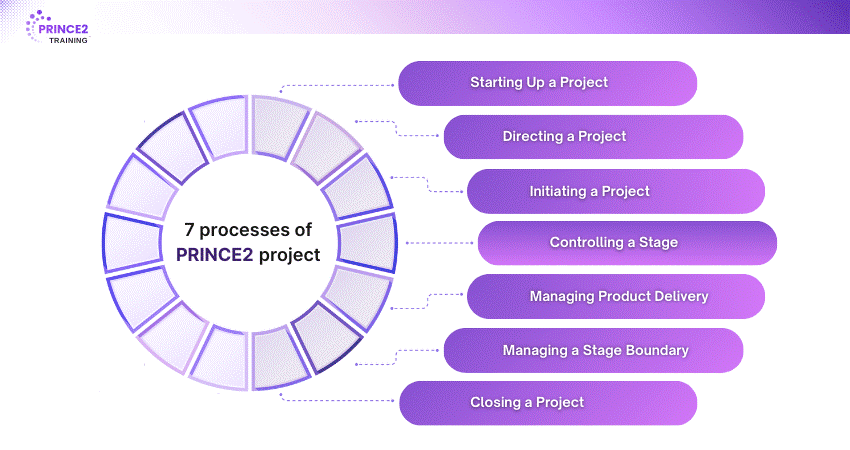
a) Starting Up a Project: It accommodates activities such as team formation, scoping, and checking if a project is feasible before getting deeply involved.
b) Directing a Project: The Project Board monitors the project’s state, makes important decisions and dictates the general concept of the project, aligning it with specific business needs.
c) Initiating a Project: This phase's objective is to plan how it will be processed, which involves creating the Project Initiation Documentation (PID) that defines the project scope, schedule, cost, and quality.
d) Controlling a Stage: The Project Manager monitors the actual work performed against the plan and addresses the problems that may exist in each stage.
e) Managing Product Delivery: This process concerns the actual development of the project deliverables and the ability of the project’s products to meet the project’s specifications and standards.
f) Managing a Stage Boundary: Upon completion of any work stage, progress is checked, modifications are made, and the subsequent procedure is determined.
g) Closing a Project: This last step involves checking whether the project has achieved its goals, provided all the end products, and obtained a formal signoff from the stakeholders before terminating the project.
PRINCE2 Certification
PRINCE2 Certification benefits a person as it offers a certified course in Project Management and exposes a candidate to better opportunities. The Certification is provided at two primary levels:
a) PRINCE2 Foundation: PRINCE2 offers an entry-level qualification to familiarise oneself with the core framework concepts and terms. It is also suitable for professionals reasonably new to Project Management or support Project Management.
b) PRINCE2 Practitioner: This higher level of Certification lies on the Foundation level and concentrates on the practical implementation of PRINCE2. It is designed for the Project Manager and any individual or professionals who handle a project.
Conclusion
We hope that from this blog you learnt What is PRINCE2 and its many benefits in Project Management. With its robust framework, you can easily have success in your projects. Employers widely recognise this Certification, thus making certified professionals more competitive in the job market.
Learn Project Management methodologies with our
PRINCE2® Practitioner Course!



 Continue Browsing