Contact@prince2training.co.uk
 01344203999




 Back
Back


Table of Content


08-Aug-2026

Maria Thompson
Software Development moves quickly and testing must keep pace. That's where Agile Testing comes in. It is a collaborative approach that integrates quality assurance into every stage of development. Instead of waiting until the end to find defects, Agile teams test continuously, adapt quickly and deliver better software with every iteration.
Whether you're new to Agile or exploring modern testing practices, understanding Agile Testing can help you build high-quality, customer-focused products more efficiently. In this blog, we'll explore its principles, methodologies, implementation process and benefits. So read on!
Table of Contents
1) What is Agile Testing?
2) How Does Agile Testing Work?
3) What are the Stages of the Agile Testing Lifecycle?
4) Five Core Principles of Agile Testing
5) What are the Different Agile Testing Methodologies?
6) How can You Implement Agile Testing in Five Steps?
7) What are the Benefits of Agile Testing?
8) Conclusion
What is Agile Testing?
Agile Testing is a software testing approach used in Agile Development. It integrates testing throughout the Software Development lifecycle through continuous collaboration and feedback. Rooted in Agile principles, it focuses on continuous testing and rapid feedback to ensure the delivery of high-quality software that meets user needs.
Unlike traditional approaches, where testing occurs after development is complete, Agile Testing treats quality assurance as an integral part of the development process. Testers, developers and stakeholders work closely together to identify improvements, evaluate customer feedback and prioritise new features and updates.

How Does Agile Testing Work?
Agile teams plan, build and test software in short work cycles. Testing is part of every stage of development rather than a separate step. Here are the key activities involved:
1) Continuous Testing
In Agile projects, testing happens continuously rather than at the end of development. As new features are built, they are tested immediately to catch and fix issues early. This approach reduces the chances of defects slipping through the cracks and helps teams deliver value to users more quickly and efficiently.
2) Team Collaboration
Agile Testing thrives on teamwork. Testers work closely with developers, product owners and other stakeholders throughout the project. This constant communication ensures everyone stays aligned with customer needs, project goals and quality expectations while addressing potential issues before they become major problems.
3) Test Automation
Automation plays a crucial role in Agile Testing by making the testing process faster and more reliable. Automated test cases typically run whenever new code is committed through a Continuous Integration pipeline, providing rapid feedback to the development team. This helps teams identify issues quickly, reduce manual effort and maintain development speed.
4) Prioritising High-risk Features
Rather than testing everything at once, Agile Testing focuses on the high-risk features first. By validating these key functionalities early, teams can ensure that the software's most valuable aspects work as expected. Once these areas are covered, Agile Testing gradually expands to include the rest of the application, thus enabling faster and more effective software Project Delivery.
What are the Stages of the Agile Testing Lifecycle?
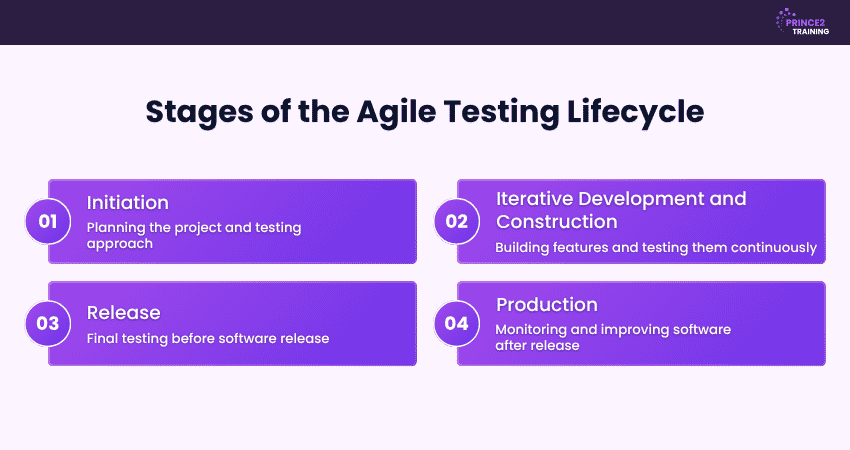
While Agile Testing takes place throughout the Software Development lifecycle, many Agile teams also follow a structured testing lifecycle. One commonly used model includes four broad stages:
1) Initiation
The journey of Agile Testing begins with the initiation phase, often called Iteration 0 in some Agile frameworks. This stage focuses on laying a strong foundation for the project. Teams define the project's goals, scope and business objectives while gathering key requirements. They also assess potential risks, estimate costs and ensure that the necessary testing resources are in place before development begins.
2) Iterative Development and Construction
This is where the majority of Agile Testing takes place. During construction iterations, testing happens continuously alongside development as features are built. By testing early and often, teams can identify and fix issues before they become costly to resolve. There are two major types of testing involved:
a) Confirmation Testing: Ensures that a feature or functionality works as intended and meets the specifications.
b) Investigative Testing: Explores the application to uncover issues that may not be directly related to functionality, such as usability challenges, performance concerns, or integration problems.
3) Release
As the product approaches launch, Testers evaluate the software as a complete system. This phase involves more comprehensive testing, including full-system validation and user acceptance testing, to confirm that the application is ready for real-world use. The main purpose is to ensure the software meets quality standards and performs reliably before it reaches users.
4) Production
Once all Agile Testing activities are successfully completed, the software is released into the production environment. However, Agile teams don't stop paying attention after deployment. They continue to monitor performance, gather user feedback and address any issues that arise, thus helping the product evolve and improve over time.
Transform every Agile principle into inspiring project success stories. Sign up for our PRINCE2 Agile® Practitioner (Version 2) Course today!
Five Key Principles of Agile Testing
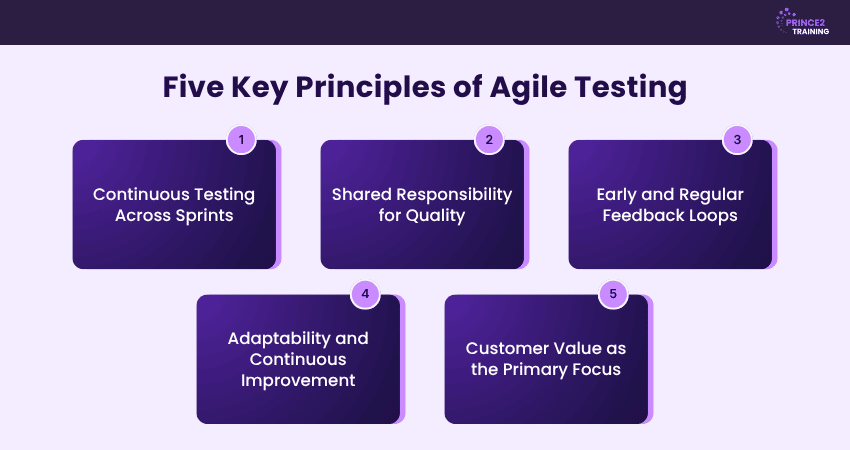
Agile Testing is built on a set of guiding principles that help teams make quality an integral part of the development process rather than a separate activity. Let's explore these principles:
1) Continuous Testing Across Sprints
In Agile projects, testing happens throughout the development process. Developers test their code as they write it, testers check new features and automated tests run regularly. This helps teams find and fix problems early instead of waiting until the end.
2) Shared Responsibility for Quality
In Agile Testing, everyone is responsible for software quality. Testing is not just the job of the testing team. Developers, testers and other team members work together to build good-quality software.
3) Early and Regular Feedback Loops
Agile Testing encourages regular feedback throughout the project. Automated tests, sprint reviews and user testing help teams improve the software. This helps them make better decisions, adapt to changes and avoid bigger problems later.
4) Adaptability and Continuous Improvement
Project requirements can change at any time. Agile Testing helps teams update their testing as the project changes. This helps them maintain software quality and respond to changes more easily.
5) Customer Value as the Primary Focus
Agile Testing always focuses on the customer. Teams test the software from the user's point of view to make sure it works properly, meets their needs and delivers the best possible experience.
What are the Different Agile Testing Methodologies?
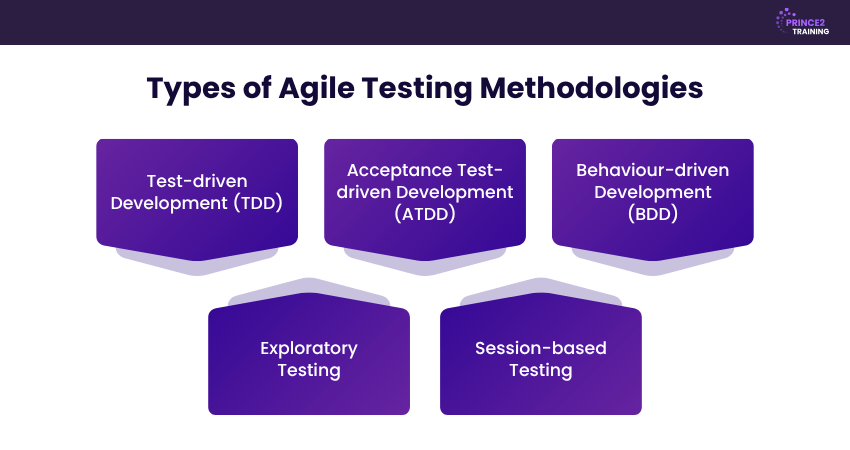
As teams gain more experience with Agile, they often adapt their testing methods to suit their projects. Below are some of the most common Agile Testing methodologies:
1) Test-driven Development (TDD)
This approach starts by writing tests before any code is developed. Since the feature does not yet exist, the test initially fails. Developers then write only the code needed to make the test pass. This approach encourages clean, efficient code, reduces duplication and supports continuous improvement through automated testing.
2) Acceptance Test-driven Development (ATDD)
ATDD builds on the principles of TDD but starts with a user story. The team defines how users will interact with the feature and creates acceptance tests based on those expectations. This ensures development stays aligned with customer needs and delivers features that provide real value.
3) Behaviour-driven Development (BDD)
This approach builds on ATDD by linking user stories to business goals. It focuses on why a feature is needed as well as how it should work. Tests are written to support these goals, guide development clearly and improve collaboration between technical and non-technical teams.
4) Exploratory Testing
Exploratory testing relies on the knowledge and creativity of Testers rather than predefined automated scripts. Testers actively explore the application to detect defects, usability issues and potential risks. This flexible Agile Testing approach is particularly useful for uncovering problems that structured automated tests may miss.
5) Session-based Testing
Session-based testing gives more structure to exploratory testing. Before each session, the tester sets a clear goal. Testing is then carried out in a focused session, followed by a review of the results. This helps teams stay organised while keeping the flexibility of exploratory testing.
Become a sought-after Project Management professional in no time. Register for our PRINCE2® Courses today!
How Can You Implement Agile Testing in Five Steps?
Transitioning from traditional testing to Agile Testing requires thoughtful Project Planning and gradual adoption. The following are the Agile Testing implementation steps:
Step 1: Assess Your Current Testing Process
Begin by understanding how Agile Testing works in your organisation today. Review factors such as:
a) Testing timelines
b) Defect rates
c) Defects reaching production
d) Team collaboration practices
Step 2: Establish Cross-functional Testing Teams
Agile Testing works best when developers, testers and product stakeholders work together as a single team. Integrating Testers directly into development teams improves communication, reduces delays and encourages shared accountability for quality. This setup helps eliminate the traditional handoff process that often slows down software delivery.
Step 3: Define Testing Roles and Responsibilities
Although everyone is responsible for quality, each team member should know their testing role. Clear responsibilities help avoid confusion. For example:
a) Developers: Unit testing, code reviews and defect resolution
b) Testers: Test planning, exploratory testing and automation strategy
c) Product Owners: Acceptance criteria, feature validation and prioritisation
Step 4: Implement Continuous Integration
A strong Agile Testing process uses Continuous Integration to run tests whenever new code is added. This helps teams find issues early and makes testing a regular part of development. Start with automated unit tests and then add:
a) Integration testing
b) Performance testing
c) Security testing
d) Regression testing
Step 5: Develop an Agile Testing Framework
Build a testing plan that is easy to follow and update when needed. It helps teams maintain a consistent testing approach across projects while allowing improvements whenever required. The plan should include how to test, how to report the results and how to check the quality of the software.
Build elite project skills from the ground up. Register for our PRINCE2® Foundation Course today!
What are the Benefits of Agile Testing?
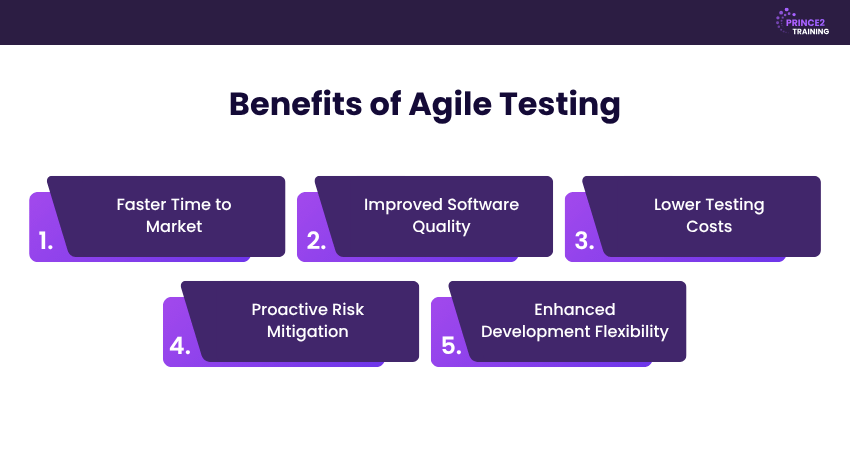
Agile Testing offers numerous advantages that improve both software quality and team performance:
1) Faster Time to Market
Because testing happens alongside development, teams can release features more quickly without waiting for lengthy testing phases. This enables organisations to respond faster to market demands and customer needs.
2) Improved Software Quality
Continuous testing helps uncover defects early, reducing the likelihood of critical issues reaching production. The result is more stable, reliable and user-friendly software that keeps users coming back for more.
3) Lower Testing Costs
Finding and fixing defects early is significantly less expensive than addressing them after release. Additionally, test automation reduces repetitive manual work, improving efficiency and lowering long-term costs.
4) Proactive Risk Mitigation
By testing continuously throughout development, teams can detect technical risks, integration challenges and performance concerns before they become major issues. This proactive approach makes projects more predictable and manageable.
5) Enhanced Development Flexibility
Agile Testing makes it easier to accommodate changing requirements and shifting priorities. Teams can quickly adjust their testing efforts while maintaining quality standards, allowing them to stay responsive in dynamic business environments.
Conclusion
Agile Testing goes beyond finding defects. It helps teams deliver better software through collaboration, rapid feedback and ongoing improvement. By using this approach, organisations can respond to changing requirements more efficiently. It helps to improve product quality and create reliable solutions that offer lasting value to users.
Take your project game up a notch with the PRINCE2 Agile® Foundation (Version 2) Training. Register today and stay future-ready!
Frequently Asked Questions
What Skills are Needed for Agile Testing?
Agile Testing needs testing skills and good teamwork. Testers should know Agile basics, test planning, testing tools and how to find software problems. Good communication also helps them work well with developers and other team members.
Who is Responsible for Testing in an Agile Environment?
Testing is a shared responsibility in an Agile environment. While QA professionals lead testing activities, developers, Product Owners and other team members also contribute by writing tests, reviewing features and validating requirements.
How do Testing Cycles Align with Agile Sprints?
Testing takes place alongside development within every Agile sprint rather than after coding is complete. As new features are built, they are continuously tested and feedback is incorporated before the sprint ends. This enables faster releases and ensures each sprint delivers a potentially shippable product increment.



 Continue Browsing