 Contact@prince2training.co.uk
 01344203999

 Back
Back


Preparing for a Scrum Master interview can be challenging, especially when you're expected to showcase both your Scrum knowledge and your ability to lead Agile teams effectively. The truth is employers look beyond textbook answers. They assess how you solve problems, coach teams, resolve conflicts, and apply Scrum principles in real-world situations. Practising the right Scrum Master Interview Questions and Answers can help you showcase these skills with confidence.
Whether you're applying for your first Scrum Master role or advancing your Agile career, this blog covers the most commonly asked Scrum Master Interview Questions and Answers, from Scrum fundamentals to scenario-based challenges. Use these insights to strengthen your preparation, refine your responses, and make a lasting impression during your interview.
Commonly Asked Scrum Master Interview Questions
The following section covers some of the most commonly asked Scrum Master Interview Questions and Answers. These are aimed at experienced professionals and includes practical topics that employers frequently assess. Reviewing these questions will help you boost your Scrum knowledgebase, spotlight your leadership skills the right way and prepare confidently for your next interview. Let’s dive in:
Q: What is Scrum?
Scrum is a lightweight Agile framework for developing, delivering and maintaining complex products. It allows collaboration within cross-functional teams in short, timeboxed iterations called Sprints. These sprints usually last between one and four weeks. At the end of each Sprint, the team delivers a potentially usable product Increment.
Scrum is founded on the three pillars of transparency, inspection and adaptation. These principles collectively are the reason teams can respond quickly to change while continuously improving their processes and delivering high-quality products. A Scrum Team includes a Product Owner, Scrum Master and Developers working together towards a shared Product Goal.
Q: What are the responsibilities of a Scrum Master?
A Scrum Master's core responsibility is to make sure that the Scrum framework is properly understood and applied. They act as servant leaders. They help the Scrum team collaborate, remove impediments and continuously improve.
Their key responsibilities include:
a) Facilitating Scrum events
b) Removing impediments
c) Coaching the Scrum Team on Scrum and Agile practices
d) Supporting the Product Owner with Product Backlog Management
e) Promoting collaboration and continuous improvement
A successful Scrum Master enables the team to deliver value while becoming more self-managing and effective.
Q: Which Agile metrics are commonly used?
Agile metrics help teams measure progress and identify opportunities for improvement. They focus on team performance rather than individual productivity.
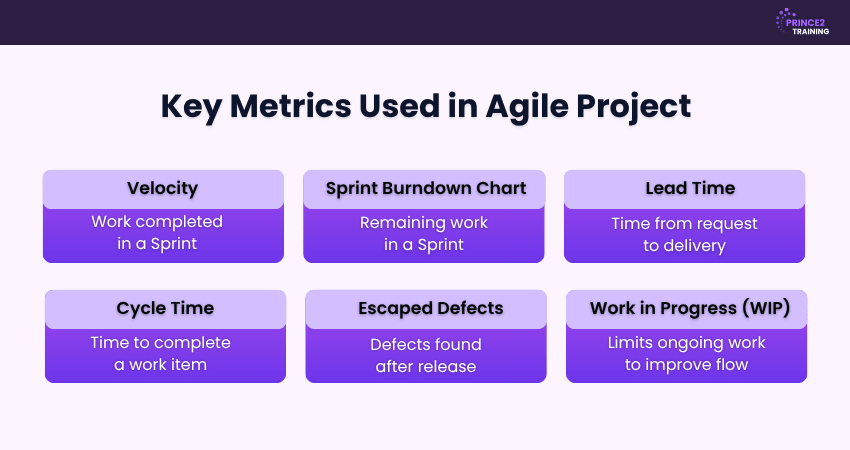
These are the commonly used Agile metrics:
a) Velocity: Measures work completed in a Sprint.
b) Sprint Burndown Chart: Shows the remaining work throughout the Sprint.
c) Lead Time: Measures the time taken from request to delivery.
d) Cycle Time: Tracks how long it takes to complete a work item after development begins.
e) Escaped Defects: Measures defects discovered after a release.
f) Work in Progress (WIP): Helps teams avoid taking on more work than they can effectively manage.
Using these metrics together provides better insights than relying on a single measurement.
Q: What is empirical process control in Scrum?
Empirical process control is the foundation of Scrum. It means making decisions based on observation, experience, and evidence rather than relying solely on detailed planning or assumptions.
It is built on three pillars:
a) Transparency: It makes sure everyone has a clear understanding of the work, goals and progress.
b) Inspection: It makes sure that the team regularly reviews the product as well as the development process.
c) Adaptation: Necessary changes are made whenever any opportunity for improvement is identified.
Events like the Daily Scrum, Sprint Review and Sprint Retrospective promote regular inspection and adaptation.
Q: Can the Definition of Done change during a Sprint?
The Definition of Done must remain unchanged during an active Sprint. That’s because changing it midway can create confusion and negatively impact the team's agreed-upon quality standards. However, it can be updated between Sprints as the Scrum Team improves its practices or introduces new quality requirements. Such consistency during a Sprint maintains transparency and ensures everyone shares the same expectations.
Q: What does incremental delivery mean in Agile?
Incremental delivery is the practice of delivering small portions of a product instead of waiting until the whole project is completed. Each Sprint produces a potentially releasable Increment. This increment builds upon previous work and delivers measurable value to users.
This approach goes a long way to help stakeholders review progress and provide early feedback. This helps in adjusting priorities based on changing business needs. It also reduces project risks by identifying issues earlier, thus making them easier and less expensive to resolve.
Gain practical Agile skills to manage projects with greater confidence through the Agile Project Management Foundation (Agile PM®) Training – Join now!
Q: What are the common reasons for Agile transformations to fail?
Many Agile transformations fail because organisations adopt Agile practices without embracing the cultural changes needed for success.
Some common reasons include:
a) Lack of executive support
b) Resistance to change
c) Poor understanding of Agile principles
d) Insufficient training
e) Weak stakeholder engagement
Successful transformation requires leadership commitment, collaboration, and continuous improvement.
Q: What is the recommended Scrum team size, and why?
A Scrum Team must consist of 10 or fewer people. Smaller teams communicate and make decisions more effectively. Larger teams often face challenges in coordination. If any additional capacity is needed, organisations typically create multiple Scrum Teams working towards the same Product Goal instead of expanding a single team.
Q: What does INVEST stand for in user stories?
INVEST is a widely used guideline for writing effective user stories. It helps ensure stories are well-structured, easy to estimate, and valuable to both the development team and stakeholders. INVEST stands for:
a) Independent: The story can be developed without depending heavily on other stories.
b) Negotiable: Details can evolve through collaboration and discussion.
c) Valuable: The story delivers clear value to the customer or business.
d) Estimable: The team can reasonably estimate the effort that’s required.
e) Small: The story is appropriately sized to fit within a Sprint.
f) Testable: Acceptance criteria make it possible to verify that the story has been successfully completed.
Using the INVEST framework helps improve Product Backlog quality and supports effective Sprint Planning.
Q: What are the Scrum ceremonies?
Scrum ceremonies, also known as Scrum events, help teams plan, collaborate and continuously improve.
Here are the five main Scrum events are:
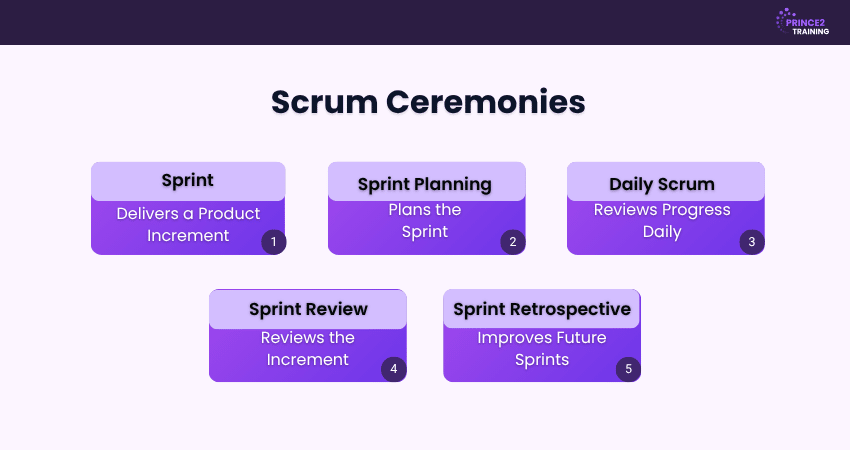
a) Sprint: This is a timeboxed event where the Scrum Team achieves a Sprint Goal and delivers a Product Increment.
b) Sprint Planning: It defines the Sprint Goal and planned work.
c) Daily Scrum: it’s a 15-minute meeting to inspect progress and adjust plans.
d) Sprint Review: It reviews the completed Increment with stakeholders.
e) Sprint Retrospective: It identifies areas for improvement. These events promote transparency, inspection and adaptation throughout development.
Q: What is timeboxing in Scrum?
Timeboxing involves completing an activity within a fixed time limit. Instead of extending deadlines, Scrum encourages teams to work within predefined time limits to maintain focus and consistency.
Every Scrum event is timeboxed. For example, a Sprint lasts up to one month, while the Daily Scrum is limited to 15 minutes. Timeboxing improves planning, prevents unnecessary delays, and supports regular inspection and adaptation.
Q: What is a release candidate in Scrum?
A release candidate is a complete product version awaiting final testing before release. It contains all the planned features and fixes for a particular release and should meet the team's Definition of Done.
Even though Scrum focuses on delivering a releasable Increment at the end of every Sprint, organisations can choose to combine several completed Increments into a single release. Before deployment, the release candidate must be thoroughly validated to make sure that it meets quality, security and business requirements.
Become a confident project leader through the PRINCE2® Foundation Training – Sign up now!
Q: How do you ensure effective communication within a Scrum team?
Effective communication begins with an open and collaborative environment where the team members don't feel uncomfortable sharing their ideas and concerns.
a) Some effective practices include:
b) Facilitating productive Scrum events
c) Encouraging active participation
d) Promoting transparency through Scrum boards
e) Building trust and psychological safety
These practices keep the team aligned with the Sprint Goal and strengthen collaboration.
Q: What role does a Scrum Master play during a Sprint Retrospective?
The Scrum Master plays the vital role of facilitating the Sprint Retrospective by encouraging open discussion, ensuring every team member contributes, and keeping the focus on continuous improvement. They help the team identify practical actions and create a safe environment where feedback leads to meaningful change.
Q: Should Scrum team velocity be increased to improve productivity?
Velocity should be used for forecasting, not measuring performance. Trying to increase it artificially can affect estimation accuracy and product quality. Instead, Scrum Teams should focus on delivering consistent value, with productivity improving naturally through better collaboration and continuous improvement.
Q: Can the Scrum team participate in the product discovery process?
Yes. Involving the entire Scrum Team in product discovery helps generate ideas, assess technical feasibility, identify risks, and better understand customer needs. This leads to stronger user stories, clearer requirements, and more effective Sprint planning.
Q: What makes a good user story?
A good user story clearly describes a feature from the user's perspective while delivering value. It should be clear, concise, and achievable within a Sprint.
An effective user story typically includes:
a) A clear user
b) A specific need
c) Business or customer value
d) Acceptance criteria
Following the INVEST principles further improves the quality of user stories.
Q: What is the difference between epics, user stories, and tasks?
Epics, user stories, and tasks represent different levels of work within Agile planning.
a) Epic: A large body of work that usually spans multiple Sprints and is divided into several user stories.
b) User Story: A smaller requirement that delivers value to the user and can typically be completed within a Sprint.
c) Task: A specific technical activity required to implement a user story, such as coding, testing, documentation, or design.
This hierarchy helps teams organise work efficiently while maintaining a clear connection between business objectives and day-to-day development activities.
Q: How do you ensure action items are completed on time?
Action items, particularly those identified during Sprint Retrospectives, should be realistic, clearly defined, and assigned appropriate ownership. A Scrum Master helps the team prioritise improvement actions without overwhelming the Sprint.
To improve completion rates:
a) Convert action items into visible backlog items where appropriate.
b) Assign clear ownership and expected outcomes.
c) Review progress during Daily Scrums or Sprint events.
d) Keep the number of improvement actions manageable.
e) Discuss unfinished actions during the next Retrospective.
Tracking improvement actions consistently helps teams turn discussions into measurable improvements rather than repeated conversations.
Q: How do you resolve conflicts within a Scrum team?
Conflict is a natural part of teamwork and, when managed well, can lead to the right decisions. A Scrum Master addresses conflicts early by understanding the root cause, listening to all perspectives, and facilitating respectful discussions focused on solutions rather than blame. If issues persist or involve organisational challenges, they work with Managers or stakeholders to remove obstacles while maintaining a collaborative team environment.
Become a confident project leader through the PRINCE2® Foundation and Practitioner Training – Join now!
Q: How do you evaluate the success of a Scrum team?
The success of a Scrum Team is measured by the value it delivers, product quality, and continuous improvement rather than the amount of work completed.
Some key indicators include:
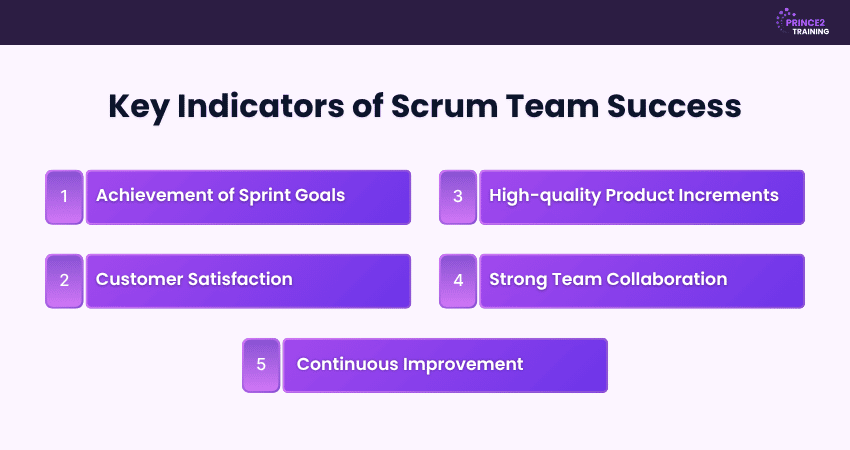
a) Achievement of Sprint Goals: Consistently meeting the Sprint goals proves that the team can effectively prioritise and deliver valuable work within the Sprint timeline.
b) Customer Satisfaction: High customer satisfaction indicates that the team is delivering features and solutions that meet user expectations. Regular feedback can ensure that the product provides real value to customers.
c) High-quality Product Increments: Quality product increments are reliable and meet the agreed Definition of Done. Maintaining high quality reduces technical debt, minimises defects and increases stakeholder confidence in the product.
d) Strong Team Collaboration: A cohesive Scrum Team works together to solve problems, adapt to challenges and continuously improve performance.
e) Continuous Improvement: By implementing lessons learned from Sprint Retrospectives, teams can boost productivity and overall effectiveness over time.
Velocity can support forecasting but should not be the primary measure of success.
Q: How do you manage a situation where the Product Owner is unavailable or not actively engaged?
If the Product Owner becomes unavailable, the Scrum Master should understand the cause and encourage better collaboration.
They can help by:
a) Scheduling backlog refinement sessions
b) Clarifying priorities
c) Improving stakeholder communication
d) Escalating organisational issues when necessary
This helps minimise disruption while keeping the team focused on the Sprint Goal.
Q: How do you promote continuous improvement within a Scrum Team?
A Scrum Master encourages continuous improvement by helping the team regularly reflect on its performance and adopt better ways of working. This can be achieved by: a) Facilitating a Sprint Retrospectives b) Encouraging constructive feedback c) Promoting experimentation d) Tracking improvement actions These practices help the team become more effective and adaptable over time.
Q: How do you keep the Scrum team focused on delivering customer value?
Keeping customer value at the centre of every Sprint starts with a clear Product Goal and Sprint Goal. The Scrum Master works with the Product Owner to prioritise Product Backlog Items based upon business value. Regular stakeholder feedback, early validation, and continuous collaboration help the team deliver solutions that meet customer needs.
Q: How do you handle disagreements among team members about the best solution to a problem?
Different opinions are common in Scrum Teams and often lead to better solutions when managed effectively. A Scrum Master encourages respectful discussions where everyone can share their views. Decisions should be based on evidence, technical feasibility, customer value, and shared goals. If consensus isn't reached, techniques such as timeboxed discussions or proof-of-concept solutions can help the team move forward.
Q: How do you onboard new members into an existing Scrum team?
Successful onboarding helps new members understand both the project and the team's way of working. An effective onboarding process includes:
a) Explaining Scrum roles and events
b) Introducing the Product Goal
c) Pairing with an experienced teammate
d) Providing ongoing guidance and feedback
A structured onboarding process helps new members contribute more quickly while strengthening team collaboration.
Q: How do you address technical debt that could affect future Sprints?
Technical debt occurs when teams choose short-term solutions instead of sustainable ones. If left unmanaged, it can reduce product quality, slow future development, and increase maintenance costs.
A Scrum Master helps the team identify and prioritise technical debt during backlog refinement and Sprint Planning. A strong Definition of Done, good engineering practices, and regular refactoring help prevent it from growing.
Q: Is the Product Owner solely responsible for communicating with stakeholders?
No. While the Product Owner mainly manages stakeholder relationships and maximising product value, effective communication is a shared responsibility across the Scrum Team. The Scrum Master facilitates collaboration between stakeholders and the team, especially during Sprint Reviews. Developers may also engage with stakeholders to clarify requirements and gather feedback, ensuring everyone remains aligned with the Product Goal.

Experience growth and efficiency with PRINCE2 Training, the globally acknowledged pioneer in professional education.


Pentagon Training Limited, Email: Contact@prince2training.co.uk, Phone: 0800 0355 832, VAT Registration No: 652 8880 03, Company registration number: 3011290
PRINCE2®, ITIL®, M_o_R®, MoP®, P3O® and MSP® are registered trade marks of PeopleCert.
All PRINCE2®, ITIL®, M_o_R®, MoP®, P3O® and MSP® courses are offered by Pentagon Training Limited.
COBIT® 5 and Agile PM® courses are offered by the Pentagon Training Limited. An accredited training organisation of the APM group ltd.
© Copyright 2026 - Pentagon Training Limited - All Rights Reserved.


 Continue Browsing

40%
SPECIAL BIG DEALSLevel Up Your Skills – Enroll Now!