01344203999




 Back
Back


Table of Content

19-Oct-2026

Maria Thompson
A great project doesn't start with a task; it starts with a clear structure. That's where a Work Breakdown Structure (WBS) steps in, transforming big, complex goals into manageable, bite‑sized pieces. It's the project roadmap that reveals every milestone and task needed to reach the finish line. In this blog, we'll break down what a Work Breakdown Structure is, why it's a Project Manager's ultimate weapon, and how you can create one that keeps your team focused and unstoppable. So read on and bring unprecedented clarity to your project planning and delivery.
What is a Work Breakdown Structure (WBS)?
A Work Breakdown Structure refers to a Project Management technique that divides a project into more manageable components. Large projects can feel overwhelming, and it is often difficult to know where to begin. A WBS helps by breaking a single complex task into clear, actionable components.
This makes it easier to plan, prioritise and decide what to work on first. Organising work into a logical hierarchy improves visibility across the project. It also supports more accurate scheduling, resource allocation, and progress tracking throughout the project lifecycle using Project Management Tools.

What's the Purpose of a Work Breakdown Structure (WBS)?
In Project Management, a WBS defines and organises the project scope by dividing it into manageable sections. It provides a clear structure that supports effective planning, execution and control. A WBS breaks work into defined components, making it easier to assign responsibilities.
Each work package includes sufficient detail to accurately estimate resources, costs, and timelines. It also helps track progress against the project plan, ensuring that the work stays aligned and the project remains on schedule.
2 Types of Work Breakdown Structures
A Work Breakdown Structure can be organised in different ways, depending on the nature and goals of the project. The two common approaches include:
1) Deliverable-based WBS
A deliverable-based WBS is centred on the project's final outputs. It divides work into major deliverables rather than project stages, making it suitable for projects where outcomes are clearly defined and distinct.
A) Advantages of Deliverable-based WBS
a) It emphasises final outputs, making progress easier to measure.
b) The risks are linked directly to individual deliverables, making them easier to identify and manage.
B) Disadvantages of Deliverable-based WBS
a) Poorly defined deliverables can lead to extra work being added beyond the original scope and budget.
b) Concentrating mainly on outputs can cause teams to overlook important process-related activities.
2) Phase-based WBS
A phase-based WBS structures the project around its lifecycle stages. Each phase represents a key part of the project timeline and is further broken down into tasks and activities. This approach works perfectly well for projects with clearly defined phases, such as construction or software development.
A) Advantages of Phase-based WBS
a) This makes it easier to understand where the project stands at any given time.
b) Managing each phase separately supports better control over schedules, resources, and costs.
B) Disadvantages of Phase-based WBS
a) The structured phase approach can feel rigid and harder to adapt to change.
b) Coordinating work and information across phases can be more complex.
Where control meets flexibility,
PRINCE2 Agile® Foundation Training
shows you how to deliver projects in fast-moving environments - Sign up now!
What are the 3 Levels of Work Breakdown Structure?
The various levels of a Work Breakdown Structure help organise work by breaking a project into progressively smaller parts. A WBS is usually built around parent and child relationships, where each level supports the completion of the level above it:
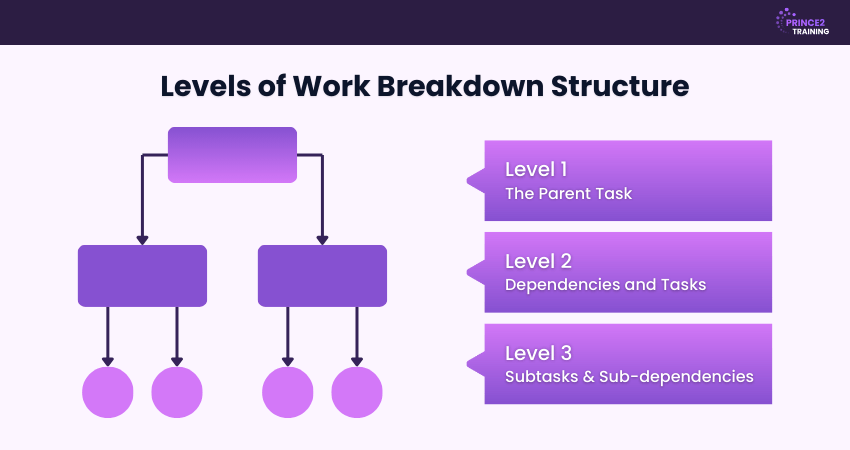
Level 1: The Parent Task
The first level represents the overall goal of the project. It is the highest-level view and typically mirrors the main project objective. For example, imagine a project focused on organising a company-wide training programme.
At level one, the WBS could simply be delivering a company-wide training programme. This level sets the direction for the entire project, with all remaining work supporting this objective.
Level 2: Dependencies and Tasks
Level two breaks the main objective into key tasks or work areas required to complete the project. These are the primary components that contribute directly to the final outcome. For the training programme example, level two tasks might include:
a) Develop training content
b) Select training platform
c) Schedule training sessions
d) Prepare communication materials
e) Arrange trainers and facilitators
These tasks provide a structured overview of what needs to happen, without yet going into detailed actions.
Level 3: Subtasks
The third level divides each major task into smaller, actionable activities. This is the most detailed level, where responsibilities, timelines, and resources become clear.
Continuing the example, subtasks under "Develop training content" could include:
a) Define learning objectives
b) Create presentation slides
c) Design practical exercises
d) Review content with stakeholders
e) Finalise training materials
At this stage, the work required to complete the project becomes clear and manageable.
Depending on project complexity, additional levels can be added to provide even more detail.
Key Components of a Work Breakdown Structure (WBS)
Each element of a Work Breakdown Structure plays a specific role and varies in level of detail. The main components of a WBS include:
a) Phases: These may represent major stages of the project lifecycle, although traditional WBS structures focus primarily on deliverables rather than phases.
b) Tasks: These are individual pieces of work carried out within each phase of the project.
c) Subtasks: These are the smaller activities that break tasks down further, supporting detailed project planning and execution.
d) Deliverables: These are the outputs produced as a result of completing tasks, which may be tangible or intangible.
e) Sub-deliverables: These are the smaller outputs that combine to form larger deliverables.
f) Work Packages: These are the lowest level of the WBS, consisting of clearly defined tasks or task groups with specific outputs.
g) Dependencies: These show the relationships between tasks, indicating the order in which work must be completed, which are known as Dependencies in Project Management.
h) Estimates: These provide approximate requirements for time, cost, and resources to support scheduling and budgeting.
i) Milestones: These highlight the completion of key stages, deliverables or significant project objectives.
Move beyond knowledge and start applying PRINCE2® with precision through our PRINCE2® Practitioner Training - Sign up now!
How to Create a Work Breakdown Structure?
Creating a Work Breakdown Structure starts with clearly defining the project's final outcome. From there, you work backwards, breaking the project into key deliverables and then dividing each deliverable into smaller tasks and subtasks, which are easier to manage. Here are the main steps:
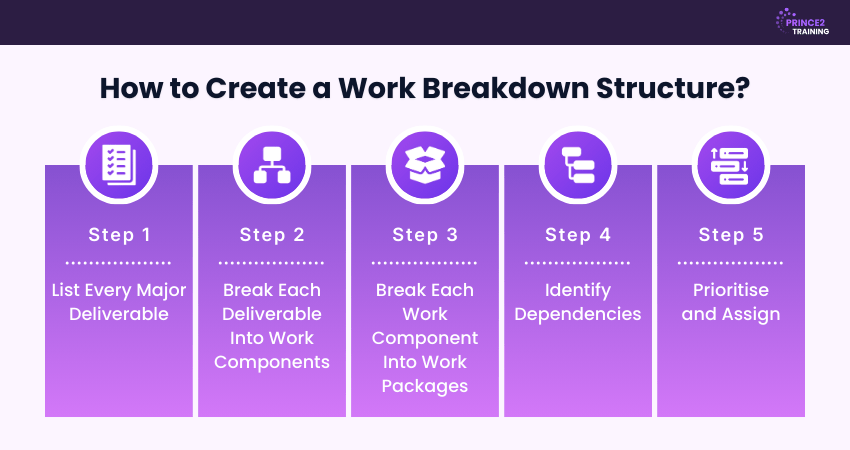
Step 1: List Every Major Deliverable
Begin by defining the overall project goal. This becomes Level 1 of your WBS. For example, imagine you are planning a corporate training event. Your Level 1 objective could be: Deliver a company-wide leadership training event.
Next, break this goal into major deliverables (Level 2). These represent the main areas of work required to achieve the objective. For a training event, major deliverables might include:
a) Training content development
b) Venue and logistics
c) Trainer coordination
d) Participant communication
e) Post-training evaluation
Before moving forward, confirm these deliverables with key stakeholders.
Step 2: Break Each Deliverable Into Work Components
Each major deliverable can then be divided into work components. These are logical groupings of related activities and may vary depending on roles, responsibilities or work types. For example, under the deliverable 'Training content development', work components could include:
a) Presentation materials
b) Practical exercises
c) Assessment materials
If needed, you can continue breaking these components down further.
For instance, 'Presentation materials' could be split into:
a) Slide design
b) Speaker notes
c) Visual assets
There is no limit to how detailed this breakdown can be.
The structure should reflect what works best for your team and project.
Step 3: Break Each Work Component Into Work Packages
Work packages form the lowest level of the WBS. These are specific tasks that can be assigned to one person or team and managed independently. Each work package should have clear outputs, timelines and resource requirements.
Continuing the example from above:
Deliverable: Training content development
Work component:
Presentation materials
Work packages:
a) Create leadership theory slides
b) Design case study visuals
c) Review and approve final slide deck
Each work package should appear only once in the WBS and clearly contribute to a single deliverable.
Step 4: Identify Dependencies
After listing all tasks, determine which activities depend on others. For example, slide design cannot be finalised until the content outline is approved. Identifying dependencies helps you plan timelines, manage resources and anticipate potential delays.
Step 5: Prioritise and Assign
Finally, arrange tasks based on priority and dependency order. Assign work packages to team members and use them to build your project schedule, working from individual tasks back up to the main deliverables.
Your WBS can also include additional details to improve clarity and transparency, such as:
a) Responsible departments or owners
b) Estimated costs and budgets
c) Start dates and completion deadlines
When built thoughtfully, a Work Breakdown Structure becomes a powerful foundation for planning, execution, and successful project delivery.
New to projects? Start strong with our Introduction to Project Management Course. Sign up now and turn ideas into clear, achievable plans!
Work Breakdown Structure (WBS) Example
Now let's look at a practical example focused on online content creation. While the layout may vary depending on the tool used, the hierarchy and logic of the breakdown remain the same. Below is a sample WBS to help you visualise how an online content project can be organised.
WBS Name: Online Content Creation
Description: Plan, create, and publish digital content to support brand awareness and audience engagement.
Completion Date: xx/yy/20zz
Budget: £30,000
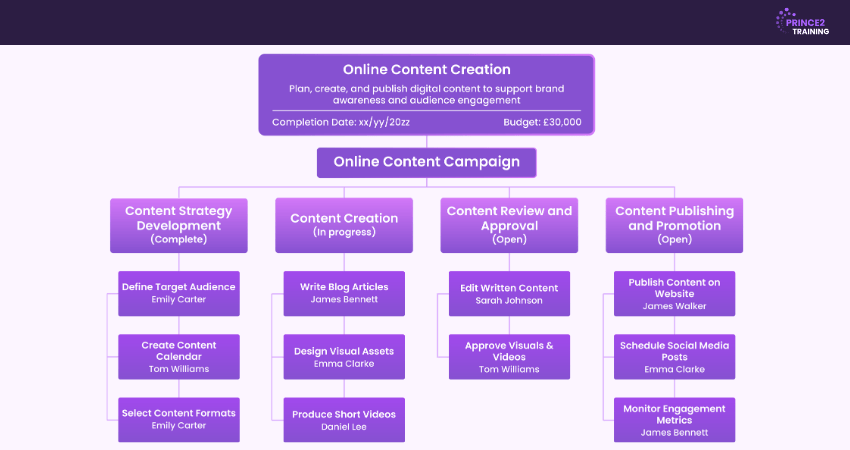
Level 1
Deliver an online content campaign.
Level 2
Content strategy development (Complete)
Content creation (In progress)
Content review and approval (Open)
Content publishing and promotion (Open)
Level 3
a) Content Strategy Development
a) Define target audience: Emily Carter
b) Create content calendar: Tom Williams
c) Select content formats: Emily Carter
b) Content Creation
a) Write blog articles: James Bennett
b) Design visual assets: Emma Clarke
c) Produce short-form videos: Daniel Lee
c) Content Review and Approval
a) Edit written content: Sarah Johnson
b) Approve visuals and videos: Tom Williams
d) Content publishing and promotion
a) Publish content on website: James Walker
b) Schedule Social Media posts: Emma Clarke
c) Monitor engagement metrics: James Bennett
As with any WBS, the structure will vary based on project scope, timelines and tools. These factors influence how detailed each level becomes and how the responsibilities and dependencies are defined.
Best Practices for Creating a Work Breakdown Structure
Here are some best practices for creating a proper WBS:
a) Apply the 100% Rule: Ensure the WBS includes all work required to complete the project deliverables and excludes anything outside the agreed scope.
b) Cover the Full Scope: Build an exhaustive and detailed structure that highlights gaps, overlaps or missing work, while removing unnecessary tasks.
c) Be Specific and Thorough: Break work down clearly and in detail. Clear definitions make planning, estimation and execution easier.
d) Avoid Duplication: Keep tasks mutually exclusive to prevent repeated work, wasted effort, and unnecessary use of time or budget.
e) Focus on Outcomes: Structure the WBS around deliverables and results rather than activities, keeping attention on what needs to be produced.
Conclusion
A Work Breakdown Structure turns any complex project into manageable steps towards success. Breaking big goals into smaller, achievable pieces creates structure and confidence across a project. When built thoughtfully, a WBS becomes a roadmap that guides teams, controls scope, improves estimates and keeps delivery aligned from the first task to the final outcome.
Stay in control at every stage of the project lifecycle with our comprehensive PRINCE2® Training - Sign up now!



 Continue Browsing