Contact@prince2training.co.uk
 01344203999




 Back
Back


Table of Content


21-Sep-2026

Veronica Davis
Think of planning a road trip without knowing how far you can travel each day. This is the kind of challenge that Scrum teams face when planning their work and that's where Sprint Velocity becomes valuable. After all, every successful sprint tells a story and this velocity is the metric that brings that story to life.
It reveals how much work your team can truly deliver, turning estimates into predictable progress. But what exactly is Sprint Velocity, and how do you calculate it effectively? In this blog, we break it down into simple, practical steps, helping you understand and use velocity to plan smarter and deliver better with every sprint. So, read on!
What is Sprint Velocity?
Sprint Velocity measures the amount of work a team can actually complete during a single sprint. As an Agile metric, it is typically calculated using story points, tasks, user stories, etc. By tracking the Sprint Velocity over time, teams can better estimate future workloads and assess their delivery performance.
For instance, if a team consistently completes 25 story points per sprint, they can estimate that they will complete around 75 story points over the next three sprints. This helps teams set realistic goals and improve sprint forecasting.

How to Calculate Sprint Velocity in Scrum?
Sprint Velocity is usually calculated at the end of each sprint by adding the story points of all the fully completed user stories. You can take the following steps to calculate Scrum velocity:
1) Plan the Sprint
Before the sprint begins, estimate and assign story points to the user stories in the product backlog. For example:
a) Create login functionality: 3 points
b) Develop product catalogue page: 8 points
c) Build user settings page: 13 points
d) Improve application performance: 21 points
e) Create reporting dashboard: 8 points
The team should commit to a realistic amount of work based on previous sprint performance and any known constraints. For instance, if the team's average velocity is 20 points, they may select user stories worth approximately 20 story points for the upcoming sprint.
2) Identify Completed User Stories
At the conclusion of the sprint, list all the user stories that are fully completed and meet the agreed acceptance criteria. These stories must be reviewed and approved by the Product Owner. Partially completed work is not counted. If a user story is unfinished, it should be moved to the next sprint and reassessed if necessary.
3) Review Story Point Estimates
Confirm the story points assigned to the completed user stories. For instance, assume that the team completed these items during the sprint:
a) Create login functionality: 3 points
b) Develop product catalogue page: 8 points
c) Add shopping cart feature: 5 points
4) Calculate Total Completed Points
Calculate the Sprint Velocity by adding the story points of all completed user stories.
In this example: 3 + 8 + 5 = 16 story points
Therefore, the team's Sprint Velocity for this sprint is 16 points.
5) Determine the Average Velocity
To improve future planning, calculate the average velocity across multiple sprints. For example, if the team achieved velocities of 18, 16, and 20 points in the last three sprints, the average velocity would be calculated using this formula:

Thus, you can apply your story points in this formula and find your average velocity. It will be calculated as shown below:

This average provides a far more reliable estimate of how much work the team can complete in future sprints.
Key Factors that Influence Scrum Velocity
There are multiple factors that can affect Scrum velocity. Understanding them is vital for teams to plan better and improve performance over time. So, here are some of those factors:
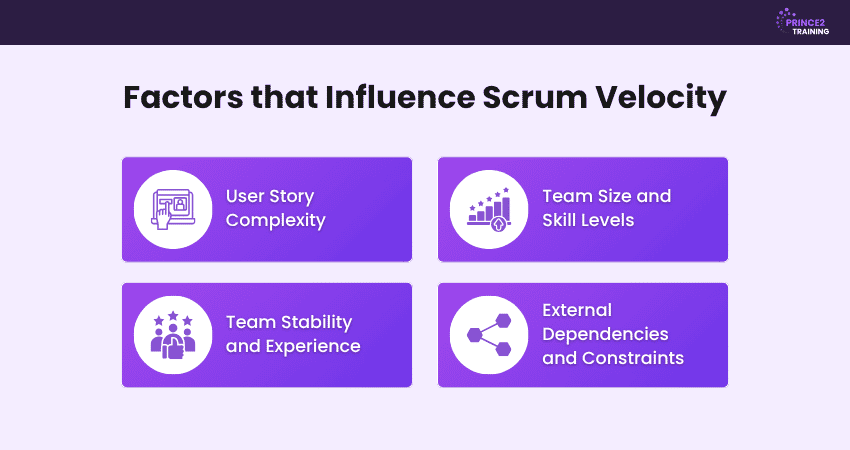
1) User Story Complexity
If a sprint contains more complex user stories, the team may complete fewer story points, resulting in a lower velocity. Inaccurate estimation of story points can also impact the results. Planning Poker can help teams discuss complexity and reach a shared estimate. To maintain steady.
2) Team Size and Skill Levels
The number of team members and their expertise play a key role here. Larger teams may complete more work, but they can also face communication and coordination challenges. On the other hand, a smaller but highly skilled team can often handle complex tasks better.
3) Team Stability and Experience
Teams that have worked together across multiple sprints usually perform better. They build strong communication habits, understand each other's strengths and solve problems more quickly, which improves the overall Sprint Velocity.
4) External Dependencies and Constraints
Reliance on other teams for tasks like integrations can slow progress if delays occur. Planning ahead and maintaining clear communication can help reduce these risks. Moreover, holidays or company events must be taken into account as they reduce the available working time.
Build essential project skills from the ground up. Register for our PRINCE2® Foundation Course now!
Common Velocity Measurement Mistakes to Avoid
While Sprint Velocity is a valuable planning and forecasting metric, certain mistakes can reduce its effectiveness. Here are some common pitfalls to avoid:
1) Counting Partially Completed User Stories:
Only include user stories that are fully completed and meet the agreed acceptance criteria. Counting unfinished work can distort velocity measurements and lead to unrealistic sprint planning.
2) Tracking Individual Velocity:
Sprint Velocity measures the performance of the entire team, not individual contributors. Using it to assess personal productivity can discourage teamwork and create unnecessary competition.
3) Linking Velocity to Performance Reviews:
Velocity should be used for planning and forecasting, not for evaluating employee performance. When teams feel pressured to achieve higher numbers, they may overestimate story points, reducing the accuracy of the metric.
4) Comparing Velocity Across Different Teams:
Each Scrum team works in a unique environment and may estimate story points differently. As a result, comparing velocity figures between teams does not provide meaningful insights and can lead to incorrect conclusions.
5) Ignoring Changes in Team Composition:
Velocity can be affected by changes such as new team members, employee departures, holidays, or shifting responsibilities. Failing to account for these crucial factors can lead to inaccurate forecasts and unrealistic sprint commitments.
Turn Agile principles into memorable project success with our
PRINCE2 Agile® Practitioner (Version 2) Course
- Register today!
Best Practices for Managing Sprint Velocity
Managing Sprint Velocity effectively helps teams improve forecasting accuracy, maintain realistic sprint commitments, and deliver value consistently. Rather than focusing on increasing velocity, teams should use it as a planning tool to better understand their capacity and identify opportunities for improvement.
The following best practices can help teams make the most of Sprint Velocity while supporting sustainable and predictable delivery:
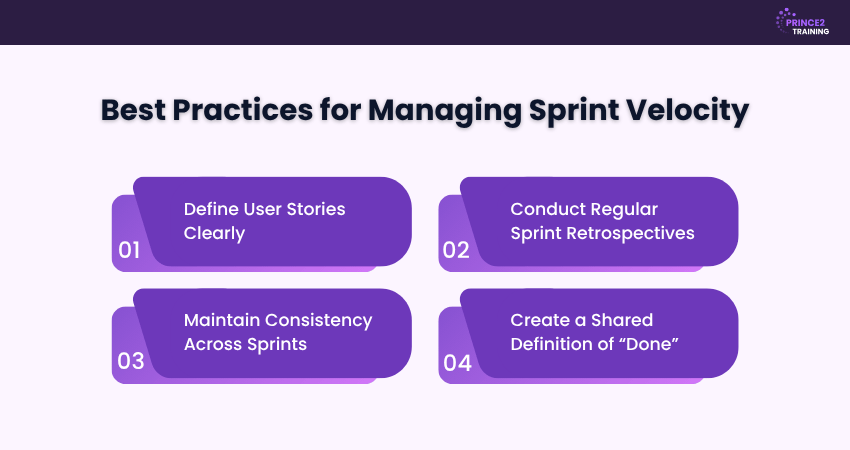
1) Define User Stories Clearly
Ensure user stories are well-defined and easy to understand before the sprint begins. Clear descriptions help the team focus on tasks without needing constant clarification from stakeholders. Additionally, when requirements are clear, teams can plan their work confidently and maintain a more consistent velocity.
2) Conduct Regular Sprint Retrospectives
After each sprint, review what worked well and what did not. Retrospectives help teams identify obstacles, communication gaps, and process inefficiencies that may affect performance. With the help of these insights, you can improve future sprints and keep your team moving in the right direction.
3) Maintain Consistency Across Sprints
Frequent changes like rotating team members or altering processes can affect velocity. Try to maintain stability. Some key factors to watch include sprint duration, estimation practices, story point scales, and team workflows. Moreover, following stable working practices helps teams better understand their true delivery capacity.
4) Create a Shared Definition of "Done"
Everyone on the team should agree on what "done" means. A shared Definition of Done ensures that completed work meets the same quality standards across all sprints. It also prevents partially finished work from being counted, resulting in accurate velocity measurements and forecasts.
Conclusion
Sprint Velocity helps teams eliminate uncertainty and bring forth clarity with every iteration. By understanding how to measure and use it, you can master the art of smarter planning and stronger delivery. It's not about speed alone; it's about learning and continuous improvement, thus guiding your team toward predictable success sprint after sprint.
Master your way to becoming a Project Management elite with our range of PRINCE2® Courses – Register now!
Frequently Asked Questions
Is Sprint Velocity in Scrum the Same as Productivity?
No, they are not the same. Sprint Velocity measures the amount of work a Scrum team completes during a sprint, usually in story points. On the other hand, productivity focuses on overall output or efficiency. Velocity is primarily a planning and forecasting tool rather than a measure of team performance or productivity.
Can We Compare the Velocities of Two Different Teams?
No, comparing the Sprint Velocity of different teams is not recommended. Each team estimates story points differently, has unique skills and works under different conditions. Velocity is most useful for tracking a single team’s progress and improvement over time, not for cross-team comparison.
What is Sprint Velocity in KPI?
Sprint Velocity in Key Performance Indicator (KPI) refers to using a team’s completed story points per sprint to track delivery capacity over time. It measures the amount of completed work in a sprint and helps improve planning and forecasting. However, it must be used for planning and improvement rather than employee evaluation.



 Continue Browsing