Contact@prince2training.co.uk
 01344203999



 Back
Back


Table of Content


13-Oct-2026

Gary Moore
Have you ever worked on a project where everything looked perfect on paper, but reality became late for feedback, rework and frustrated teammates? That is exactly why understanding What is Agile Methodology is important. Agile helps teams adapt quickly, learn continuously, and deliver value faster without waiting until the final deadline.
In this blog, you will explore What is Agile Methodology in detail including how it works, its types, principles, pillars, life cycle and the key benefits and drawbacks. This will help you use Agile more effectively and improve how your team delivers results.
What is Agile Methodology?
Agile Methodology is a flexible, iterative approach to Project Management and Software Development. Unlike traditional methods that follow a strict, step-by-step process, Agile breaks projects into smaller, manageable tasks called iterations or sprints. This allows teams to focus on delivering parts of the project quickly and efficiently.
Agile encourages collaboration, regular feedback, and adaptability. Teams continuously gather customer input and make improvements along the way, ensuring the final product meets evolving needs. This method helps deliver high-quality results faster while staying responsive to change.

How Does the Agile Methodology Work?
Agile Methodology works through short, repeatable cycles, which are called sprints or iterations, that last for one to four weeks. Each sprint involves planning, developing, testing, and reviewing a small part of the project. Teams set clear goals for each sprint and work together daily to track progress, solve issues, and stay aligned.
Here's How it Functions:
1) Plan the Sprint: The team decides which tasks or features to work on.
2) Develop and Test: features during the sprint, using Agile testing to identify issues early.
3) Daily Stand-ups: Short daily meetings keep everyone updated and aligned.
4) Review and Demo: At the end, the team reviews the work and demonstrates it to stakeholders for feedback.
5) Retrospective: The team reflects on what went well and what can be improved.
This process repeats, which allows the team to adapt quickly to feedback and changing requirements. It ensures the final result meets the user's needs efficiently for better results.
The Agile Manifesto: Values and Principles
The Agile Methodology is built on a foundational document known as the Agile Manifesto. Created in 2001 by a group of software practitioners, it introduced a new way of working that prioritised people, adaptability, and customer value over rigid processes and documentation.
The Agile Manifesto is organised into two key parts: four core values and twelve guiding principles. Together, they explain how Agile teams should think, behave, and deliver work in real-world project environments.
The Four Core Values
The four core values describe what Agile teams prioritise when making decisions. Here are the values of Agile:
1) Individuals and Interactions Over Processes and Tools:
Agile focuses on communication, teamwork, and collaboration. Tools and processes are useful, but people working together effectively create better outcomes. Regular discussions, quick feedback, and open communication help teams solve problems faster and make better decisions.
2) Working Software Over Comprehensive Documentation:
In traditional projects, teams spent a lot of time writing detailed documents before coding began, which slowed progress. Agile reduces this paperwork and uses short user stories so Developers can start quickly. Documentation is still created when needed, but the focus is on delivering a working product early and improving it through feedback and updates.
3) Customer Collaboration Over Contract Negotiation:
Agile encourages continuous involvement from customers or stakeholders throughout the project. Instead of depending only on initial agreements and fixed requirements, teams regularly communicate, review progress, and gather feedback. This ongoing collaboration helps ensure the product matches user expectations and allows changes to be made as needs evolve.
4) Responding to Change Over Following a Plan:
Project requirements evolve as business needs, market conditions, or user feedback change. Agile accepts this reality and allows teams to adjust priorities and features during development rather than following an original plan. This flexibility helps ensure the final product remains relevant and aligned with current user expectations.
The Twelve Principles
The twelve principles of the Agile Manifesto give an overview of What is Agile Methodology and how Agile should be applied in practice. They guide team behaviour, communication, and delivery. Here are those principles:
1) Satisfy customers through early and continuous delivery of valuable work
2) Welcome changing requirements, even late in development
3) Deliver working product increments frequently with regular intervals
4) Maintain close collaboration between business stakeholders and Developers
5) Build projects around motivated individuals and support them properly
6) Encourage face-to-face communication as the most effective method
7) Treat a working product as the primary measure of progress
8) Promote sustainable development and a steady working pace
9) Maintain technical excellence and good design
10) Keep processes simple and avoid unnecessary work
11) Enable self-organising teams to produce the best solutions
12) Regularly reflect and improve through continuous learning and adaptation
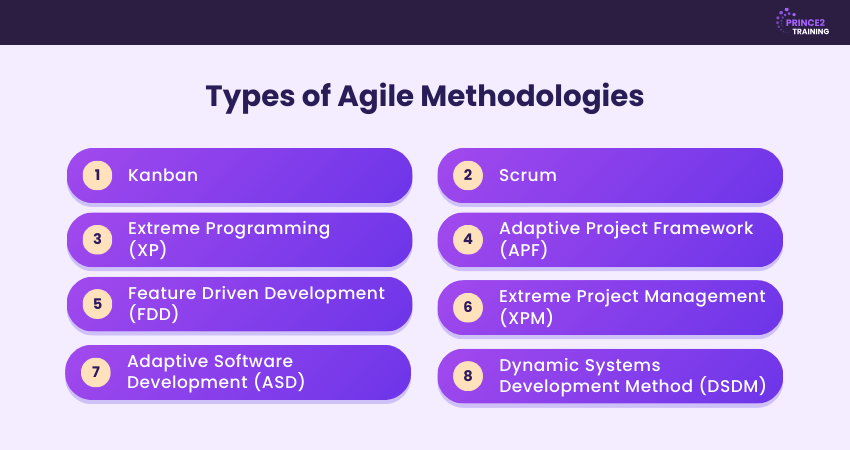
8 Types of Agile Methodologies
Agile is a family of flexible and adaptive frameworks that offer a unique approach to planning, executing, and delivering projects. Here are some of the most popular types:
1) Kanban
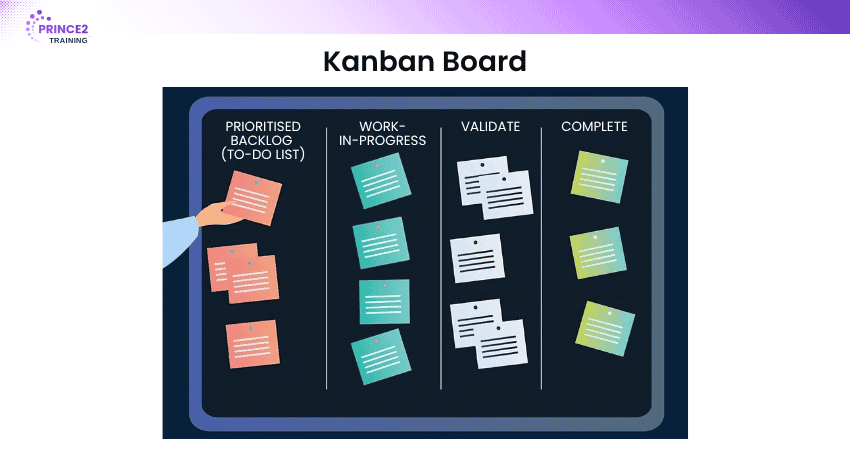
Kanban is a visual Workflow Management approach that focuses on real-time communication and task tracking. It uses boards with columns like To Do, In Progress, and Done to help teams visualise work, limit work-in-progress, and improve flow. There are no fixed iterations, so tasks move fluidly based on team capacity. It's ideal for continuous delivery and operational teams.
Key Highlights:
1) Visual task management
2) Limits work-in-progress
3) Continuous improvement
4) No set roles or time frames
Start your Project Management career with our Introduction to Project Management Training for a solid foundation!
2) Scrum
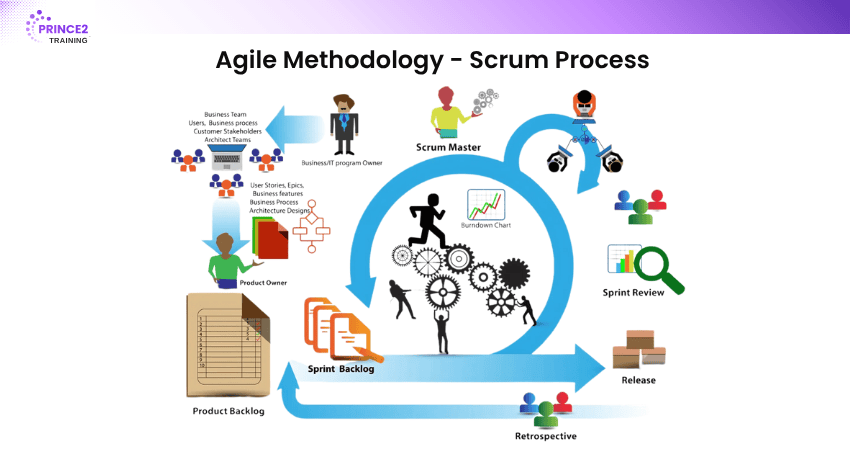
Scrum is one of the most widely used Agile frameworks for managing complex projects. It breaks projects into short cycles called sprints, usually two to four weeks. It includes roles like Product Owner, Scrum Master, and Development Team. Daily stand-up meetings and sprint reviews ensure transparency and adaptability.
Key Highlights:
1) Time-boxed sprints
2) Defined team roles
3) Product backlog prioritisation
4) Frequent reviews and retrospectives
3) Extreme Programming (XP)
Extreme Programming (XP) is focused on improving software quality and responsiveness. It promotes technical excellence through practices like pair programming, test-driven development (TDD), continuous integration, and frequent releases. XP is best for projects with changing requirements and tight deadlines.
Key Highlights:
1) Frequent releases
2) Test-driven development
3) Simple design and continuous feedback
4) High coding standards
4) Adaptive Project Framework (APF)
APF is designed to handle projects with unclear or constantly changing requirements. It encourages iterative planning and feedback loops to refine objectives along the way. Stakeholders are closely involved, and goals may evolve throughout the project.
Key Highlights:
1) Adaptable and flexible
2) High stakeholder involvement
3) Continuous learning and refinement
4) Value-driven delivery
5) Feature Driven Development (FDD)
Feature Driven Development (FDD) is a model-driven, short, structured and iterative process focused on delivering tangible features every few days. It begins with a broad model, followed by feature lists, planning, designing, and building by feature. It's ideal for large teams working on complex systems.
Key Highlights:
1) Feature-focused planning
2) Scalable for big projects
3) Emphasis on design and code quality
4) Structured but flexible
6) Extreme Project Management (XPM)
Extreme Project Management (XPM) is built for chaotic and rapidly changing environments. It embraces uncertainty and uses short planning cycles to make constant adjustments. Rather than controlling the project, XPM guides it based on discovery and learning.
Key Highlights:
1) Embraces change and risk
2) Suitable for experimental projects
3) Encourages creativity and innovation
4) Focus on flexibility over structure
7) Adaptive Software Development (ASD)
Adaptive Software Development (ASD) is ideal for complex software projects where requirements change frequently. It focuses on rapid delivery through three phases: speculate, collaborate, and learn. It values learning from each iteration and adapting the approach accordingly.
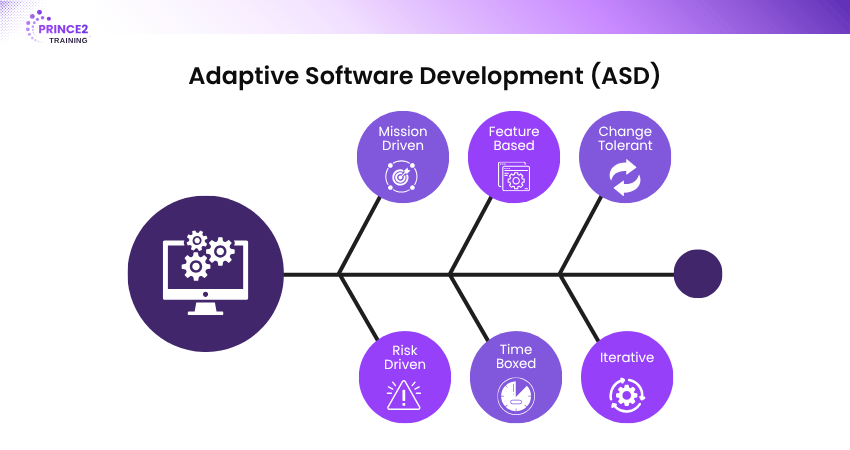
Key Highlights:
1) Encourages innovation and flexibility
2) Emphasises learning over rigid planning
3) Focus on teamwork and rapid delivery
4) Useful for uncertain or emerging technologies
8) Dynamic Systems Development Method (DSDM)
Dynamic Systems Development Method (DSDM) is a disciplined Agile method with strong governance and user involvement. It has fixed time and cost constraints but allows for scope flexibility to prioritise business value delivery. It suits projects needing formal standards, like government or enterprise-level work.
Key Highlights:
1) Fixed cost and time, flexible scope
2) High user engagement
3) Strong project governance
4) Ideal for regulated industries
Build core Agile project knowledge for success with our PRINCE2 Agile® Foundation Training now!
How to Implement Agile Methodology into Projects?
Implementing Agile Methodology is not just about changing how a project is scheduled. It involves adopting a collaborative mindset, improving communication, and delivering value in smaller, manageable stages. Here is how you can implement it when you know What is Agile Methodology:
1) Choose the Right Agile Framework
Start by selecting a framework that suits the project and team structure. For example, Scrum works well for projects that require structured sprint cycles, while Kanban is better for teams managing a continuous workflow. Choosing the right framework ensures the team can apply Agile practices effectively instead of forcing a process that does not fit the work.
2) Assemble Your Agile Team
Create a cross-functional team with members who can collaborate closely. An Agile team usually includes Developers, Testers, Designers, a Product Owner who represents business needs, and a Scrum Master who guides the process. Clear roles and open communication are essential, so everyone understands responsibilities and can contribute to problem-solving.
3) Plan the Project
Agile planning focuses on short-term goals rather than a single long-term plan. Break the project into smaller tasks or user stories and prioritise them based on value and urgency. These tasks are then organised into iterations or sprints, allowing the team to deliver small, usable portions of the product at regular intervals.
4) Manage Stakeholder Expectations
Stakeholders are required to be involved throughout the project. Regular meetings, sprint reviews, and demonstrations help them understand the project's progress and provide feedback. By maintaining transparency, teams reduce misunderstandings and can adjust features early instead of making major changes at the end.
5) Measure Success
Agile success is measured through value delivery and improvement rather than only deadlines. Teams monitor progress using metrics such as completed work, product quality, customer feedback, and team performance. Regular retrospectives also help identify what worked well and what should be improved in the next iteration.
Life Cycle of Agile Methodology
Agile Methodology follows a dynamic and repetitive life cycle that focuses on continuous improvement, collaboration, and flexibility. Instead of following a strict linear path, it loops through phases repeatedly and delivers working software after each cycle. Let's discuss the life cycle of this methodology:
1) Requirement Gathering
This is the starting point of the Agile lifecycle. The team collaborates with stakeholders to understand what needs to be done. They gather the requirements in the form of user stories that are short, simple descriptions of a feature from the user's perspective.
Key Activities Include:
1) Identify project goals and user needs
2) Break down features into user stories
3) Prioritise backlog items based on value and urgency
4) Prepare for sprint planning
2) Design
Once requirements are defined, the design phase begins. Agile doesn't focus on detailed documentation but works on just enough design to guide development. It emphasises simplicity and flexibility and allows designs to evolve.
Key Activities:
1) Sketch wireframes or mockups
2) Define User Interface and User Experience (UI/UX) flows and architecture
3) Collaborate with Developers for technical feasibility
4) Ensure designs align with sprint goals
3) Development (Coding)
Now, Developers start building the features defined in the user stories. Work is completed in small parts during each sprint, and collaboration among team members is continuous. The goal is to create a functional version of the product step by step.
Key Activities:
1) Write clean, testable code
2) Use pair programming or collaborative coding
3) Implement small and functional parts of the system
4) Ensure each feature is production-ready
4) Testing
Agile integrates testing into every sprint, not just at the end. Continuous testing helps catch bugs early and ensures the product is always in a releasable state. Test-driven Development (TDD) is often used.
Key Activities:
1) Perform unit, integration, and user testing
2) Automated and manual testing included
3) Log bugs and fix them within the sprint
4) Validate features against user stories
5) Deployment
After successful testing, the working product or feature is released to users or a production environment. Agile supports frequent releases, allowing users to access new features sooner and provide feedback on real usage.
Key Activities:
1) Deploy to staging or production environments
2) Use Continuous Integration and Continuous Deployment (CI/CD) pipelines for automation
3) Release new features incrementally
4) Monitor for issues post-deployment
6) Review (Maintenance)
This is the reflection and maintenance stage. The team holds a sprint review and a retrospective to evaluate what worked, what didn't, and how to improve in the next cycle. Maintenance involves fixing post-release bugs and enhancing features.
Key Activities:
1) Review completed work with stakeholders
2) Collect feedback for improvement
3) Conduct retrospectives for team learning
4) Tackle maintenance and optimisation tasks
Achieve recognised project leadership by registering for our PRINCE2® Practitioner Training today!
Benefits of Agile Methodology
Agile offers a wide range of benefits that drive better outcomes for businesses, teams, and customers.
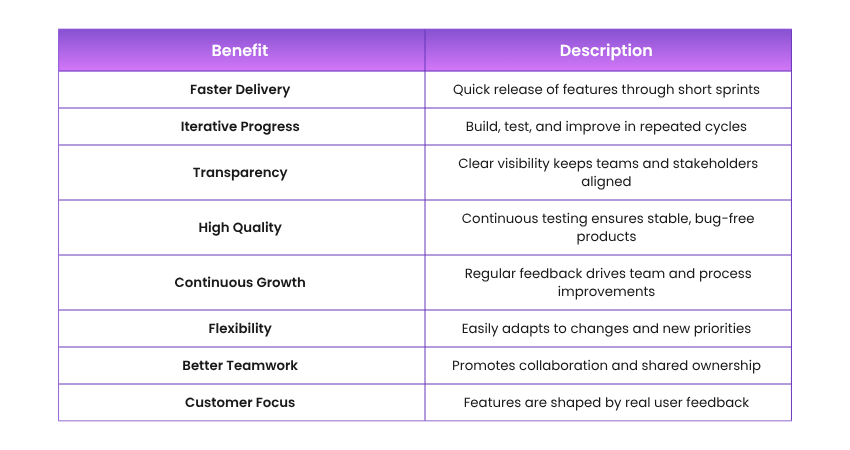
1) Faster Delivery
Agile promotes faster delivery by breaking projects into smaller, manageable tasks. Teams can quickly develop, test, and release functional features, allowing stakeholders to see results sooner and providing opportunities for early feedback and timely adjustments.
2) Iterative Development
Agile uses short, repetitive development cycles called sprints. This allows teams to constantly refine and improve the product, making it easier to adapt to changes and deliver incremental value throughout the project life cycle.
3) Transparency
Agile encourages open communication and regular progress updates through daily stand-ups, sprint reviews, and visual boards. This ensures all team members and stakeholders are aligned, aware of project status, and involved in decision-making.
4) Quality Assurance
Testing is integrated into every sprint in Agile, allowing for continuous validation of the product. Frequent reviews and early bug detection help maintain high-quality standards and ensure that each feature meets the required specifications.
5) Continuous Improvement
Agile supports continuous improvement through regular retrospectives where teams reflect on what worked and what didn't. This ongoing learning helps enhance processes, strengthen collaboration, and improve overall project performance over time.
6) Agile Methods are Adaptable
Agile methods easily adapt to changing project requirements. Teams can adjust priorities, shift focus, and embrace new ideas quickly, ensuring the final product stays relevant and aligned with evolving customer and business needs.
Start leading high-impact projects – Our Introduction to Project Management Training opens the door. Join today!
7) Agile Fosters Collaborative Teamwork
Agile builds a strong culture of teamwork by encouraging collaboration among cross-functional teams. Developers, testers, designers, and stakeholders work closely together, ensuring better communication, faster problem-solving, and shared ownership of project success.
8) Agile Methods Focus on Customer Needs
Agile keeps the customer at the centre of development by gathering feedback early and often. This customer-focused approach ensures that the delivered product meets real-world needs and provides maximum value to end users.
Limitations of Agile Methodology
While Agile offers many benefits, it's not a perfect fit for every project or organisation. Here are some of its limitations:
1) High customer involvement is needed, which may not always be possible
2) Hard to predict timelines and costs due to ongoing changes
3) Not ideal for inexperienced or rigid teams
4) Minimal documentation can cause issues in maintenance or compliance
5) The risk of scope becomes high if changes aren't controlled properly
6) Less suited for regulated or large-scale projects
7) Requires cultural and mindset shifts, which can face resistance
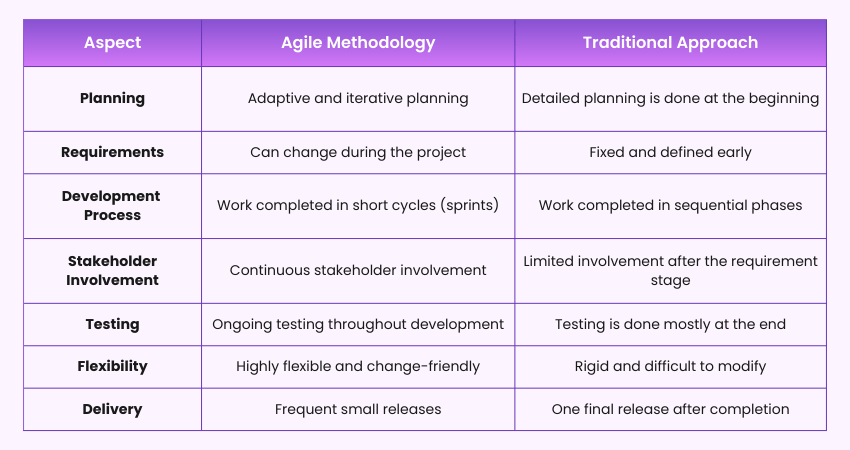
Agile Methodologies vs Traditional Approaches
Agile and traditional Project Management approaches differ mainly in how they plan, execute, and deliver work. Traditional methods, often called the Waterfall approach, follow a fixed sequence of stages, while Agile focuses on flexibility, collaboration, and continuous improvement.
The choice between them depends on project complexity, requirement stability, and the need for adaptability. Now that you have a solid understanding of What is Agile Methodology, here is a detailed difference between Agile Methodologies and Traditional Approaches:
Conclusion
Agile continues to shape how modern teams deliver products with speed, flexibility and strong customer focus. Understanding What is Agile Methodology gives professionals the tools to embrace change, improve collaboration and deliver value that truly matters. Whether you are new to Agile or looking to refine your approach, adopting its principles can transform how your team works and succeed in today's fast-moving world.
Gain globally recognised Project Management expertise for success with industry-leading PRINCE2 Training today!
Frequently Asked Questions
What is Agile vs Scrum?
Agile is a Project Management philosophy based on flexibility, collaboration, and iterative delivery. Scrum is a specific Agile framework that implements these principles through defined roles, events, and time-boxed sprints. In simple terms, Agile is the overall mindset, while Scrum is one structured way to apply it.
What are the Three Roles in Agile?
In Scrum-based Agile teams, the three primary roles are the Product Owner, Scrum Master, and Development Team. The Product Owner manages requirements and priorities, the Scrum Master facilitates the process and removes obstacles, and the Development Team builds, tests, and delivers the product increment.
When Should Agile not be Used?
Agile may not be useful for projects with fixed requirements, strict regulations, or limited stakeholder availability. It is less effective when the scope cannot change and documentation must be clear, or teams lack collaboration experience.



 Continue Browsing