Contact@prince2training.co.uk
 01344203999




 Back
Back


Table of Content


03-Jul-2026

Veronica Davis
Projects often fail because responsibilities are unclear. When multiple team members assume someone else is handling a task, delays, confusion, and communication breakdowns can quickly follow. Understanding What is a RACI Chart can help organisations eliminate this uncertainty by clearly defining roles and expectations across every stage of a project.
Whether you're leading a small initiative or managing a large cross-functional team, knowing What is a RACI Chart can improve accountability, collaboration, and project efficiency. In this blog, you will explore the core RACI roles, the steps to create a RACI Chart, its benefits, examples, and more. So, let’s begin!
Table of Contents
1) What is a RACI Chart?
2) 4 Core RACI Chart Roles
3) How to Make a RACI Chart: A Step-by-step Guide
4) Pros and Cons of RACI Matrix
5) RACI Alternatives
6) RACI Chart Examples
7) Conclusion
What is a RACI Chart?
The RACI Chart, also known as the RACI matrix, is a Project Management framework that outlines roles and responsibilities for every task within a project. It ensures accountability and clarity by categorising team members into four key roles: Responsible, Accountable, Consulted, and Informed.
Think of a RACI Chart like the cast list of a play. Without clear roles, you might have five people delivering the same line—or worse, no one saying it at all. It prevents role overlap, ensures accountability, and streamlines workflows, making it a must-have for complex projects.

4 Core Roles of RACI
The RACI Chart is a structured approach to defining roles and responsibilities within a project. It categorises team members into four distinct roles: Responsible, Accountable, Consulted, and Informed. Let’s break down each category with greater clarity and depth.
1) Responsible (R)
The Responsible party is the doer—the person (or team) actually getting their hands dirty with the task. They are the action-takers, the movers and shakers. If this were a restaurant, they’d be the chefs in the kitchen, making sure orders get cooked to perfection.
Example: In a website redesign project, the UI/UX Designer assigned to create wireframes would be Responsible for developing and delivering the wireframe designs.
2) Accountable (A)
The Accountable person is the final decision-maker. They ensure the work gets done properly and approve the completed task. Think of them as the head chef, ensuring the dishes meet quality standards before they go out to customers.
Example: The Project Manager overseeing the website redesign would be Accountable for approving the wireframes before passing them on for development.
3) Consulted (C)
The Consulted group includes subject-matter experts or stakeholders whose input is essential. They don’t do the work but provide guidance, suggestions, or approvals. This could be the nutritionist advising a restaurant on how to create a healthy menu.
Example: A Marketing Manager might be consulted to ensure branding consistency before the wireframes are finalised. Their input helps align the design with the company’s visual identity and messaging.
4) Informed (I)
The Informed parties need to be kept in the loop but don’t actively contribute. They need updates, but they don’t get a say in the process. These are the customers who receive their food but don’t have a say in how it's cooked.
Example: The customer support team might be informed about website updates so they can anticipate and prepare for customer inquiries. While they don’t contribute to the design, staying informed helps them assist users effectively.
How to Make a RACI Chart: A Step-by-step Guide
Now, let us take a closer look at the step-by-step process of creating a RACI Chart, which is a valuable framework for defining roles and responsibilities within a project or organisation.
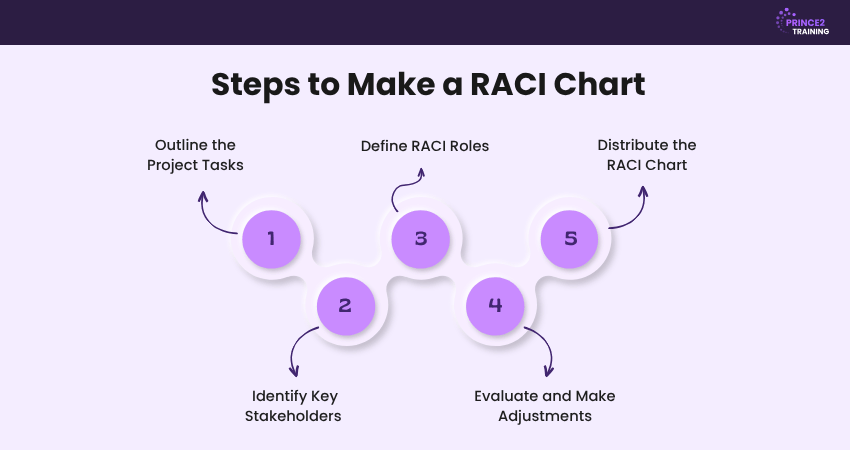
Step 1: Outline the Project Tasks
Start by listing all the key tasks in your project. Think of this as your project grocery list—if you don’t write it down, you’re bound to forget something important.
A well-detailed task list ensures that nothing is left out. Every minor step, from research to execution, should be documented. This provides a clear map for everyone involved.
Example: For a product launch, tasks might include market research, content creation, social media promotion, and product testing.
Step 2: Identify Key Stakeholders
Who’s involved? Create a list of everyone playing a role in the project—your marketers, developers, executives, designers, and anyone else who needs to be included.
Ensuring that all relevant stakeholders are included helps avoid bottlenecks later. Having the right people involved at the right time makes decision-making smoother.
Example: In a marketing campaign, the key stakeholders might include the marketing team, designers, sales department, and external advertising agencies.
Step 3: Define RACI Roles
Now, assign Responsible, Accountable, Consulted, and Informed roles for each task. Be cautious—having too many Accountable people leads to confusion, and having too few Responsible individuals can delay execution.
A balanced role assignment keeps the workflow smooth. Having a clear distinction between decision-makers and action-takers ensures efficiency.
Example: In a Software Development project, developers would be Responsible, the Product Manager Accountable, testers consulted, and the executive board informed.
Step 4: Evaluate and Make Adjustments
Take a step back and review the chart. Do you have clear ownership? Are there gaps or overlaps? It’s like adjusting the seasoning in a dish, making sure the balance is just right.
Reviewing the assignments with stakeholders ensures there are no conflicts or gaps. Regular updates may be required as the project progresses.
Example: If a task has multiple Accountable roles, streamline it by choosing a single person for final approval while others remain Consulted.
Step 5: Distribute the RACI Chart
Share it with your team and make sure everyone understands their role. A RACI Chart is only useful if everyone’s on board otherwise, it’s just another spreadsheet gathering dust.
Hold a meeting to explain the chart and answer questions. A clear briefing ensures alignment and prevents misunderstandings.
Example: In an HR restructuring process, sharing the RACI Chart with department heads can help clarify new responsibilities and ensure a smooth transition.
Build the skills needed to ace the PMP® Exam with the PMP® Exam Prep Boot Camp – Join now!
Pros and Cons of RACI Matrix
While this framework enhances clarity and accountability, it also has its limitations. Understanding its benefits and challenges can help teams implement it effectively. Now, let’s break down the key advantages and potential drawbacks of using RACI.
Pros
Here are the pros of the RACI Matrix:
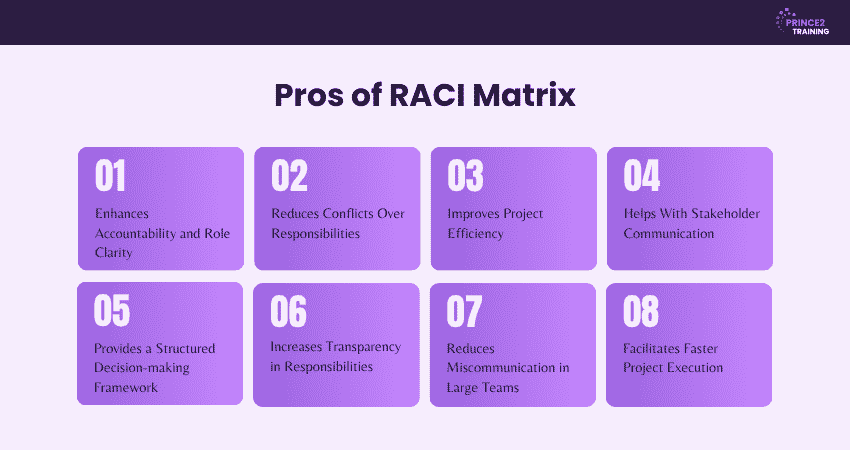
1) Enhances Accountability and Role Clarity
a) Clearly defines roles, preventing confusion over task ownership.
b) Eliminates ambiguity by designating Responsible, Accountable, Consulted, and Informed roles.
c) Ensures no tasks are overlooked or duplicated.
d) Fosters a culture of accountability, improving team performance and efficiency.
2) Reduces Conflicts Over Responsibilities
a) Prevents disputes by clearly delineating who is responsible for what.
b) Reduces task overlaps and eliminates uncertainty in role assignments.
c) Minimises potential disagreements through well-documented responsibilities.
d) Helps project leaders swiftly resolve misunderstandings before they escalate.
3) Improves Project Efficiency
a) Streamlines workflows by systematically assigning duties.
b) Reduces duplication of work and unnecessary delays.
c) Ensures smooth collaboration by clarifying approvals and consultations.
d) Enables teams to work more efficiently and stay on track with deadlines.
4) Helps With Stakeholder Communication
a) Clearly defines stakeholder involvement, preventing unnecessary interference.
b) Ensures that relevant updates reach the right people at the right time.
c) Keeps decision-makers engaged without overwhelming them with excessive details.
d) Enhances coordination between project teams and external stakeholders.
5) Provides a Structured Decision-making Framework
a) Defines clear authority for approvals, ensuring smoother decision-making.
b) Clarifies who provides input, who makes decisions, and who needs to be informed.
c) Prevents bottlenecks by eliminating uncertainty in responsibility chains.
d) Aligns decisions with project goals, enhancing strategic planning.
6) Increases Transparency in Responsibilities
a) Provides a structured overview of each team member’s role.
b) Ensures all stakeholders have visibility into the project’s structure.
c) Reduces misunderstandings and improves collaboration.
d) Fosters trust and alignment within the team.
7) Reduces Miscommunication in Large Teams
a) Serves as a centralised reference to prevent role confusion.
b) Helps large teams stay aligned on responsibilities and expectations.
c) Minimises errors caused by unclear role assignments.
d) Ensures seamless coordination across different departments and teams.
8) Facilitates Faster Project Execution
a) Eliminates delays caused by unclear responsibilities and approvals.
b) Ensures tasks progress smoothly from one stage to the next.
c) Reduces dependencies that could slow down workflow.
d) Helps teams make quicker, more informed decisions while maintaining quality.
Build a strong foundation in structured Project Management with the PRINCE2® Foundation Training – Join now!
Cons
Now, let us look at the disadvantages of using RACI:
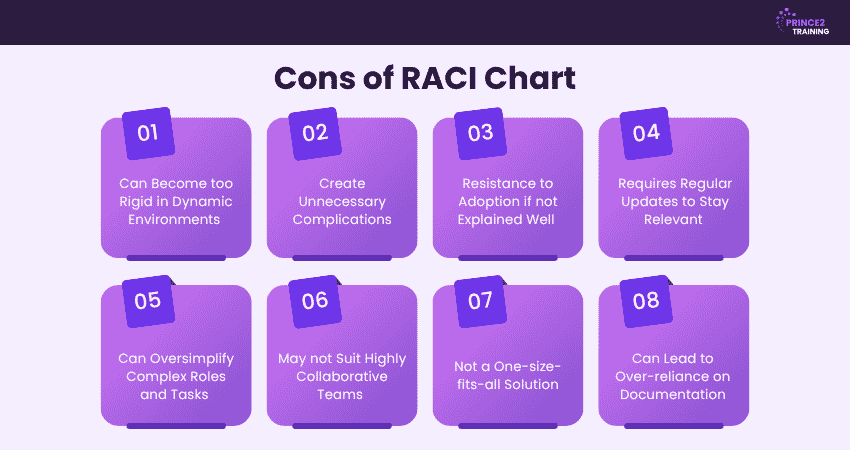
1) Can Become Too Rigid in Dynamic Environments
a) Limits flexibility in fast-paced projects where roles need to shift quickly.
b) Can slow down decision-making when quick adaptability is required.
c) May frustrate teams that thrive in less structured work environments.
d) Works best in stable projects but may not suit highly Agile teams.
2) Create Unnecessary Complications
a) Excessive detail can create an unnecessary administrative burden.
b) Too many assigned roles can slow down processes instead of streamlining them.
c) Risk of micromanagement if approvals become overly complex.
d) Should be kept simple to maintain efficiency and avoid bottlenecks.
3) Resistance to Adoption if Not Explained Well
a) Teams may see it as extra work if the benefits aren’t clearly communicated.
b) Misunderstanding the framework can lead to improper implementation.
c) Without proper training, employees might resist using it.
d) Requires a clear explanation to show how it improves workflow and accountability.
4) Requires Regular Updates to Stay Relevant
a) Project roles evolve, making outdated charts ineffective.
b) Can cause confusion if responsibilities don’t reflect real-time changes.
c) Needs ongoing review to remain a useful Project Management framework.
d) Should be updated regularly to align with shifting priorities and team dynamics.
5) Can Oversimplify Complex Roles and Tasks
a) Some responsibilities may not fit neatly into one RACI category.
b) Complex projects may require more nuanced role definitions beyond RACI’s scope.
c) May lead to oversights if a task involves multiple overlapping responsibilities.
d) Can sometimes fail to capture the depth of collaboration needed for certain tasks.
6) May not Suit Highly Collaborative Teams
a) Teams that emphasise open collaboration may find strict role assignments restrictive.
b) Can create unnecessary silos if team members strictly adhere to their RACI roles.
c) Might limit the ability of employees to contribute beyond their assigned responsibilities.
d) Works best in hierarchical structures but can be challenging in cross-functional teams.
7) Not a One-size-fits-all Solution
a) May not be applicable for all industries or project types.
b) Some teams may require more flexible responsibility models than RACI provides.
c) Works well for structured workflows but may not suit creative or experimental projects.
d) Organisations may need to modify or supplement RACI with other frameworks.
8) Can Lead to Over-reliance on Documentation
a) Encourages process-driven decision-making, which can slow down responsiveness.
b) Team members may focus too much on RACI Charts instead of real-time collaboration.
c) May discourage informal communication, leading to unnecessary formalities.
d) Works best when used as a guideline, not a rigid rulebook.
Want to excel in Project Management? Become a leader with our
Certified Associate in Project Management Course (CAPM®)
- Register Now!
RACI Alternatives
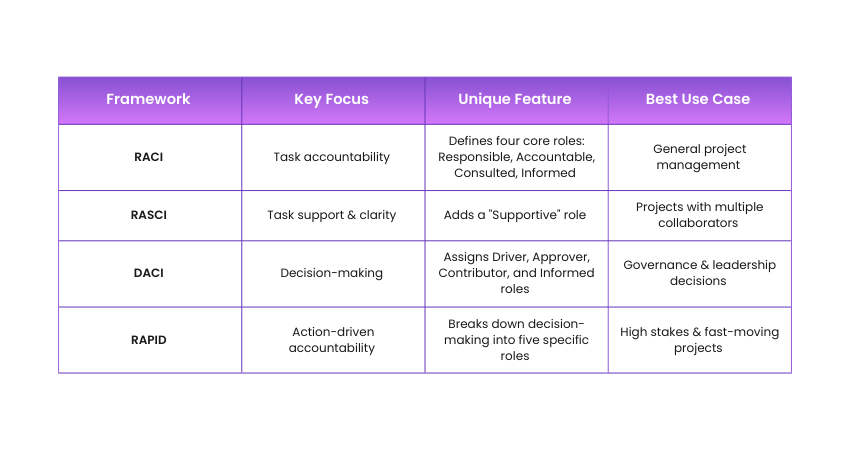
While RACI is a great framework, it’s not the only option. Here are some alternatives:
RASCI
RASCI is an extension of RACI that introduces a Supportive role to add extra clarity to task assignments. The Supportive role includes individuals who assist the Responsible party but do not have direct accountability.
This framework helps when multiple stakeholders contribute to a task but do not hold final decision-making power. It ensures that responsibilities are better distributed, reducing bottlenecks and confusion in execution.
DACI
DACI is specifically designed for decision-making processes, making it an excellent choice for governance and leadership-driven projects. The framework assigns a Driver who ensures progress, Approvers who make final decisions, Contributors who provide input, and Informed parties who are kept updated.
This method is particularly effective in Agile environments where quick and structured decision-making is critical for success.
RAPID
RAPID focuses on action-driven accountability, ensuring every process step has a designated owner. It stands for Recommend, Agree, Perform, Input, and Decide, assigning clear roles in the decision-making and implementation cycle.
By structuring accountability around actions rather than static roles, RAPID is beneficial in high-stakes projects where execution speed and precision are paramount.
Comparison of RACI Alternatives
RACI Chart Examples
To better understand how a RACI Chart works in practice, let's look at two common project scenarios. These examples show how responsibilities can be assigned clearly to improve accountability, collaboration, and project execution. Let’s look at them below:
Example 1: Creating a White Paper
Imagine a marketing team preparing a white paper to support a product launch. Multiple contributors are involved, making it important to define ownership and communication responsibilities.
Roles Involved:
a) Writer
b) Editor
c) SEO Specialist
d) Chief Marketing Officer (CMO)
Key Responsibilities:
a) Research and content creation
b) Editing and quality review
c) SEO and keyword optimisation
d) Publication and stakeholder communication
RACI Assignments:
a) R (Responsible): The writer conducts research and prepares the content.
b) A (Accountable): The editor oversees quality, accuracy, and final approval.
c) C (Consulted): The SEO specialist provides input on keywords and optimisation.
d) I (Informed): The CMO receives updates on progress and publication status.
Example 2: Building a Software Application
Software Development projects often involve multiple teams working simultaneously. A RACI Chart helps ensure everyone understands their role throughout the development lifecycle.
Roles Involved:
a) Project Manager
b) UI/UX Designer
c) Developers
d) Testers
e) DevOps Engineer
f) Technical Writer
Key Responsibilities:
a) Defining project requirements
b) Designing user journeys and interfaces
c) Developing application features
d) Conducting testing and quality assurance
e) Managing deployment and infrastructure
f) Creating technical documentation
RACI Assignments:
a) R (Responsible): Developers build the application.
b) A (Accountable): The Project Manager (or Product Manager) is accountable for successful delivery.
c) C (Consulted): Testers, UI/UX Designers, and Technical Writers provide input throughout development.
d) I (Informed): Business stakeholders receive updates on progress, releases, and milestones.
Conclusion
A RACI Chart is a valuable tool for improving accountability, communication, and collaboration in projects. Clearly defining roles and responsibilities, it helps teams reduce confusion, make informed decisions, and work efficiently. Understanding What is a RACI Chart can help organisations create clearer workflows and achieve better project outcomes consistently.
Learn industry-standard Project Management best practices with the Project Management Professional (PMP)® Training – Sign up now!
Frequently Asked Questions
What Does a Good RACI Look Like?
A good RACI Chart is clear, simple, and easy to understand. The RACI Chart clearly shows who is responsible for completing tasks, who is accountable for outcomes, and who should be consulted or informed.
Is RACI Outdated?
No, RACI is not outdated. While modern teams use more flexible ways of working, the RACI Chart remains a valuable tool for clarifying roles and responsibilities. RACI Chart is particularly effective for complex projects where clear accountability, communication, and decision-making are essential.
What is the Golden Rule of RACI?
The golden rule of RACI is that each task should have only one accountable person. Having a single owner for the outcome ensures clear accountability, reduces confusion, prevents overlapping responsibilities, and supports effective decision-making.



 Continue Browsing