01344203999




 Back
Back


Table of Content

09-Jun-2026

Veronica Davis
Have you ever wondered how a business not just survives but thrives? Or, What are Business Improvement Techniques? They are the arsenal that empowers organisations to dissect, analyse, and enhance their operations. But what exactly falls under this umbrella, and how can they catalyse your company's growth?
This blog is your gateway to understanding What are Business Improvement Techniques, and how they can transform your business from the inside out. Be it streamlining processes, cutting costs, or improving customer satisfaction, these techniques are the blueprint for success. Let's dive in to unravel the strategies that can make your business not just better but the best in its class.
Table of Contents
1) Introduction to Business Improvement Techniques
2) Different Business Improvement Techniques
3) Key Elements of Business Improvement Techniques
4) Conclusion
Introduction to Business Improvement Techniques
Business Improvement strategies are pivotal in pinpointing areas within your organisation that require refinement for enhanced performance. These strategies employ a systematic method to identify, analyse, and implement enhancements across various facets of a business.
The commitment to these techniques lies in their ability to boost efficiency, improve quality, and drive innovation, all while aiming for sustainable growth and a competitive market advantage. Let's explore them in detail:
1) Continuous Improvement Methodologies
At the heart of Business Improvement Techniques is the principle of continuous improvement, encapsulated by philosophies such as Kaizen, Lean Thinking, and Six Sigma. These approaches champion the pursuit of excellence through ongoing, incremental changes, underscoring that even minor adjustments can yield substantial gains in productivity, quality, and customer satisfaction.

2) Kaizen
Kaizen, translating to "change for the better," advocates for consistent, small-scale enhancements by all organisational members. It fosters a culture where continuous improvement is ingrained, and employee participation is crucial in problem identification and resolution.
3) Lean Thinking
Derived from Toyota's manufacturing approach, Lean Thinking is centred on waste reduction and value maximisation in processes. It focuses on delivering greater value to customers using fewer resources, thereby enhancing efficiency and profitability.
4) Six Sigma
Six Sigma is a data-centric methodology designed to reduce defects and process variability. Utilising statistical methods, it aims for a performance standard where a maximum of 3.4 defects per million opportunities is deemed acceptable.
Different Business Improvement Techniques
Here are 11 refined Business Improvement Techniques to revitalise your processes:
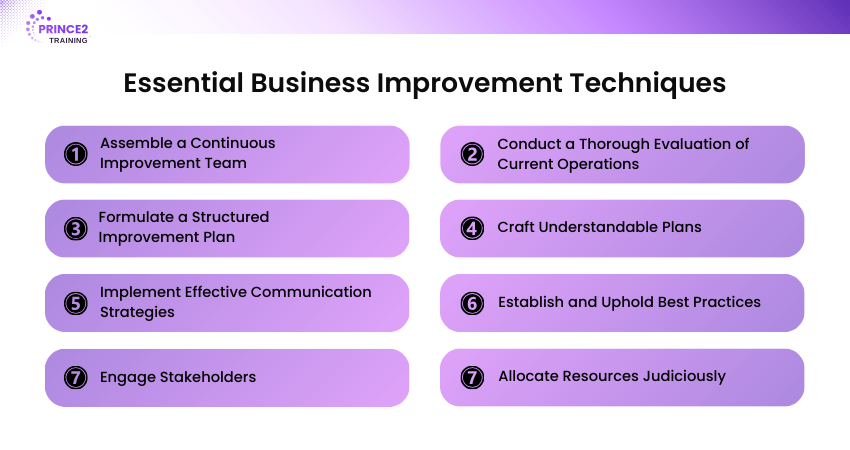
1) Incorporate diverse team members across the organisation, especially senior individuals, to gain insights into departmental functions and longstanding issues. Keep this team active post-implementation to ensure ongoing efficiency and address recurring problems.
2) Before initiating changes, conduct a comprehensive review of your current operations, noting strengths and weaknesses to inform areas of improvement and strategy development.
3) Adopt a systematic approach when crafting improvement plans, considering factors such as the specific problem, potential changes, implementation strategies, necessary tools, and resource availability.
4) Ensure your improvement plans are clear and jargon-free for easy comprehension across the organisation. Provide explanations for technical processes to avoid confusion and clarify the rationale behind each improvement.
5) Facilitate open communication within the organisation to gather feedback and ideas, which are crucial for the successful implementation and monitoring of Business Improvement Techniques.
6) Integrate industry-standard best practices into your operations to maintain consistency, reduce errors, and prevent productivity-decreasing misunderstandings among colleagues.
7) Keep stakeholders informed and, where appropriate, involve them in decision-making processes that could impact the company's operations or financial projections.
8) Survey employees and team leaders to identify the most beneficial resources and allocate them effectively to optimise processes.
9) Hold consistent meetings with various departments to assess the impact of changes and solicit feedback, adjusting the frequency based on organisational size and the scope of changes.
10) Promoting teamwork across different departments can be highly beneficial, as the roles of various teams often intersect. By fostering a collaborative environment, teams can support each other's objectives and uncover valuable lessons from across the organisation.
11) Diversity and inclusion offer manifold benefits to professionals, organisations, and clients. This multiplicity of viewpoints can enhance problem-solving and decision-making, positively impacting Business Improvement initiatives.
Boost your career to new heights by registering for our Six Sigma Green Belt Course —reserve your place today!
Key Elements of Business Improvement Techniques
For effective implementation of Business Improvement Techniques (BITs), organisations must consider several essential elements:
1) Process Analysis and Mapping
The cornerstone of any improvement initiative is the thorough understanding and documentation of current processes. This step involves detailing inputs, outputs, and stakeholders and identifying potential bottlenecks.
Process maps are invaluable tools that visually highlight areas ripe for improvement. Applications of Process Analysis and Mapping include:
a) Spotting Inefficiencies: Businesses can use process analysis to detect inefficiencies, redundancies, and bottlenecks, setting the stage for targeted improvements.
b) Workflow Visualisation: Creating visual workflow diagrams simplifies the comprehension of task flows and interactions, aiding in pinpointing optimisation opportunities.
c) Baseline Metrics Establishment: This practice sets the standard for performance metrics, allowing for the measurement of improvement impacts over time.
d) Compliance and Standardisation: Ensuring operations adhere to industry regulations and maintaining standardised procedures for consistent quality.
2) Performance Metrics and Key Performance Indicators (KPIs)
Defining and tracking clear performance metrics is crucial. KPIs help businesses monitor progress and assess the effectiveness of improvement measures, encompassing metrics like customer satisfaction, cycle times, and defect rates. Performance metrics are utilised for:
a) Strategic Goal Alignment: KPIs ensure business operations are in sync with overarching strategic goals, guiding improvement efforts towards desired results.
b) Progress Monitoring: They provide immediate feedback on performance, facilitating prompt adjustments and corrective actions.
c) Improvement Area Identification: KPIs spotlight areas needing attention or falling short of standards, focusing improvement initiatives where most impactful.
d) Target Setting and Benchmarking: Serving as benchmarks, KPIs enable businesses to gauge their performance and set achievable targets for improvement projects.
3) Root Cause Analysis
Unearthing the fundamental reasons behind problems or inefficiencies is vital for devising effective solutions. Methods like the "5 Whys" and Fishbone diagrams are instrumental in digging into the core of issues. Root Cause Analysis is crucial for:
a) Issue Recurrence Prevention: Addressing the root causes helps prevent future occurrences of the same problems.
b) Data-driven Decisions: It relies on data to identify the true origins of issues, ensuring improvements are fact-based.
c) Solution Prioritisations: This analysis aids in ranking solutions by their potential impact on the root cause, optimising resource allocation.
d) Problem-solving Skill Enhancement: It promotes a culture of analytical thinking and proactive problem resolution within the organisation.
Grab the chance to upgrade your abilities with our Lean Six Sigma Green Belt Course—sign up today!
4) Change Management
Improvements often necessitate changes in processes, technologies, or organisational structures. Effective change management is key to ensuring employees are ready and willing to embrace these changes. Change Management is applied through:
a) Employee Engagement and Adoption: It secures employee involvement in the improvement process, enhancing the chances of successful change adoption.
b) Resistance Mitigation: Structured change management anticipates and addresses resistance, smoothing the transition.
c) Productivity Maintenance: It minimises operational disruptions, maintaining productivity during improvement implementations.
d) Sustainability Assurance: Change management helps maintain long-term improvements, fostering an environment of ongoing adaptation and growth.
5) Employee Involvement and Training
Employees are integral to an organisation, and their active participation in improvement initiatives is invaluable. Training and knowledge-sharing platforms empower them to share expertise and ideas. Employee Involvement and Training is essential for:
a) Leveraging Expertise: Tapping into the knowledge employees have about their roles and processes maximises the effectiveness of improvements.
b) Cultivating Continuous Improvement: Training instils a mindset of ongoing enhancement, motivating employees to seek improvement opportunities.
c) Morale and Motivation Boost: Involvement in initiatives elevates employee morale and motivation, fostering a sense of ownership and pride.
d) Skill Development: Training equips employees with the necessary skills to adapt to and implement changes effectively.
By embracing these critical components of BITs, businesses can methodically identify, tackle, and maintain enhancements throughout their operations, propelling growth, innovation, and a competitive edge.
Conclusion
This blog on What are Business Improvement Techniques can be the launch pad for your company's transformative journey. With these potent strategies in hand, you're well-equipped to raise the bar for your operations. Adopt these methods and witness your business transform into an exemplar of efficiency and effectiveness, setting a benchmark for others in the industry.
Become a top-tier professional by joining our extensive Lean Six Sigma Black Belt Course – sign up today!



 Continue Browsing