Contact@prince2training.co.uk
 01344203999



 Back
Back


Table of Content

08-Jul-2026

Rose Alfred
Think about the last time an IT issue disrupted your work. Delayed support, recurring outages, or unclear processes can quickly affect productivity and customer experience. This is where the Benefits of ITIL become clear, helping organisations build a structured, reliable, and efficient approach to IT service management.
From streamlining workflows to supporting continuous improvement, ITIL provides a proven framework that helps organisations deliver consistent, high-quality services while adapting to changing business needs. In this blog, you will learn about what is ITIL and the Benefits of ITIL. Let’s begin!
What is ITIL?
ITIL, short for Information Technology Infrastructure Library, is a globally recognised framework that provides best practices for IT Service Management (ITSM) and IT Asset Management (ITAM). It helps organisations align IT services with business goals through structured processes, procedures, and guidelines that can be applied across different industries and technologies.
Originally developed by the UK Government's Central Computer and Telecommunications Agency (CCTA) in the 1980s. ITIL has evolved to support modern approaches such as Agile, DevOps, and Lean practices. Today, organisations worldwide use ITIL to improve service consistency, strengthen collaboration, and manage IT services more efficiently.

What are the Benefits of ITIL?
Understanding the Benefits of ITIL helps businesses improve efficiency, strengthen service management, and adapt to changing demands. Let’s look at some of its key benefits below:
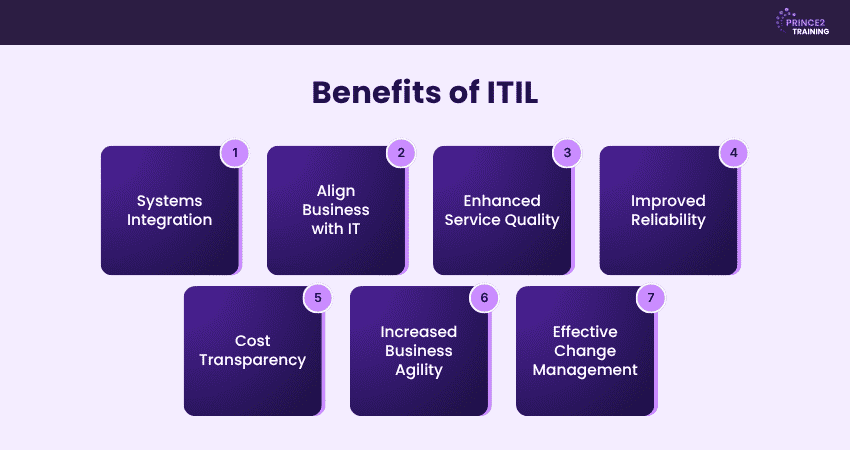
1) Systems Integration
ITIL integrates well with third-party tools and other management frameworks, creating smoother workflows across departments. This improves collaboration, increases visibility into IT operations, and helps teams work more efficiently towards shared goals.
2) Align Business with IT
ITIL helps align IT services with business objectives by ensuring technology supports organisational priorities. This enables IT teams to move beyond technical support and contribute strategically to business growth, decision-making and long-term success.
3) Enhanced Service Quality
ITIL focuses on delivering services that meet agreed service levels and customer expectations. By monitoring performance and managing customer relationships effectively, organisations can improve service availability, responsiveness, and user satisfaction.
4) Improved Reliability
ITIL introduces structured incident, problem, and service management processes that reduce downtime and improve system stability. By identifying root causes and preventing recurring issues, organisations can deliver dependable and consistent IT services.
Bridge the gap to modern service management and stay ahead of every service challenge with the
ITIL® Version 5 Foundation Bridge Training
– Sign up today!
5) Cost Transparency
ITIL enables organisations to monitor IT service costs using clear processes and measurable performance data. This improves budget planning, prevents unnecessary spending, and supports informed financial decisions that maximise the value of IT investments.
6) Increased Business Agility
ITIL helps organisations respond quickly to changing business needs, emerging technologies, and customer expectations. Its practices encourage continual improvement, enabling businesses to innovate faster while maintaining reliable IT services.
7) Effective Change Management
ITIL provides a structured approach to planning, reviewing, and implementing changes with minimal disruption. It improves control over IT changes through proper documentation, risk assessment, and approval processes.
Conclusion
As technology continues to evolve, organisations need a reliable framework to deliver consistent and high-quality IT services. Understanding the Benefits of ITIL helps businesses improve efficiency, strengthen service management, and adapt to changing demands, making IT a valuable driver of long-term business success.
Learn to turn IT excellence into everyday success by signing up for the ITIL Courses today!
Frequently Asked Questions
What are the Seven Key ITIL Practices?
The seven key ITIL practices are:
a) Incident Management
b) Problem Management
c) Change Enablement
d) Service Request Management
e) Service Desk
f) Service Level Management
g) Continual Improvement
What's the Difference Between ITSM and ITIL?
ITSM is the approach to managing and delivering IT services that support business goals. In contrast, ITIL is a best practice framework that provides structured guidance for implementing ITSM effectively. Simply put, ITSM defines the objective, while ITIL provides the roadmap to achieve it.
What are the Six Value Chain Activities in ITIL?
The six value chain activities in ITIL are:
a) Plan: Define strategy and direction
b) prove: Drive continual enhancements
c) Engage: Collaborate with stakeholders
d) Design & Transition: Develop and introduce services
e) Obtain/Build: Acquire or create required resources
f) Deliver & Support: Operate services and provide ongoing user support



 Continue Browsing