Contact@prince2training.co.uk
 01344203999




 Back
Back


Table of Content


05-Oct-2026

David Walter
Have you ever started a project and felt like everyone was speaking a different language? One person talks about suppliers, another about customers, while someone else is buried in the process steps. It’s easy for things to get messy fast. That’s exactly where a SIPOC Diagram comes in handy. It’s a simple but powerful tool that pulls all these pieces together into one clear picture.
Instead of chasing scattered details, you can see who’s involved, what resources are needed, and what the end result should look like. In this blog, we’ll break down how SIPOC works, why it matters, and how you can use it to make business processes smoother, smarter, and more successful.
Table of Contents
1) What is a SIPOC (Suppliers, Inputs, Process, Outputs, Customers) Diagram?
2) What are SIPOC Diagrams Used for?
3) How to Create a SIPOC Diagram in Seven Steps?
4) Benefits of Using SIPOC Diagrams
5) Conclusion
What is a SIPOC (Suppliers, Inputs, Process, Outputs, Customers) Diagram?
A SIPOC Diagram is a powerful visual tool used in process improvement and Project Management. It provides a structured way to capture the key parts of any workflow at a glance. Understanding what SIPOC Diagram is involves a firm grasp on the following key elements of a process:
1) Suppliers
: Those who provide inputs
2) Inputs
: Resources needed for the process
3) Process
: The steps involved
4) Outputs
: The results of the process
5) Customers
: Those who receive the outputs
This diagram helps teams understand the process flow, identify potential issues, clarify roles and responsibilities and more. It's a high-level view that helps you in process mapping and can be a starting point for more detailed analysis.

What are SIPOC Diagrams Used for?
A SIPOC Diagram is part of the “define” phase in the DMAIC process which is short for Define, Measure, Analyse, Improve, Control. Even if you’re not working on Six Sigma, SIPOC Diagrams are still very useful for:
1) Explaining a Business Process
: They give a clear, high-level overview that helps new employees or stakeholders understand how a process works.
2) Keeping Team Members Aligned
: Creating a SIPOC at the start of a project helps you frame discussions and ensure everyone is on the same page.
3) Clarifying Process Parts
: Building one prompts teams to identify suppliers, customers, and key requirements, making it easier to spot areas for improvement.
Using a SIPOC Diagram with your team can help answer questions like:
1) How can we make this process simpler?
2) Are we providing a quality product to customers?
3) Can we manage our suppliers better?
4) Are suppliers meeting our needs?
5) Do we clearly understand our customers and their needs?
6) Where are the inefficiencies in our process?
You can try out some SIPOC templates in this
link.
Lay the groundwork for greatness with our
PRINCE2® Foundation Course
- Register now and set the stage for assured project success!
How to Create a SIPOC Diagram in Seven Steps?
Creating a SIPOC Diagram doesn’t always require you to follow the acronym in order. Many teams start with the process section, since it’s often the easiest, and then move on to the others. Here are the steps to take to craft the ideal SIPOC Diagram:
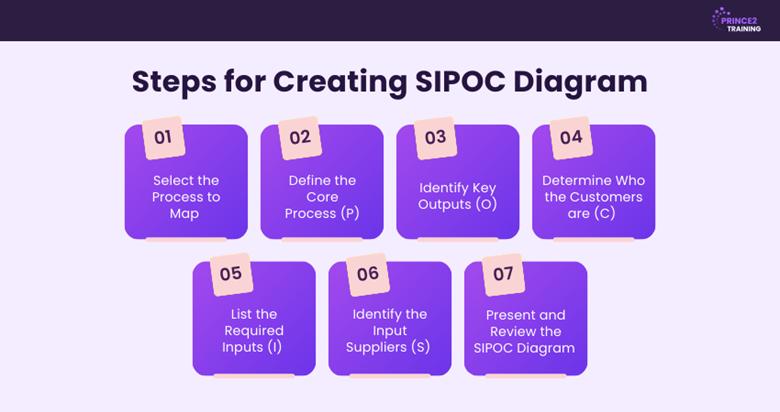
1) Select the Process to Map
Pick the process you want to map. It could be a new process you’re planning or an existing one you want to improve. A SIPOC Diagram gives you a crystal clear overview and helps spot problems.
For example, imagine you want to improve your Customer Returns process. A SIPOC Diagram can help you map out each step. From suppliers providing return labels, to inputs like packaging and systems, to outputs such as refunds or replacements.
2) Define the Core Process (P)
Start with the 'Process' section and outline four to five high-level steps. Keep it simple and focus on the main actions rather than detailed tasks. For example, in the case of a Customer Returns process, here’s how the core process works:
1) Customer requests a return
2) Return label is issued
3) Customer ships product back
4) Warehouse inspects the item
5) Refund or replacement is processed
3) Identify Key Outputs (O)
Identify what the process produces. Outputs can be products, services or data/information. For a Customer Returns process, the outputs might include the customer receiving a refund or replacement and the business regaining returned inventory for restocking or inspection.
4) Determine Who the Customers are (C)
Customers are the people or groups who benefit from the outputs. They can be external, like online shoppers, or internal, like your team. For a Customer Returns process, the outputs might include the customer receiving a refund or replacement and the business regaining returned inventory for restocking or inspection.
5) List the Required Inputs (I)
Inputs are the resources needed for the process. These can include materials, data, or services. For a Customer Returns process, inputs could include the customer’s return request, a return label, shipping services, warehouse staff for inspection, and a payment system to process refunds or replacements.
6) Identify the Input Suppliers (S)
Suppliers provide the inputs you need. For a Customer Returns process, suppliers could include customers (for return requests), courier services (for product collection), warehouse staff (for inspections), and payment providers (for processing refunds).
7) Present and Review the SIPOC Diagram
Once created, share the SIPOC Diagram with your team and stakeholders. Make it easy to access, ideally through a Project Management tool, so everyone works from the same version and communication stays clear.
Master the hybrid Project Management approach of PRINCE2® and Agile in our
PRINCE2 Agile® Foundation and Practitioner Training
– Sign up now!
Benefits of Using SIPOC Diagrams
As explained above, a SIPOC Diagram is a useful tool that helps your team stay aligned when planning a project. It shows what resources you need and what it delivers to customers. Here are some key benefits of using SIPOC Diagrams:
1) Enhances Customer Service Delivery
Reviewing the diagram helps you spot gaps between what you deliver and what customers need, so you can improve your services. This ensures customer satisfaction stays at the heart of your process. It also builds long-term customer trust and loyalty.
2) Anticipating Project Requirements
It shows whether the suppliers and inputs match the outputs you want. Any issues can be fixed before starting the project, saving time and avoiding costly mistakes later. This preparation makes projects run smoother and boosts success rates.

3) Optimising Efficiency
The SIPOC Diagram helps you identify steps that don’t add value, making your process leaner and more effective. Streamlining processes also helps reduce wasted resources and improve overall productivity. Over time, this can lower costs and increase business profitability.
4) Educating Team Members
It’s a great way to explain processes to your team or stakeholders so they can contribute more effectively. This shared understanding builds stronger collaboration and smoother teamwork. It also helps new team members learn faster and adapt quickly.
Conclusion
More than a process map, think of a SIPOC Diagram as a lens that sharpens focus and simplifies complexity. By capturing the essentials of any workflow, it helps your team spot gaps and deliver real value. Embracing SIPOC means paving the way for smarter and smoother successful outcomes. It also creates a shared understanding that unites teams toward common goals.
Turn every project vision into unparalleled success stories. Sign up for our comprehensive PRINCE2® Training now!



 Continue Browsing