Contact@prince2training.co.uk
 01344203999




 Back
Back


Table of Content

17-Sep-2026

David Walter
In the modern business environment, successful projects depend on strong leadership, collaboration, and effective planning. However, many organisations still struggle to understand the difference between Agile-focused and traditional management roles. This is why Scrum Master vs Project Manager remains an important topic as more businesses adopt Agile, Scrum, and hybrid management approaches.
Imagine a product development team working under tight deadlines while managing changing customer requirements. In Scrum Master vs Project Manager, one role supports Agile teams and improves workflows, while the other focuses on planning, budgets, timelines, and project delivery. In this blog, you will learn the differences between a Scrum Master and a Project Manager and how each role contributes to better teamwork, efficiency, and project success.
Table of Contents
1) Who is a Scrum Master?
2) Who is a Project Manager?
3) Key Differences Between a Scrum Master and a Project Manager
4) When to Choose a Scrum Master vs Project Manager?
5) Conclusion
Who is a Scrum Master?
A Scrum Master is a professional who helps teams successfully follow Scrum principles and Agile practices during a project. They support the Scrum team by organising meetings, improving collaboration, and guiding team members on Scrum best practices to ensure smooth workflow and continuous improvement.
A Scrum Master is often called a “servant leader” because their focus is on supporting the team and removing obstacles that may affect progress. Apart from the Product Owner and Development Team, the Scrum Master is one of the three key roles in a Scrum team and plays an important part in delivering successful Agile projects.
What Does a Scrum Master Do?
A Scrum Master’s responsibility focuses on improving teamwork, removing obstacles, and helping the team work more efficiently. Some of their key responsibilities include:
a) Facilitating Scrum Meetings: Conducting daily stand-ups, sprint planning sessions, sprint reviews, and retrospectives to keep the team aligned and organised.
b) Removing Obstacles: Identifying and resolving issues that may slow down team progress and affect productivity during the project.
c) Coaching Agile Practices: Guiding team members on Scrum principles, Agile values, and best practices to improve project workflows.
d) Supporting Team Collaboration: Encouraging open communication, teamwork, and cooperation between team members and stakeholders.
e) Acting as a Servant Leader: Supporting the team’s needs, helping them stay focused, and creating a productive working environment for successful project delivery.

Who is a Project Manager?
A Project Manager is a professional responsible for planning, organising, and managing projects to ensure they are completed on time, within budget, and meet business goals. They coordinate teams, manage resources, and oversee project activities to keep work progressing smoothly.
They focus on maintaining project structure by ensuring all tasks align with the project’s objectives and deadlines. Also, Project Managers are responsible for managing risks, monitoring progress, communicating with stakeholders, and ensuring the outcome meets organisational expectations successfully.
What Does a Project Manager Do?
A Project Manager role focuses on coordinating teams, managing resources, and ensuring project goals are achieved efficiently. Some of their key responsibilities include:
a) Defining Project Scope and Goals: Setting clear project objectives, deliverables, and expectations to guide the team throughout the project lifecycle.
b) Managing Budgets and Schedules: Creating project timelines, allocating resources, and monitoring budgets to keep projects on track.
c) Leading Meetings and Communication: Conducting project meetings and maintaining clear communication between teams, stakeholders, and clients.
d) Creating Communication Plans: Ensuring project updates, changes, and progress reports are shared effectively with relevant stakeholders.
e) Managing Project Risks: Identifying potential risks, resolving issues, and implementing strategies to minimise project delays or challenges.

Key Differences Between a Scrum Master and a Project Manager
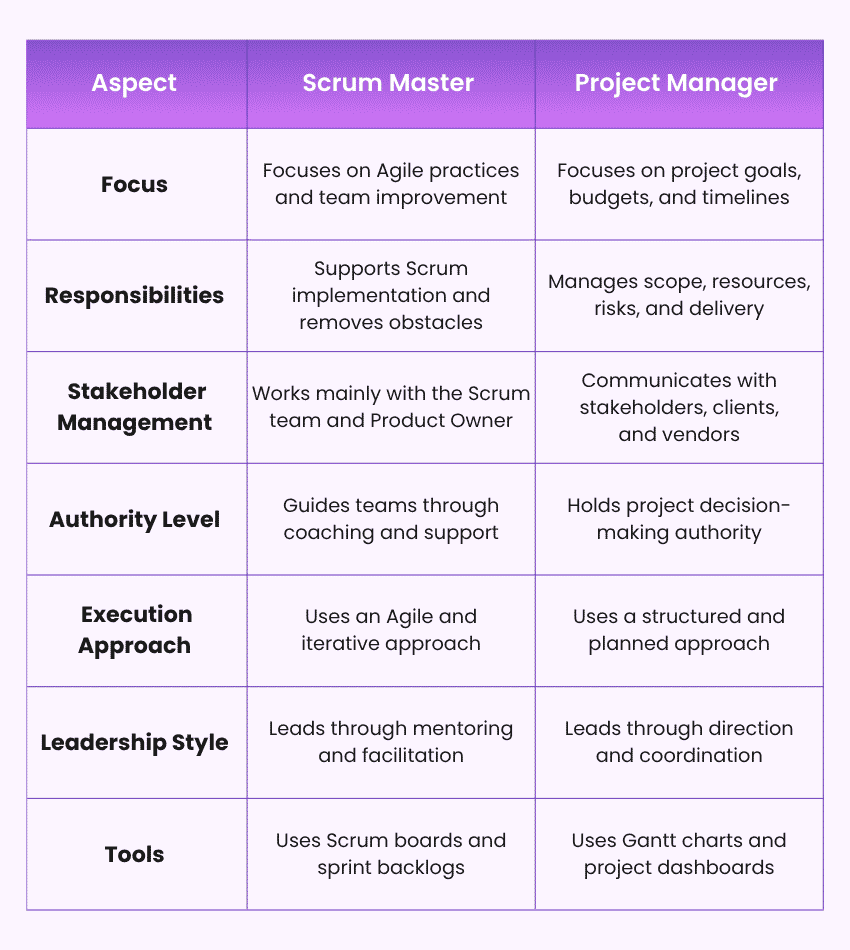
Both contribute to successful project delivery, but their responsibilities, leadership styles, and working approaches differ significantly. Understanding these differences helps organisations choose the right leadership approach for different project environments. Let’s look at them below for a clear understanding between Scrum Master vs Project Manager:
1) Focus
Scrum Masters focus on team collaboration, Agile practices, continuous improvement, and maintaining effective Scrum implementation. Their goal is to create a productive and adaptable working environment.
In contrast, Project Managers focus on achieving project objectives within scope, time, and budget constraints. They balance resources, risks, and stakeholder expectations to ensure controlled and successful project delivery.
2) Scope and Responsibilities
A Scrum Master’s primary focus is on improving team performance and ensuring Scrum principles are followed correctly. They support collaboration, remove obstacles, and help teams work more effectively within Agile environments. Their focus is more on how the work is completed.
In contrast, Project Managers oversee every aspect of a project delivery, including scope, budget, timelines, resources, communication, and risk management. They are responsible for ensuring the project achieves its goals and delivers the expected outcomes successfully.
3) Stakeholder Management
Scrum Masters mainly communicate with the Scrum team and the Product Owner. They facilitate daily stand-ups, sprint reviews, and retrospectives to improve teamwork, remove blockers, and maintain smooth project operations.
In contrast, Project Managers manage communication with a wider group of stakeholders, including clients, executives, vendors, and department heads. They provide project updates, manage expectations, and adapt communication styles based on stakeholder needs and project requirements.
4) Authority Level
A Scrum Master is a servant leader who guides and coaches the team instead of controlling it directly. They encourage self-organisation, shared ownership, and collaborative decision-making within the team.
In contrast, Project Managers hold formal decision-making authority within the project. They assign tasks, manage priorities, set deadlines, and make important decisions to ensure project goals are achieved effectively.
5) Execution Approach
Scrum Masters follow an Agile and iterative approach to project execution. They manage work through short development cycles, encourage continuous feedback, and adapt workflows based on changing requirements and team learning.
In contrast, Project Managers follow a more structured and planned approach to project execution. They create detailed project plans, define milestones, and ensure tasks are completed according to schedules, budgets, and project objectives.
Build strong Project Management fundamentals today with the
PRINCE2® Foundation Training!
6) Team Leadership and Facilitation
Scrum Masters lead through coaching, mentoring, and facilitation. They encourage problem-solving, transparency, and teamwork while helping team members take ownership of their work and responsibilities.
In contrast, Project Managers provide direct leadership by organising resources, assigning responsibilities, monitoring progress, and maintaining project direction. They ensure the team stays aligned with project goals and deadlines.
7) Tools
Scrum Masters use Agile-focused tools like Scrum boards, sprint backlogs, and burndown charts. These tools help teams track sprint progress, visualise workflows, and support continuous improvement during iterative development cycles.
In contrast, Project Managers depend on structured Project Management tools like Gantt charts, project schedules, and performance dashboards. These tools help manage timelines, risks, budgets, reporting, and overall project performance.
Learn to lead complex projects with greater confidence by joining the
PRINCE2® Practitioner Training
now!
When to Choose a Scrum Master vs Project Manager?
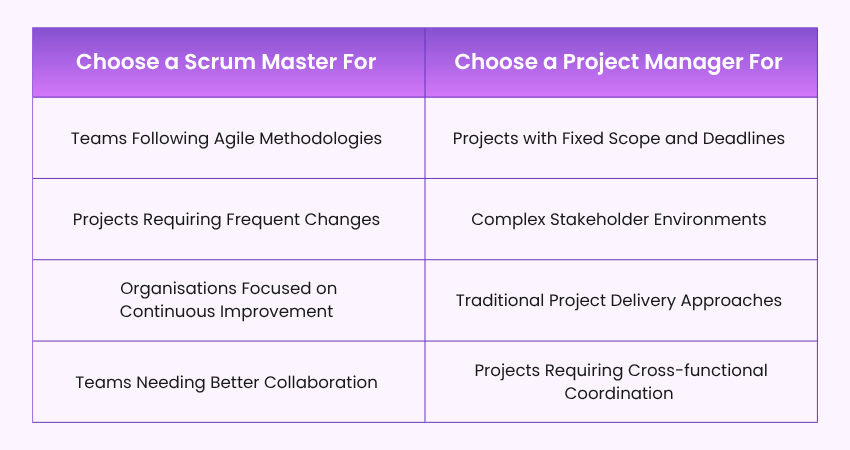
Choosing between a Scrum Master and a Project Manager depends on the project type, delivery approach, team structure, and business requirements. Let’s look at some key areas to consider and how each contributes to project success below:
1) Choose a Scrum Master For
a) Teams Following Agile Methodologies: A Scrum Master is ideal for teams using Agile and Scrum practices. They help teams work efficiently in sprints, improve collaboration, and adapt to changing requirements through continuous feedback.
b) Projects Requiring Frequent Changes: Projects that evolve based on customer feedback and market demands benefit from a Scrum Master’s flexible and adaptive approach. This is common in software development and startup environments.
c) Organisations Focused on Continuous Improvement: Scrum Masters help teams identify inefficiencies, improve workflows, and maintain Agile best practices to support continuous improvement and productivity.
d) Teams Needing Better Collaboration: A Scrum Master improves communication, removes obstacles, and helps teams manage workflows more effectively for smoother project execution.
2) Choose a Project Manager For
a) Projects with Fixed Scope and Deadlines: A Project Manager is suitable for projects requiring clear planning, structured timelines, and predefined deliverables. This approach is common in industries like construction and finance.
b) Complex Stakeholder Environments: Projects involving multiple stakeholders, vendors, or departments require strong coordination and communication, which Project Managers handle effectively.
c) Traditional Project Delivery Approaches: Organisations using structured Project Management methods that require detailed planning, documentation, and controlled execution managed by a Project Manager.
d) Projects Requiring Cross-functional Coordination: Projects involving multiple teams benefit from a Project Manager’s ability to manage resources, timelines, dependencies, and project alignment.
Conclusion
Understanding Scrum Master vs Project Manager helps organisations choose the right leadership approach based on their project goals, team structure, and delivery methods. While both roles contribute to successful project outcomes, their responsibilities and working styles differ significantly. Thus, selecting the right role can improve collaboration, efficiency, adaptability, and project success.
Learn to plan, manage, and deliver projects the right way with the
PRINCE2 Training
– Sign up now!
Frequently Asked Questions
Can a Scrum Master be a Project Manager?
Yes, a Scrum Master can become a Project Manager. A Scrum Master focuses on Agile practices and team facilitation, while a Project Manager manages planning, scope, timelines, budgets, and delivery. Transitioning between these roles requires an understanding of both Agile and traditional Project Management approaches.
Is Scrum Master Higher Than Project Manager?
A Scrum Master is not necessarily considered higher or lower than a Project Manager because both roles have different responsibilities and areas of focus. The importance of each role depends on the organisation and project requirements.
Is Scrum Master Equal to Project Manager?
A Scrum Master is not equal to a Project Manager because both roles have different responsibilities and approaches to project delivery. A Scrum Master focuses on supporting Agile teams and improving workflows, while a Project Manager manages planning, resources, budgets, timelines, and overall project execution.



 Continue Browsing