Contact@prince2training.co.uk
 01344203999




 Back
Back


Table of Content

08-Sep-2026

Veronica Davis
Did you know that numerous projects fail what they have promised to their clients—calling it a high time for the Project Manager to step up into the business? A Project Manager's Job Description mainly involves managing the entire project’s execution, ranging from beginning to final completion.
As a result, they go beyond solely the business' necessity and its stakeholders. This blog will share spotlights on the Project Manager Job Description, including their roles, responsibilities, skills required, and average salary.
Table of Contents
1) What is the Role of a Project Manager?
2) Responsibilities of a Project Manager
3) Project Manager Skills
4) Project Manager’s Job Description Template
5) Average Salary of a Project Manager
6) Conclusion
What is the Role of a Project Manager?
The Project Manager's role is multi-faceted and involves a broader project operation than any other professional within the team. Here is an overview of their roles described:
1) They ensure the timely completion of their project goals and within a designated budget.
2) They help solve complex issues within the team as they arise.
3) They serve to lead the team comprehensively and ensure clear communication between their team members.
4) They thoroughly engage with stakeholders and clients to ensure efficient project operations.
5) They inspire motivation among the team and help align its team members toward shared project goals.

Responsibilities of a Project Manager
Before beginning with the topic, it's important to understand the difference between the words ‘Roles’ and ‘Responsibilities.’ A role is a person’s function that defines their broader professional purpose.
At the same time, responsibilities are the specific tasks that a person is expected to perform in their role. Below, we have elaborated on the key responsibilities of the Project Manager:

1) Leadership
Leadership is the most crucial responsibility of a Project Manager. They help in assembling a team by analysing each member’s strengths and weaknesses and fostering clear communication. Based on that, they delegate tasks, set deadlines, and provide the necessary resources to ensure maximum project operations efficiency.
2) Execution
The Project Manager takes care of each project’s stage by supervising the allotted tasks given to its team members. For this, they communicate regularly with its members, the stakeholders, and the associated clients.
3) Planning
The Project Manager also formulates the project plans for an accurate deadline meetup and within a designated budget. This includes the scope of the project, financing requirements, communication strategy, execution plan, financial roadmap, and backup (in case of any project stage failure).
4) Budget Management
The Project Manager is responsible for strategising the project budget and ensuring the team sticks to it accurately. If any stage exceeds the budget, they revise the entire budget by reducing expenditure in the least required areas for more satisfactory budget management.
5) Maintenance
The Project manager goes beyond the project completion by developing the plans for ongoing maintenance and troubleshooting. They ensure that the client's expectations are thoroughly met for the final client’s delivery without being directly involved in the process.
6) Documentation
A Project Manager must possess a roadmap to analyse the team’s progress and measure it accurately. For this, they must efficiently document the projects, including data collection and verbal as well as written status reports.
Achieve the highest level of Project Management qualification with our
Agile Project Management Foundation & Practitioner (AgilePM®) Training
- Sign up today!
Project Manager Skills
The Project Manager requires a unique blend of Soft and Hard skills. This skillset helps them easily navigate the complex landscape of Project Management. Here are some of the key Project Manager’s skills stated below:

1) Problem-solving
A Project Manager must approach the problem in a decisive manner. For this, they should be prepared for any forthcoming problems and ready to solve them as they arise. As a result, problem-solving ability plays a key role in their job roles and responsibility.
2) Organisational Skills
Project Managers are also excellent project organisers. They must juggle multiple tasks by skilfully mapping schedules, allocating resources, and monitoring project timelines. At times, they also face stringent deadlines, calling for robust organisational skills.
3) Adaptability Skills

A Project Manager must adapt to all kinds of unforeseen challenges and adjust their Project Management strategies accordingly. This ensures the projects are thoroughly carried forward without any sort of obstruction.
4) Team Leadership
A Project Manager is also a Project team’s leader. As a result, they need to cultivate a team collaborative environment by motivating them through the project’s commencement to completion.
Level up your Project Management expertise with our Agile Project Management Practitioner (Agile PM®) Course - Register today!
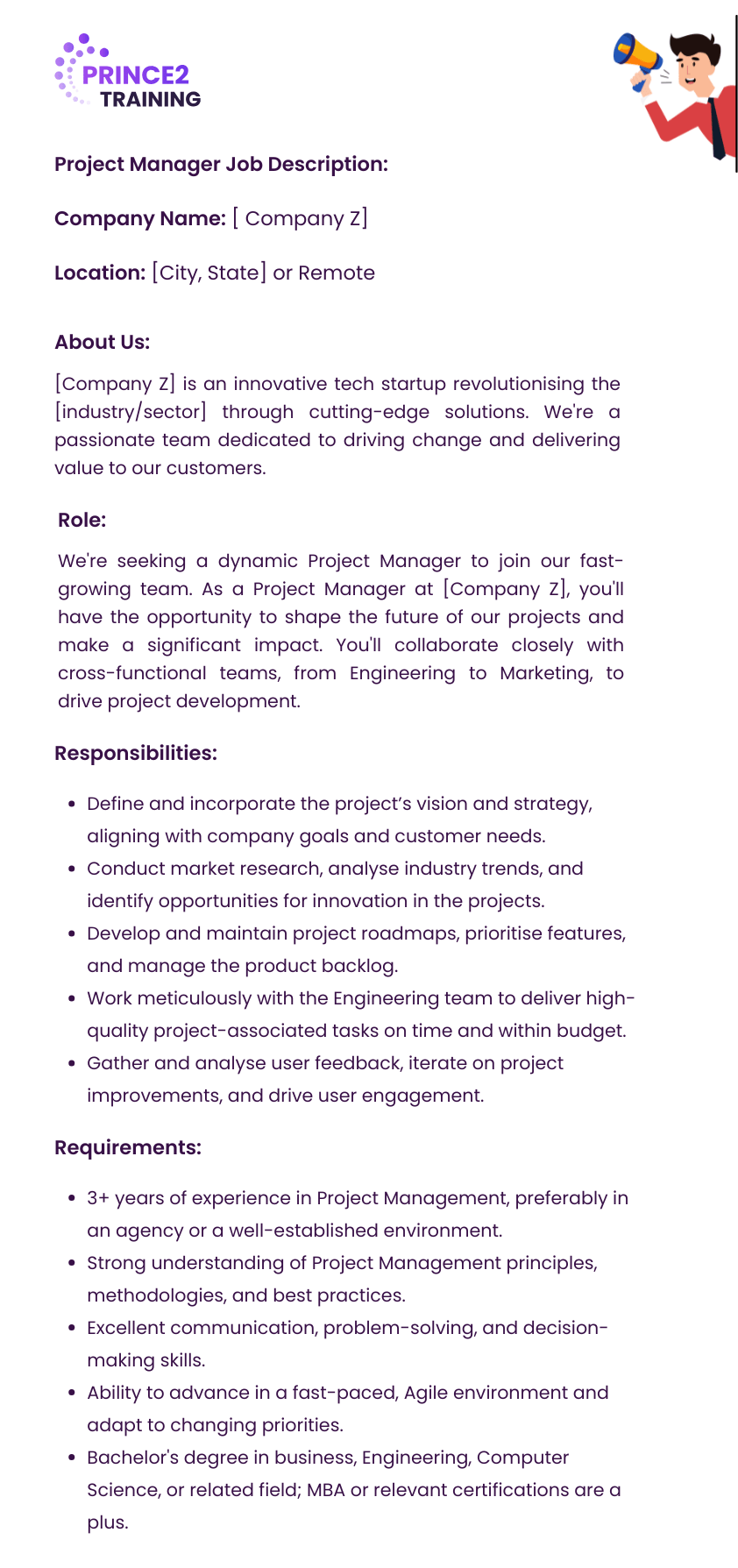
Project Manager’s Job Description Template
Here is the sample Job Description template for the Project Managers:
Average Salary of a Project Manager
The Project Manager’s salary depends widely on the job location, market demand and current inflation rates. Here is the average Project Manager's salary in the UK based on their experience levels:

Source: Glassdoor
Master Project Management fundamentals with our
CAPM® Certification Training
- Join now!
Conclusion
A Project Manager stands as the key pillar for any project’s success. Their Project Manager Job Description ranges from commencement to completion for optimal execution of the project. They ensure the projects are completed on time and within the allotted budget. Moreover, their role extends to helping the team create troubleshooting steps and providing a smoother final project delivery.
Excel in the finest Project Management practises- Register for our PMP® Exam Prep Boot Camp Course today!



 Continue Browsing