Contact@prince2training.co.uk
 01344203999




 Back
Back


Table of Content

08-Sep-2026

Veronica Davis
The Project Management Triangle, also known as the Triple Constraint or Iron Triangle. It is the fundamental concept in Project Management that illustrates the relationship between three key constraints: Scope, Time, and Cost.
These constraints are often depicted as a triangle, where each side represents one of the constraints. The core idea is that any change to one constraint will inevitably impact the other two, making it crucial for project managers to balance them effectively to achieve project success. Let's get into the details of the Project Management Triangle!
What is the Project Management Triangle?
The Project Management Triangle, also known as the Triple Constraint. It is the model that highlights the three primary constraints in any project. These constraints are – cost, time, and scope. These are interdependent, meaning that a change in one will inevitably affect the others.

If a product launch deadline is moved up, additional personnel may need to be hired (increasing costs) or the number of features reduced (limiting scope). By understanding how these constraints interact, project managers can make informed decisions without triggering a cascade of failures. It can be compared to a game of Jenga—the entire structure shifts if one block is removed or adjusted.
Purpose of the Project Management Triangle
The Project Management Triangle is not just a theoretical concept—it is a practical tool that assists project managers in making trade-offs and balancing priorities effectively. It serves as a guide when unexpected challenges arise. The triangle ensures that:
a) Realistic expectations are set regarding what can be achieved within given constraints
b) Stakeholders understand the impact of changes on overall project success
c) Resources and workflows are optimised without derailing objectives
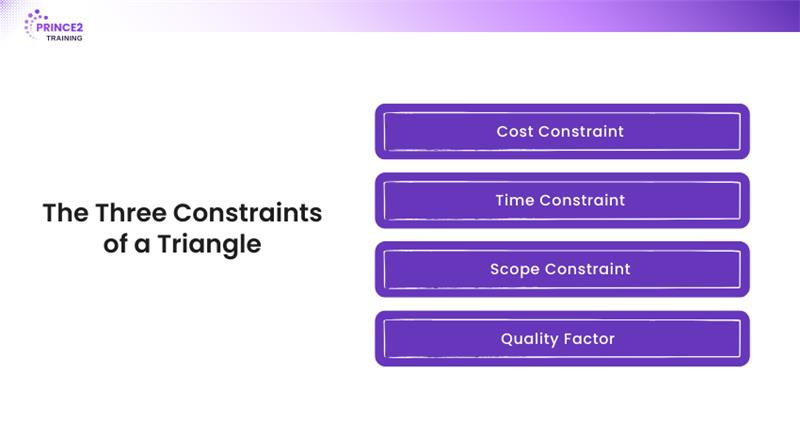
The Three Constraints of a Triangle
Let us look at the three constraints of a triangle:
Cost Constraint
A budget binds every project, and exceeding it can lead to severe consequences. The cost must be managed by balancing expenses related to resources, labour, materials, and unexpected contingencies.
Time Constraint
Time is a significant pressure in any project. Whether a software launch, marketing campaign, or construction deadline is involved, each project operates on a timeline.
Scope Constraint
Scope refers to a project's specific objectives, deliverables, and requirements. Expanding scope without adjusting time or cost is a common pitfall, often known as scope creep.
Quality Factor
While the triangle mainly focuses on cost, time, and scope, quality is the underlying force connecting them. A project may be completed on time and within budget, but if quality is compromised, the outcome is ineffective.
Build Agile Expertise with the Agile PM® Foundation Certification – Join Today!
Managing the Project Management Triangle
Let us look at the factors to managing Project Management Triangle:
Stakeholder Communication
Clear and continuous communication with stakeholders is essential for managing the triangle. Transparency regarding limitations and potential trade-offs prevents unrealistic expectations. If a client is told, "Yes, the project can be delivered in half the time," but later informed that quality will suffer, frustration and mistrust will result.
Risk Management
Each project presents risks—budget overruns, missed deadlines, or changing requirements. Identifying these risks early and preparing contingency plans ensures projects remain on track. If a software company anticipates sudden feature requests, allocating buffer time in the schedule prevents last-minute panic.
Change Management Plans
Projects are rarely static, and changes are inevitable. A structured approach to assessing, approving, or rejecting changes ensures stability. For instance, NASA's space projects undergo rigorous change management to ensure new modifications do not compromise mission success.
Constraint-Based Methodology
Smart project managers leverage methodologies like Agile and Lean to adapt dynamically to constraints. Agile teams, for example, break work into sprints, enabling flexibility in adjusting scope while maintaining deadlines and budgets.
Project Management Tools
Tools such as Trello, Jira, or Microsoft Project help efficiently track time, budget, and scope. Automation and analytics also provide real-time insights to adjust constraints before they escalate into issues.
Lead Agile Projects with Confidence with the AgilePM® Certification – Join Now!
Effective Strategies for Managing the Project Triangle
Let us look at the strategies for managing the Project Triangle:

Define and Prioritise Goals
a) Identify the most critical aspects of the project to ensure the focus remains on key deliverables
b) Break down goals into smaller, measurable objectives to track progress efficiently
c) Align team efforts with business priorities to maintain consistency in execution
d) Assess potential risks early to develop mitigation plans before issues arise
e) Regularly revisit and adjust goals based on project updates and stakeholder input
f) Ensure all team members have a clear understanding of priorities to avoid confusion and inefficiency
Set Clear Expectations
a) Clearly communicate project constraints to stakeholders to align their expectations.
b) Define roles and responsibilities to ensure accountability within the team.
c) Establish realistic deadlines to avoid last-minute rush and compromised quality.
d) Outline project milestones and review them periodically to track alignment with objectives.
e) Set limitations on scope expansion to prevent unnecessary additions that strain resources.
f) Maintain an open line of communication to handle any concerns and ensure expectations remain aligned.
Provide Regular Updates
a) Schedule consistent progress meetings to review developments and address any issues.
b) Use Project Management tools to share real-time updates with team members and stakeholders.
c) Document project changes and communicate them effectively to prevent misalignment.
d) Provide clear status reports highlighting achievements, challenges, and next steps.
e) Encourage feedback from stakeholders to ensure concerns are addressed promptly.
f) Adapt reporting methods based on audience needs, ensuring clarity and relevance.
Adapting the Triangle to Fit Your Management Style
Discover how to adapt the timeless principles of the Triangle to align seamlessly with your personal style and drive success:
Resource-Saving Project Methods
If cost is a major constraint, resource-efficient strategies such as outsourcing, automation, or cloud-based tools can be implemented to reduce expenses without compromising quality.
Time-Saving Project Methods
Agile, Scrum, or Kanban methods break tasks into smaller, manageable units, providing flexibility and faster turnaround times for projects with strict deadlines.
Understand Project Management Essentials with APM PFQ Certification – Sign up Now!
Advantages of Using the Project Management Triangle
Let us look at the advantages of using the Project Management Triangle:
Reduces Risks
By understanding trade-offs, risks can be mitigated before they escalate into crises. With careful planning and monitoring, potential pitfalls can be identified early, allowing for timely interventions and necessary adjustments before issues become severe.
Clarifies Project Priorities
The triangle ensures that teams remain focused on critical project aspects instead of being distracted by less essential details. Clearly defining priorities enables project goals to be structured effectively, ensuring that the most important tasks receive the required attention.
Enhances Resource Allocation
Budget, personnel, and time can be allocated efficiently, preventing unnecessary waste and inefficiency. When resources are distributed wisely, productivity increases and overall project efficiency significantly improves, leading to better results.
Establishes Clear Expectations
By setting realistic expectations, conflicts between teams and stakeholders are minimised. Clear communication regarding deliverables, constraints, and potential trade-offs ensures that all parties have a shared understanding, reducing misunderstandings and disputes.
Improves Project Oversight
With a structured approach, progress can be tracked, necessary adjustments made, and goals aligned effectively. Project managers can oversee the workflow efficiently, identify bottlenecks, and implement corrective measures promptly to maintain steady progress.
Become a Certified Associate in Project Management (CAPM®) - Register Now!
Conclusion
Mastering the Project Management Triangle is akin to being a skilled juggler—time, cost, and scope must be balanced while ensuring quality. The key lies in understanding trade-offs, setting clear priorities, and employing effective management strategies to keep projects on track. Projects can be successfully executed with minimal stress and maximum impact by utilising tools, methodologies, and proactive communication.
Frequently Asked Questions
What is a Project Management Triangle?
The Project Management Triangle represents the balance between scope, time, and cost—three interdependent constraints determining project success. Adjusting one impacts the others.
What is the Agile Triangle?
The Agile Triangle focuses on value, quality, and constraints (scope, time, cost). It prioritises delivering value to stakeholders while maintaining flexibility and adapting to changes.
What is RACI in Project Management?
RACI is a responsibility matrix defining roles: Responsible, Accountable, Consulted, and Informed. It clarifies team members' tasks and decision-making authority, ensuring accountability and efficiency.



 Continue Browsing