Contact@prince2training.co.uk
 01344203999




 Back
Back


Table of Content


08-Sep-2026

Maria Thompson
In the field of Project Management, two titles often cause confusion: Project Leader vs Project Manager. While they sound interchangeable and both drive projects toward success, their approaches and focus areas differ greatly. One inspires and guides teams through vision and creativity, while the other ensures structure, control and timely delivery.
Understanding the differences between Project Leader vs Project Manager is key to assigning the right role for the right project. This blog will help you in decoding these distinctions. So read on, explore what truly sets a Project Leader apart from a Project Manager and use it to your next strategic advantage!
What is a Project Leader?
A Project Leader is a professional who's responsible for managing and directing a project from start to finish. They play a significant role in planning, organising and motivating the team to ensure that objectives are met successfully and within the defined scope and timeline.
Role of a Project Leader
Here are the roles played by a Project Leader:
1) They establish clear project objectives and develop a roadmap in line with organisational goals to guide the team properly.
2) They build and manage project teams by promoting collaboration and ensuring every member has a full understanding of their responsibilities.
3) They make key decisions, resolve conflicts and adjust plans as needed to address challenges and maintain progress.
4) They identify the potential risks and implement strategies to minimise their impact, thus ensuring project stability.
5) They manage the project closure by evaluating results, documenting the lessons learned and conducting reviews to improve future performance.

What is a Project Manager?
A Project Manager is a professional who looks after the planning, execution and successful delivery of a project. Their role involves providing direction, coordinating the teams and managing resources to ensure every project goal is met within the set time and budget. They also act as the main communication link between stakeholders. They ensure transparency throughout the project lifecycle.
Role of a Project Manager
Here are the key roles played by a Project Manager:
1) They define the project scope by outlining objectives, deliverables, and limitations clearly.
2) They lead and manage the project team by assigning tasks, guiding members, and allocating resources effectively.
3) They develop and maintain detailed project schedules to ensure the timely completion of milestones.
4) They oversee the project budget, monitoring expenses to prevent overruns and identify opportunities for cost efficiency.
5) They identify, evaluate and mitigate risks to minimise their effect on project success.
6) They maintain complete and accurate project documentation, including plans, reports and records, for transparency and future reference.
Project Leader vs Project Manager: Five Major Differences
Here are the key differences between Project Leader vs Project Manager:
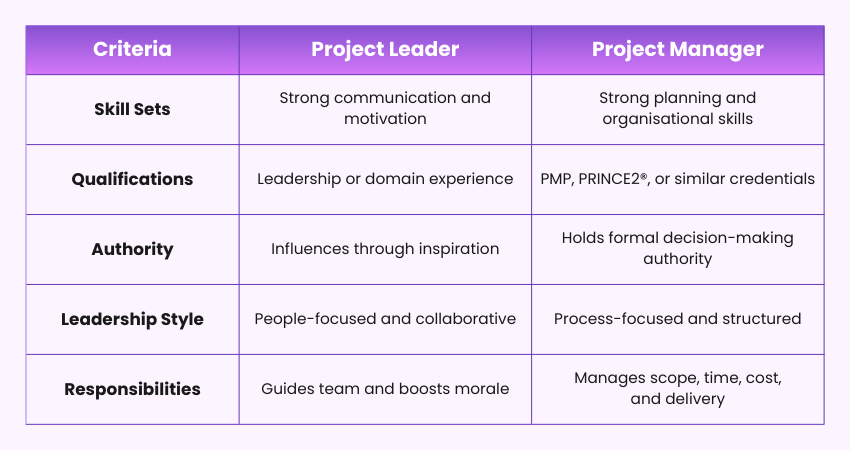
1) Project Leader vs Project Manager: Skill Sets
Project Leaders are hands-on professionals with strong technical expertise. They actively participate in tasks, solve complex problems and guide their teams using in-depth knowledge of their field.
On the other hand, Project Managers focus on strategy and coordination. They excel at planning, communication, Risk Management, and ensuring all project components come together seamlessly to achieve overall success.
2) Project Leader vs Project Manager: Qualifications
Project Leaders usually come from technical or domain-specific backgrounds. Their qualifications are directly related to the project’s area, for example, engineering, IT or design.
In contrast, Project Managers often have formal training in management or business. They hold recognised certifications such as PMP or PRINCE2®, which highlight their Project Management expertise and strategic oversight skills.
3) Project Leader vs Project Manager: Authority
Project Managers hold formal authority and are accountable for the overall success or failure of the project. They make the key strategic decisions that shape the project’s direction.
Meanwhile, Project Leaders have a strong influence within their technical or functional domain. They make critical decisions related to their expertise but operate under the guidance of the Project Manager.
4) Project Leader vs Project Manager: Leadership Style
Project Leaders embrace a participative and motivational approach. They encourage collaboration, value input from team members, and spark creativity. They inspire the team by connecting individual goals with the project’s larger vision and promoting innovation and continuous improvement.
Meanwhile, Project Managers tend to follow a directive leadership style. They provide structure, set clear expectations, and closely monitor progress to ensure compliance and timely delivery.
5) Project Leader vs Project Manager: Responsibilities
A Project Leader is deeply involved in the day-to-day project execution. They guide the technical work by supporting continual team collaboration and resolving challenges as they arise.
On the other hand, a Project Manager oversees the broader picture. They manage resources, timelines, budgets, risks, and communication with stakeholders to ensure the project stays on track with business objectives.
Core Skills of a Project Leader
Project Leaders play a big role in project success by guiding and motivating their teams to achieve their individual and collective goals. They harness a combination of skills to manage complex tasks and maintain focus. Here are some of the most important skills every Project Leader should have:
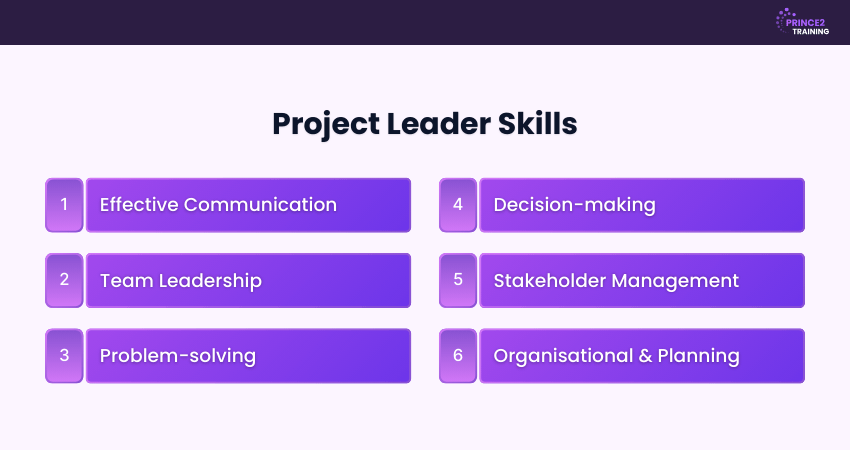
1) Effective Communication
Clear communication is a basic requirement for project success. Project Leaders must be able to explain the goals, expectations and progress clearly to both their teams and stakeholders. They also need to listen actively, acknowledge different viewpoints, encourage open discussions, and handle conflicts professionally.
2) Team Leadership
Strong leadership means inspiring and empowering team members to do their best work. Project Leaders must create a positive and supportive environment, celebrate both small and big achievements and give helpful feedback to help team members grow and stay motivated.
Why choose between control and speed when our PRINCE2® Agile® Practitioner Course can give you both? Sign up now and boost your project!
3) Problem-solving
Project Leaders must be able to recognise issues early on, analyse them carefully and develop practical solutions. They must think critically, evaluate risks and make confident decisions to keep the project moving forward, even if they are under pressure.
4) Decision-making
Project Leaders must make quick and effective decisions by weighing options, considering the risks and keeping project goals in mind. Making smart, timely choices can help maintain momentum and ensure the team stays aligned with objectives.
5) Stakeholder Management
Maintaining strong relationships with stakeholders is vital. Project Leaders must keep stakeholders informed about the project's progress, address any concerns promptly and manage expectations as realistically as possible. By communicating openly and building trust, they ensure that stakeholders stay confident and satisfied with the project’s result
6) Organisational & Planning Abilities
Good planning is one of the most crucial prerequisites for project success. Leaders need to break large tasks down into smaller, manageable ones, set realistic timelines and use the resources efficiently. They must monitor progress regularly, adjust plans when needed and make sure the project stays on track.
Core Skills of a Project Manager
A successful Project Manager possesses a diverse range of skills. These skills are key to managing complex projects and leading teams efficiently. These skills include the following:
1) Project Planning
Strong Project Managers are experts in creating detailed project plans, breaking down tasks and setting achievable timelines. They can identify task dependencies, allocate resources and anticipate challenges to keep projects running smoothly.
2) Risk Management
Project Managers can proactively identify and manage risks throughout the project lifecycle. By crafting contingency plans and monitoring risk factors, they minimise disruptions to ensure that the project remains stable.

3) Budgeting & Cost Control
Project Managers are skilled in estimating costs and tracking expenses. They make informed adjustments when needed, based on the budget, to ensure the project remains financially healthy and on track with its goals.
4) Risk Mitigation
By continuously recognising and addressing potential risks, Project Managers prevent costly delays and failures. Their foresight and strategic planning go a long way to help safeguard project objectives.
5) Stakeholder Engagement
Effective Project Managers can maintain strong relationships with stakeholders. They communicate clearly, address every concern and keep everyone informed. This helps them ensure collaboration, alignment and trust throughout the project lifecycle.
6) Enhancing Team Efficiency
Project Managers are experts at streamlining project processes using proven frameworks and tools. This helps them reduce redundancies and improve productivity. Their structured approach helps with the smooth execution and optimal use of resources.
7) Delivering Successful Projects
Ultimately, Project Managers ensure that their projects are delivered within the set budget, on time and according to scope. Their organised approach elevates decision-making, control and overall success rates.
Behind every successful project is a manager who knew where to start. Become that guiding light with our Introduction to Project Management Course - Sign up now!
Project Leader vs Project Manager: Who is the Better Fit?
Both roles are needed for a project’s success, but their impact depends on the project’s nature and goals. Consider these points:
1) Project Leader:
They are best suited for complex or innovative projects that require creativity, flexibility and vision.
2) Project Manager:
They are ideal for structured projects with clear deliverables and timelines.
Ultimately, both the Project Leader and Project Manager roles complement each other. Effective projects benefit from a Project Leader’s inspiration and a Project Manager’s precision.
Conclusion
Understanding the difference between Project Leader vs Project Manager is vital because they bring different strengths to the table. One fuels inspiration, while the other ensures precision. Recognising their unique roles can help any organisation strike the delicate balance between creativity and control. This is the key to turning challenges into achievements and ideas into impactful, lasting results.
Master the art of flexible leadership with our
PRINCE2® Practitioner Course
– Sign up now



 Continue Browsing