01344203999




 Back
Back


Table of Content


05-Oct-2026

Richard Harris
Have you ever finished a project task feeling proud, only to hear, “This isn’t what we wanted”? Suddenly, your excitement turns into stress and confusion. It’s not that the work was wrong; it just wasn’t what everyone agreed on. This happens when Project Deliverables aren’t clearly defined, and it can turn a smooth project into endless corrections and late nights.
In this blog, we will explain what Deliverables in Project Management. You will learn what Project Deliverables are, why they matter, and the main types. We will also explain how to identify and manage them, and the difference between process and product Deliverables, so you can deliver the right results.
What are Project Deliverables?
Project Deliverables are the internal or external outcomes produced from a project's activities that are necessary to achieve its goals. These may include products, design plans, software, reports, or marketing content. Deliverables give the team a clear target and help track progress to ensure the project stays on track.
When Project Deliverables are clear from the start, everyone understands what needs to be done and what the result should look like. A Project Initiation Document can help establish these expectations early, preventing confusion, saving time, and keeping the work on track. Regularly reviewing Deliverables also helps spot problems early and ensures the project moves smoothly towards success.

Importance of Deliverables in Project Management
Deliverables give clear goals, help track progress, and make communication easier in a project. They also make sure the final work meets the expected standards. Here is an explanation of why Project Deliverables are important:
1) Act as Key Project Milestones
Deliverables act as checkpoints within a project. When a deliverable is completed, it confirms that a significant part of the work has been achieved. This helps teams move step by step and stay aligned with the project plan.
2) Enable Progress Tracking and Measurement
Deliverables make it easier to see what work has been completed and what still needs attention. This allows teams to identify delays early, resolve issues quickly, and maintain the project schedule.
3) Improve Stakeholder Communication
Clear Deliverables help everyone understand what will be delivered and when it will be delivered. This keeps clients, managers, and team members informed and reduces confusion and misunderstandings.
4) Ensure Quality Standards
Deliverables help set clear rules for what the final work should look like. This makes it easy to check work, avoid mistakes, and make sure the result meets expectations and quality goals throughout the project.
Gain essential Project Management knowledge and credentials through PRINCE2® Foundation Training – Join now!
Types of Project Deliverables
Project Deliverables come in different forms depending on who they are for and what they do. Here are the main types:
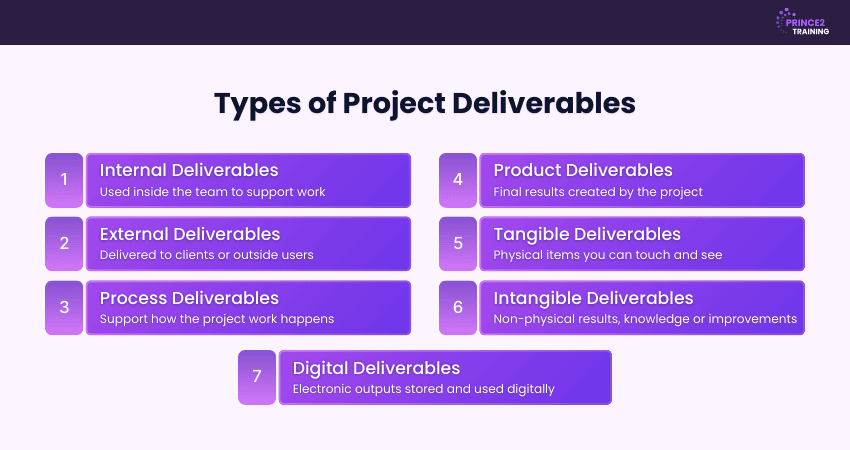
1) Internal Deliverables
These Project Deliverables are shared with clients or stakeholders outside the organisation. They are often the final outcomes of the project.
Examples: Project plans, meeting notes, budget reports, training materials, progress reports, and testing documents.
2) External Deliverables
These Project Deliverables are given to clients or people outside the organisation. They are often the final results of the project.
Examples: A completed building, a software application, a website, a published report, or a user manual.
3) Process Deliverables
These Deliverables support the project process. They help guide how the work should be done and ensure the project runs smoothly.
Examples: Project charter, timeline (Gantt chart), quality check documents, resource plan, communication plan, and review checklists.
4) Product Deliverables
These Project Deliverables are the actual results or items created by the project. They are what the project objectives to deliver at the end.
Examples: A mobile app, a car model, a marketing campaign, an online resource, or an installed system.
5) Tangible Deliverables
These are physical objects you can see and touch. They exist in the real world and can be easily checked or measured.
Examples: A printed brochure, a book, a physical product, a machine part, or a completed building.
6) Intangible Deliverables
These are non-physical results. They add value through knowledge, services, or improved processes.
Examples: Training programmes, business strategies, updated company policies, research results, or improved customer experience.
7) Digital Deliverables
These are Deliverables that exist only in digital form. They are created, stored, and used electronically.
Examples: Software, e-books, websites, digital marketing designs, online reports, and databases.
Build strong project skills from beginner to advanced with our PRINCE2 Foundation & Practitioner Training – Join now!
How to Identify Project Deliverables?
Identifying and defining Project Deliverables early is essential for project success. Below is a clear process to help identify Project Deliverables effectively:
1) Define Project Scope
First, decide what the Project Scope will include and what it will not include. This helps everyone understand the project limits and prevents extra tasks from being added later. A clear scope keeps work focused and organised.
2) Start with Your Project Objectives
Review your main project goals. Your Deliverables should directly support these objectives and help achieve them. Clear goals make it easier to decide what needs to be delivered. Strong objectives provide clear direction for identifying Deliverables.
3) Break Down the Work
Divide the project into smaller tasks or work packages. This makes it easier to identify what needs to be produced at each stage and what the final outcomes should look like. Breaking work down simplifies planning and control.
4) Identify Specific Deliverables
Go through your tasks and ask, “Will this task produce something we will hand over or complete?” If yes, that item is a Deliverable. Project Deliverables can be reports, designs, software, or new processes.
5) Involve Key Stakeholders
Share the list of Deliverables with clients, managers, or team members. Their feedback helps ensure nothing is missed and that everyone agrees on what will be delivered. Clear communication at this stage avoids misunderstandings later.
6) Look at Internal and External Deliverables
Remember that some Project Deliverables are for your team (like progress reports) and some are for the client (like a finished product or presentation). Both types are important. Both support successful project delivery.
7) Map Deliverables to KPIs
Make sure each Deliverable supports a project goal or success measure. If a Deliverable helps the project reach its goals, it should be tracked carefully. Project Deliverables must link to success measures.
How to Manage Project Deliverables?
Managing Project Deliverables well helps keep the project on time and makes sure everyone gets what they expect. Here are the steps to manage Deliverables:
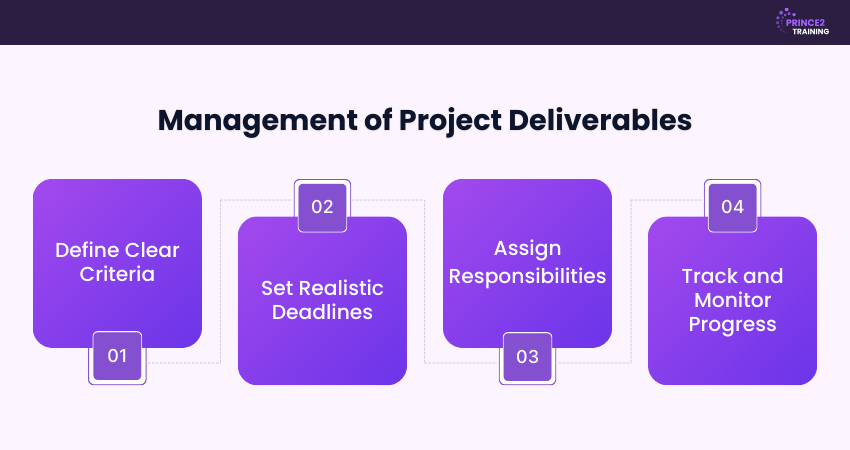
1) Define Clear Criteria
Clearly explain what each Deliverable should look like when it is finished. Make sure everyone agrees on the details, including a Definition of Done to confirm completion. This helps avoid confusion and makes it clear when a task is truly done and approved.
2) Set Realistic Deadlines
Set deadlines that are fair and achievable. Think about the amount of work, the time available, and the people working on it. Involve your team when planning timelines, so everyone understands and supports the schedule.
3) Assign Responsibilities
Give each Deliverable to a specific person or team. Make sure everyone knows what they need to do. This builds responsibility and makes it easier to see who is handling each task and if help is needed.
4) Track and Monitor Progress
Check the progress of each Deliverable regularly. Use simple tools or progress updates to see what is done and what still needs work. Checking often helps you spot problems early and fix them before they slow down the project.
Become an Agile-savvy Project Leader with our PRINCE2 Agile® Practitioner Training – Register today!
Examples of Project Deliverables
Every project creates different types of Deliverables. These are not only the results, but they can also be created during the project. Here are some examples of Project Deliverables:
1) Documentation Deliverables
These are the papers or files that help plan and track the project. Examples include a project plan, a document that lists goals or a report that shows how the project is going. Progress reports and budget updates also fall under this type.
2) Services and Outcomes Deliverables
Some projects do not give a physical product but provide a service instead. Examples include training sessions, workshops, advice or guidance, and action plans. These help people learn, improve or solve a problem.
3) Data and Information Deliverables
Some Project Deliverables are based on information or research. This can include survey data, research reports or charts made from analysing information. These help teams make good decisions. For example, a customer survey report or a sales dashboard.
Process Deliverables vs Product Deliverables
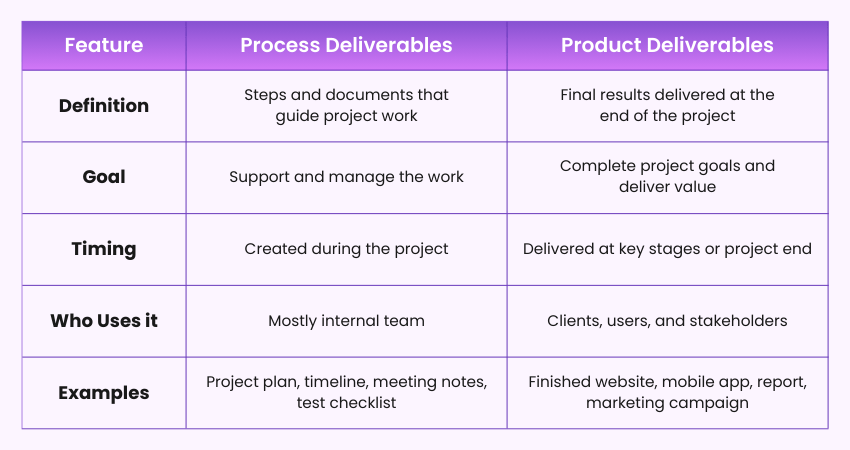
Process Deliverables support the work, while Product Deliverables are the final results. Both play an important role in completing a project. The table below shows the main differences between them:
Conclusion
Project Deliverables are the backbone of successful projects. When teams clearly define what needs to be produced and track progress along the way, work becomes smoother and goals are easier to achieve. Understanding Deliverables in Project Management helps teams stay organised, meet expectations, and deliver real value. With the right planning and communication, every project can move confidently from start to finish.
Start your journey toward professional project success with our PRINCE2 Training – Join now!
Frequently Asked Questions
What Defines Deliverables?
Deliverables are the clear, measurable outputs a project must produce. They can be documents, products, services or digital items that show progress and help complete project goals.
What are Deliverables vs Objectives?
Objectives are the clear goals or benefits a project wants to achieve, while Deliverables are the specific outputs created to reach those goals. Objectives explain the “why,” such as improving customer experience, and Deliverables explain the “what,” like launching a new website or completing a final report.
Are KPIS the Same as Deliverables?
No, they are different. Deliverables are what a project creates, like a report or website. KPIs show how well the project or result performs. Deliverables are the output, and KPIs measure success.



 Continue Browsing