Contact@prince2training.co.uk
 01344203999




 Back
Back


Table of Content

21-Sep-2026

Hailey Davis
Have you ever worked on a project that started with a clear plan but slowly drifted off course due to missed deadlines or constant changes? It is a common challenge across industries, where even small gaps in tracking can lead to setbacks. This is where Project Controls becomes crucial, bringing structure and discipline to keep teams aligned, focused, and in control from the very beginning.
It helps organisations turn uncertainty into clarity through better tracking, forecasting, and performance insights. These practices enable teams to spot issues early, improve collaboration, and make timely, informed decisions. In this blog, you will learn about what are Project Controls, its importance, components, techniques, benefits, and more. Let’s get started!
What are Project Controls?
Project Controls refer to the processes and tools used to plan, monitor, and manage project activities. They ensure projects are delivered within time, budget, and to the set quality standards. Also, they provide a structured approach to track progress, measure performance, and keep all aspects of a project aligned with its objectives.
These controls are important for complex projects, where managing multiple variables can be challenging. By focusing on key areas like cost and schedule management, it helps teams identify risks early and maintain timelines effectively. This enables better decision-making and keeps the project moving in the right direction.
Who Manages Project Controls?
Generally, Project Controls are managed by Project Management professionals responsible for monitoring schedules, budgets, and project performance. In many cases, the Project Manager oversees these activities, especially in smaller projects or organisations. For larger or more complex projects, dedicated roles handle Project Controls. Some common professionals include:
1) Project Control Engineer
2) Project Controls Manager
3) Project Controls Specialist
Their main responsibility is to identify risks or challenges, analyse project performance, and support decision-making to keep the project on track. This ensures better control, improved accuracy, and successful project delivery.
Why are Project Controls Important?
Project Controls are important because they help manage a project in a structured and controlled way. They support the development of a strong project plan before execution, using tools such as a Work Breakdown Structure to ensure all activities are aligned with the organisation’s strategic goals and Project Governance practices. This alignmen saves both time and cost while improving overall efficiency.
Also, they provide clear answers to critical project questions, such as expected costs, timelines, and the quality of outcomes. By offering better visibility and control, Project Controls enable teams to make informed decisions, reduce uncertainties, and keep the project on track.
Key Components of Project Controls
Project Controls are built on key components that help plan, track, and manage a project effectively. Let’s look at them below:
1) Planning and Scheduling:
Defines project activities, timelines, and milestones to ensure tasks are completed in the right sequence and on time.
2) Cost Estimation and Control:
Involves forecasting project costs, setting budgets, and monitoring expenses to prevent overspending.
3) Risk Assessment and Management:
Identifies potential risks, evaluates their impact, and implements strategies to reduce or avoid them.
4) Change Control:
Manages any changes in scope, schedule, or cost to ensure they are properly evaluated and approved before implementation.
5) Performance Monitoring and Reporting:
Tracks progress using key metrics and provides regular updates to support informed decision-making.
Drive Agile projects with confidence and clarity by joining the
PRINCE2 Agile® Foundation and Practitioner Training
today!
When to Use Project Controls?
Project Controls are used throughout the entire project lifecycle to ensure effective Project Management and successful delivery. They provide structure, visibility, and control, helping teams manage time, cost, and resources efficiently at every stage through integrated project management. Let’s look at where their use is crucial:
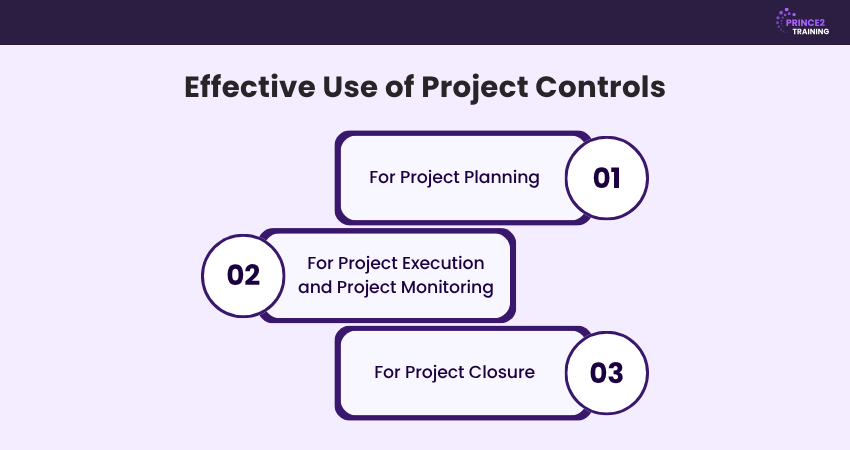
1) Project Planning
Project Controls are established at the beginning of a project. They play a key role in defining schedules, estimating costs, allocating resources, and identifying stakeholders. At this stage, controls help reduce uncertainty, improve the accuracy of forecasts, and ensure that the project starts with a well-structured and realistic plan.
2) Project Execution & Project Monitoring
During execution, Project Controls are used to track progress, manage resources, and ensure the project stays on schedule and within budget. They help identify issues like delays, cost overruns, or resource gaps early. They enable teams to identify issues such as delays, cost overruns, or resource gaps early, allowing for timely corrective actions and maintaining overall project performance.
3) Project Closure
At the end of the project, Project Controls are used to evaluate overall performance. They help analyse what worked well and what did not, providing valuable insights and data that can be used to improve future projects.
Take control of high-stakes project delivery with the
PRINCE2® Practitioner Training
– Join now!
Essential Project Control Techniques
Project Control techniques help teams monitor performance, manage risks, and keep projects aligned with their objectives. These methods provide measurable insights and support data-driven decision-making throughout the project lifecycle. Some of the most important techniques are outlined below:
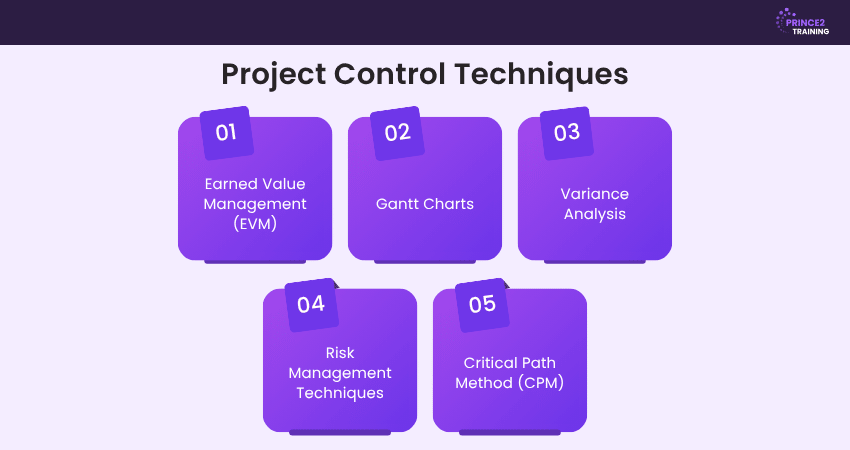
1) Earned Value Management (EVM)
It is a powerful technique used to measure project performance across cost, time, and scope. It helps determine whether a project is on schedule, within budget, and delivering value using key metrics like Planned Value (PV) and Earned Value (EV).
2) Gantt Charts
Gantt charts are a visual tool that maps project tasks against a timeline. It helps teams track progress, understand task dependencies, and identify potential delays early, making it widely used in Project Management.
3) Variance Analysis
Variance analysis is a method of comparing planned performance with actual performance. It focuses on key metrics such as Cost Variance (CV) and Schedule Variance (SV), enabling teams to take timely corrective actions and maintaining overall project performance with the help of RAG Status.
4) Risk Management Techniques
It refers to a structured approach to identifying, analysing, and managing project risks. It includes risk identification, impact assessment, and mitigation planning to reduce uncertainties and improve decision-making.
5) Critical Path Method (CPM)
It is a scheduling technique that identifies the longest sequence of dependent tasks in a project. It helps determine the total project duration and highlights critical activities that must be completed on time to avoid delays in overall delivery.
Learn the essentials of project delivery and understand projects with clarity and confidence by signing up for the
PRINCE2® Foundation Training
now!
Benefits of Effective Project Controls
Project Controls provides several benefits that improve project performance and outcomes. Let's look at some of the key benefits below:
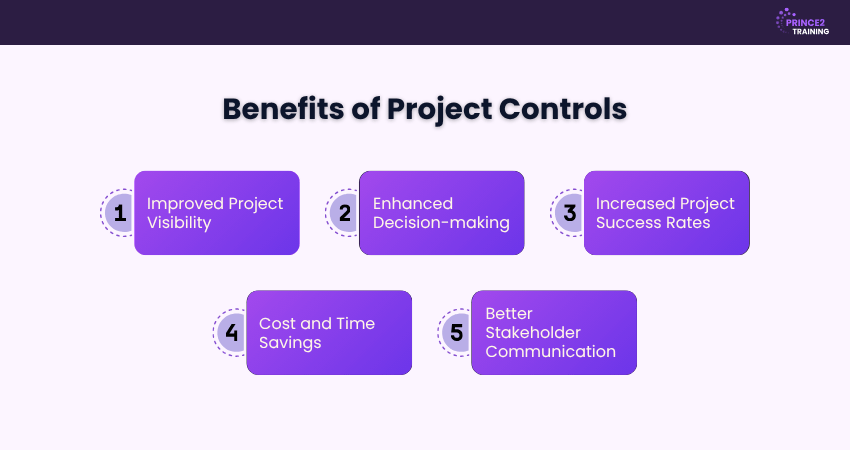
1) Improved Project Visibility
Project controls provide clear insights into project status, performance, and potential risks. This helps teams track progress effectively and maintain better control over all project activities. Also, it ensures that issues are identified early before they escalate.
2) Enhanced Decision-making
With accurate and timely data, teams can identify trends, identify issues early, and make informed decisions. This leads to effective risk management and improved project outcomes. As a result, decisions are more proactive rather than reactive.
3) Increased Project Success Rates
By identifying deviations early and taking corrective actions, Project Controls helps ensure that project objectives are achieved. This improves overall success rates and stakeholder satisfaction, reducing the chances of project failure or rework.
4) Cost and Time Savings
Project Controls support efficient resource allocation and early issue resolution. This helps reduce delays, prevent cost overruns, and optimise the use of resources. It ultimately improves overall project efficiency and productivity.
5) Better Stakeholder Communication
Project Controls enable regular and transparent reporting on project progress, challenges, and achievements. This builds trust and keeps stakeholders aligned throughout the project lifecycle. Also, it ensures expectations are clearly managed at every stage of a project lifecycle.
What are Some Examples of Project Controls?
Project Controls can be applied in different areas to ensure effective planning, monitoring, and delivery. Let's look at some of the examples below:
1) Project Planning:
Creating a detailed plan that defines objectives, scope, budget, timelines, and deliverables, often using tools like a Work Breakdown Structure (WBS).
2) Schedule Management:
Developing and tracking a project schedule to ensure tasks are completed on time and progress stays on track.
3) Cost Management:
Setting a project budget and monitoring actual spending to control costs and avoid overruns.
4) Risk Management:
Identifying potential risks, evaluating their impact, and implementing strategies to minimise or avoid them.
5) Quality Management:
Establishing standards and processes to ensure deliverables meet the set quality expectations.
6) Change Management:
Managing changes to scope, schedule, or budget through a structured approval and impact assessment process.
7) Performance Measurement:
Using Key Performance Metrics (KPIs) to track progress and evaluate project success, with regular reporting to stakeholders.
8) Communication Management:
Planning how project information is shared to keep stakeholders informed and aligned.
9) Issue Management:
Identifying, tracking, and resolving project issues to prevent disruptions and delays.
Conclusion
Project Controls play a crucial role in ensuring projects are delivered efficiently, on time, and within budget. By applying the right processes and techniques, teams build better visibility, manage risks proactively, and make informed decisions at every stage of the project lifecycle. Ultimately, these controls enhance coordination, improve performance, and drive consistent project success.
Turn project ideas into successful delivery and build confidence in every project you lead with the
PRINCE2 Training
– Sign up now!
Frequently Asked Questions
What are Project Controls in PRINCE2?
PRINCE2 Project Controls are mechanisms that help managers monitor performance, manage risks, and keep projects within agreed limits for cost, time, quality, and scope. These mechanisms support informed decisions and timely corrective actions to keep the project on track.
What is WBS in Project Controls?
A Work Breakdown Structure (WBS) in Project Controls is a deliverable oriented hierarchy that breaks the total project scope into smaller work packages. It forms the foundation for scheduling, cost estimation, and tracking, ensuring all work is included and aligned with the project objectives.
What are the 7 Keys of Project Management?
The 7 keys of Project Management are:
a) Stakeholder Commitment: For alignment and support
b) Realising Business: Links outcomes to goals
c) Predictable Schedule: Improves planning
d) Managed Scope: Prevents changes
e) High Performing Teams: Drive efficiency
f) Mitigated Risks: Reduces uncertainty
g) Organisational Benefits: Long-term value



 Continue Browsing