Contact@prince2training.co.uk
 01344203999




 Back
Back


Table of Content

08-Sep-2026

Veronica Davis
Are you struggling to select the best Project Management approach for your team? Discover the strengths and differences of PRINCE2 and Waterfall, two of the most popular Project Management methodologies. Learn how PRINCE2’s structured framework can provide flexibility and control, while Waterfall’s linear approach ensures clarity and simplicity. Read this blog on PRINCE2 vs Waterfall and find out which methodology best suits your project needs.
Table of Contents
1) What is PRINCE2 Methodology?
2) What is Waterfall Methodology?
3) Is PRINCE2 the same as Waterfall?
4) PRINCE2 vs Waterfall: Key Differences
5) Conclusion
What is PRINCE2 Methodology?
‘Projects in a Controlled Environment (PRINCE2)’ is a globally recognised Project Management approach, particularly prevalent in the UK, Western Europe, and Australia. It’s a certification program that focuses on segmenting projects into stages that are both manageable and controllable.
PRINCE2 is built on four main elements: Principles, Themes, Processes, and Tailoring. It’s founded on seven core principles that serve as the framework’s pillars. For a project to be deemed a ‘PRINCE2 project,’ it must embody all these principles.
The methodology also includes seven themes, which are essential facets of Project Management that need ongoing attention during the project’s life. These themes are akin to the Knowledge Areas found in the PMBOK® Guide.
These themes are operationalised through seven processes that outline the specific roles and responsibilities, as well as the timing for each task. PRINCE2’s processes, which are divided into 41 distinct activities, are comparable to the Process Groups in the PMBOK® Guide, mirroring its 49 processes.

What is Waterfall Methodology?
The Waterfall model follows a linear progression, commonly employed in the development of software. It begins with a comprehensive requirement-gathering stage, where developers aim to fully understand the user’s vision for the software before any coding starts.
Initially, the team dedicates time to grasping the desired appearance and functionality of the software. Following this, they move on to design, creating a detailed blueprint to guide the development. Adhering to this plan ensures a smoother development phase with minimal roadblocks.
After constructing the system, the focus shifts to testing, ensuring the software operates as intended. This phase may include user participation in trial runs. Finally, the project transitions to maintenance, where developers handle installation, support, and ongoing upkeep for the client.
Expand your knowledge about the core principles of
PRINCE2® Foundation & Practitioner Training
– Register now!
Is PRINCE2 the same as Waterfall?
PRINCE2 is often mistaken for a Waterfall methodology, but this is not accurate. Although PRINCE2 can be implemented in a Waterfall fashion, it is fundamentally distinct. PRINCE2’s primary aim is to deliver organisational benefits and products through a versatile framework suitable for controlled project environments.
The PRINCE2 strategy prioritises structured organisation, stringent control, and high quality across a project’s entire span. It’s designed to be adaptable, allowing customisation to meet the unique requirements of your organisation and project.
PRINCE2’s application is not confined to the Waterfall model; it’s versatile enough to be integrated into various Project Management approaches, including agile methodologies.
Embrace the opportunity and sign up for our
PRINCE2® Foundation Course
today to start crafting your successful future in Project Management.
PRINCE2 vs Waterfall: Key Differences
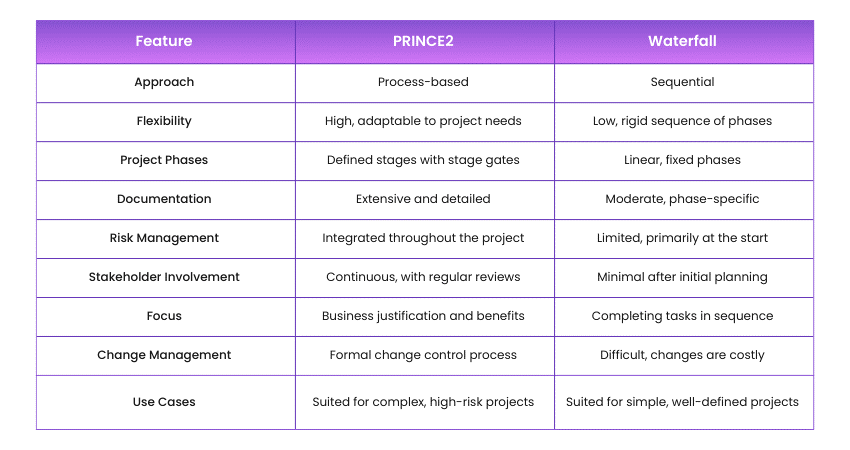
The significant difference between PRINCE2 and Waterfall methodology is that PRINCE2 is a Project Management methodology, while Waterfall is a development approach. They also follow different processes or phases.
PRINCE2 Processes in Detail
PRINCE2 consists of seven processes that help manage projects effectively:
1) Start-up the Project: This initial phase begins with a project mandate, a request to start a new project. The organisation assesses the mandate to check the project's feasibility and then approves or rejects it.
2) Initiate the Project: Once approved, the project is initiated with a document outlining the project's objectives, estimated cost, benefits, potential risks, and more.
3) Direct the Project: The project initiation document is reviewed by the board for approval. They analyse the project's benefits and decide whether to authorise it.
4) Control Stages: The PRINCE2 Project Manager assigns tasks to team members, resolves issues and conflicts, and tracks the project's progress.
5) Manage Product Delivery: This stage ensures the proper delivery of the project product.
6) Manage Stage Boundary: This phase includes two stages: the Project Manager updates the project board with observations and progress reports, and the board evaluates this data to make informed decisions about the next stage.
7) Close the Project: The final process checks if the project has achieved its objectives on time and within budget.
Waterfall Model Stages in Detail
The Waterfall model for software development also consists of seven sequential stages:
1) Requirements: The most crucial stage where the project plan is created, including flow diagrams that map out responsibilities, resources, and timelines.
2) Analysis: Established requirements are analysed for feasibility, helping authorities optimise Project Management for success.
3) Design: Documenting requirements like programming languages and hardware, this stage has two steps: high-level design (outline of design and functionality) and low-level design (detailed approach to development).
4) Coding and Implementation: The source code is created based on the product model, logic, and design requirements, initiating the software development process.
5) Testing: The product undergoes testing to identify and fix errors. The Quality Assurance (QA) team conducts various tests, such as quality assurance, system, and beta tests, to reveal and address issues.
6) Operation and Deployment: The completed product is released to the end user, marking the launch of the product.
7) Maintenance: Continuous upgrades improve the product. Post-launch, bugs might be detected, requiring updates. Upgrades can also come as patch updates or new versions.
Both PRINCE2 and Waterfall have distinct phases that structure their respective methodologies, ensuring effective Project Management and development.
Conclusion
PRINCE2 offers a flexible and dynamic approach, which is ideal for projects requiring frequent adaptation. Waterfall, on the other hand, suits projects with well-defined stages and stable requirements. Both have their merits, and the choice between PRINCE2 and Waterfall should be based on the specific demands and environment of the project at hand. Understanding both methodologies enables managers to make informed decisions, ensuring project success in various scenarios.
Take your Project Management career to the next level with our PRINCE2® Training – sign up now!
Frequently Asked Questions
How Does PRINCE2 Stack up Against Waterfall?
PRINCE2, a flexible Project Management methodology, adapts to various projects with structured processes. Waterfall, a sequential development approach, works well for clear, defined projects. PRINCE2 offers more adaptability and control, whereas Waterfall ensures clarity and straightforward progression.
What is the Waterfall Model Similar to?
The Waterfall model is similar to traditional manufacturing and construction processes. They follow a linear and sequential approach, where each phase must be finished before beginning the next. This makes Waterfall ideal for projects with well-defined, unchanging requirements and clear stages.
What is the Major Drawback of the Waterfall Model?
The major drawback of the Waterfall model is its inflexibility. Once a phase is completed, revisiting it is difficult, making it challenging to accommodate changes or new requirements. This rigidity can lead to issues if project requirements evolve, or unforeseen problems arise during later stages.



 Continue Browsing