Contact@prince2training.co.uk
 01344203999




 Back
Back


Table of Content

07-Sep-2026

David Walter
PRINCE2 Risk Management is one of the significant phases of Project Management. It creates awareness of potential risks, analyses them, and efficiently controls them. Enhanced Risk Management strategies are essential for any project to succeed in today’s business world, which is characterised by numerous risks and uncertainties.
PRINCE2 is one of the most popular Project Management models, and it depicts Risk Management throughout the Project Life Cycle. This blog will define Risk Management as part of PRINCE2, discuss why it is critical in the context of projects, establish what principles and processes it owns, and thus help responsible project managers and all participating teams deal with risks that may occur in projects and ultimately improve those projects.
Table of Contents
1) What is PRINCE2 Risk Management?
2) How does PRINCE2 help manage Risks?
3) How does the PRINCE2 Risk Management approach work?
4) PRINCE2 Risk Management process
5) Conclusion
What is PRINCE2 Risk Management?
PRINCE2 Risk Management precisely entails identifying, evaluating, and mitigating risks in a project. It guarantees the possibility of threats or opportunities management. As in most frameworks, PRINCE2 has a balanced approach of viewing risk as an issue and an opportunity. The process includes:
a) Identification:
The key steps in Risk Management
b) Assessment:
Assessing the probability and the potential consequences that risks will pose to the project objectives
c) Control:
Mitigating strategies for addressing risks.
PRINCE2 also helps define risks in terms of their impact and probability, which aids efficiency in managing them, including project performance and overall organisational objectives.
How does PRINCE2 help manage Risks?
Here's how PRINCE2 helps in managing risks:
a) Structured approach:
PRINCE2 guides managing risks, clearly and effectively stating that risks should be identified and managed during project work. It is a structured process that can assist the project team in responding adequately to various risks that may threaten the project's success.
b) Risk Management strategy:
The Risk Management strategy is an essential aspect of PRINCE2 that must be developed during a project's initial phase. This document sets out a way of identifying, evaluating and controlling risks while working on the project. It also describes areas of authority and accountability concerning Risk Management.
c) Risk Register:
According to PRINCE2, a Risk Register is recommended to facilitate risk identification and management. Risk information entered into the Risk Register may include risk type, exposure, likelihood, and treatment plan. This aids in monitoring the risks and their status, which is essential in a project.
d) Risk Management approach:
Risk Management is an essential factor in PRINCE2, and the practice has provisions that support risk anticipation. It stresses the need to recognise risks during the early stages of the project development phase and find adequate ways to cope with them. This proactive approach effectively manages risk because it reduces the negative effect of risks on project outcomes.
e) Regular reviews:
According to PRINCE2, the Risk Register and Risk Management strategy should be reviewed as needed. This guarantees that risks are adequately observed and efficient response measures. Regular reviews also help the project teams identify new risks likely to occur during a project.
f) Integration with other processes:
PRINCE2 integrates Risk Management with Project Management processes. For example, Risk Management is closely linked to planning, change control, and quality management processes. This integration ensures that Risk Management is integral to Project Management activities.
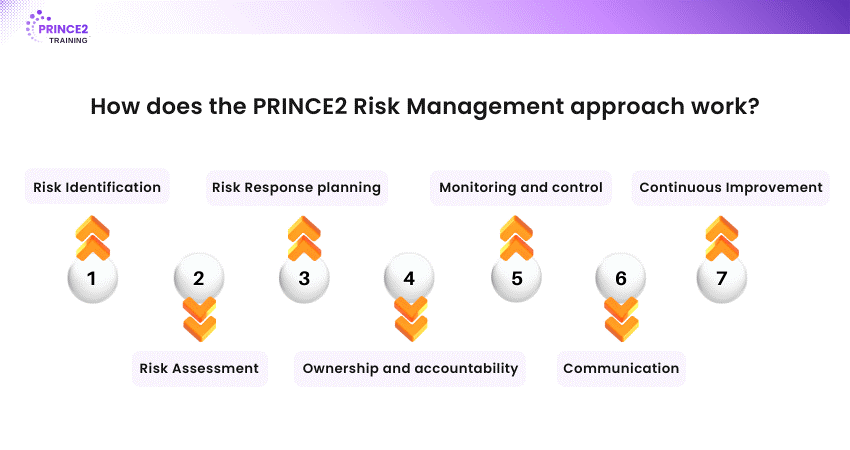
How does the PRINCE2 Risk Management approach work?
PRINCE2 Risk Management process operates through a methodology that entails systematic identification, evaluation, control, and reduction of risks in a project throughout its life cycle. Here's how it works:
a) Risk Identification:
The first approach is to assess the risk potential that may hinder the achievement of the project's objectives. This is achieved by conducting brainstorming sessions and risks and checking project documentation and lessons learned from similar projects.
b) Risk Assessment:
Once risks are established, they are evaluated by their probability of occurrence and likely effect on the project. This makes it easier for an organisation to address risks and target the most probable risks that could hinder a project's success.
c) Risk Response planning:
A response is prepared for each identified risk. This plan outlines what will happen if the risk occurs. Possible responses to risks are risk mitigation (actions aimed at decreasing the probability or consequences of the risk), risk avoidance (elimination of the risk), risk transfer (passing the risk to a third party), and risk acceptance (acknowledgement of the risk and its possible consequences).
d) Ownership and accountability:
Every Risk Response is linked with a coordinator who executes the plan. This also ensures that risks are managed and someone is directly responsible for them.
e) Monitoring and control:
Using Risk Management tools, the status and adequacy of response plans are tracked throughout the project. If needed, this enables one to adapt response strategies and ensures risks are addressed effectively.
f) Communication:
The PRINCE2 Risk Management approach emphasises the importance of communication. It is also essential to share risk and response plans with stakeholders so that they are aware of the type of risks that may impact the project.
g) Continuous Improvement:
Risk Management reviews are conducted following the project to change the Risk Management framework for the following projects. This means that the PRINCE2 Risk Management approach grows with experience, and this is done through feedback.
PRINCE2 Risk Management process
PRINCE2 Risk Management identifies, assesses, and controls risks encountered in any project phase. Here’s a detailed breakdown of this process:
1) Risk Management strategy:
The first one is the Risk Management Strategy, which states how risks are going to be managed and what procedures, techniques, and tools are going to be used. It was developed during the project's initiation and serves as a guide to other subsequent Risk Management.
2) Identify:
These include brainstorming sessions, risk workshops, and analysis of strengths, weaknesses, opportunities, threats, and past project experiences. When preparing this document, the goal is to compile a list of all possible threats that might affect the project.
3) Assess:
Once a risk has been identified, it is evaluated to assess its likelihood and consequence to the project. This assessment involves two key activities:
a) Risk Estimation:
Assessing the probability of each risk in occurrence and its consequences on achieving project goals.
b) Risk Evaluation:
This is done by matching the estimated risks against the project's risk appetite and risk thresholds to rank them.
4) Plan:
For each prioritised risk, the risk response plan is created. This plan includes:
a) Mitigation:
Measures that can prevent the risk or lessen its effect.
b) Avoidance:
Measures that can be taken to obliterate the threat.
c) Transfer:
Transferring the risk to another party
d) Acceptance:
Recognising the possibility and getting ready to mitigate the effects when it occurs.
5) Implement:
Risk Mitigation plans are carried out. Risk owners are made to take charge of certain risks so that proper control and follow-ups can be made actively.
6) Communicate:
Communication throughout the project is crucial to ensure all stakeholders have the information they need concerning risks and how to contain them. Another critical aspect of Risk Management is maintaining and updating the Risk Register frequently.
7) Monitor and review:
The Risk Management process entails constant monitoring to ensure the efficiency of the response plans and identify new risks. This continuous review makes Risk Management more effective and relevant to the project's changing conditions.
Attain in-depth knowledge about PRINCE2® principles, themes, and processes with our
PRINCE2® Foundation Course!
Conclusion
The PRINCE2 Risk Management process identifies, assesses, plans, and controls risks essential to avoiding uncertainty and making the projects reachable to the planned objectives. It also offers a rational and strategic approach to dealing with risks, whereas in most cases, Risk Management merely offers the project teams a way of working on risks once they surface in the project.
Enhance your understanding on how you can provide a common approach and towards a project with our PRINCE2® Training!



 Continue Browsing