Contact@prince2training.co.uk
 01344203999




 Back
Back


Table of Content

30-Jul-2026

Hailey Davis
Understanding what truly delights your customers can feel like chasing a moving target, which is where the Kano Model becomes especially valuable. This powerful framework helps organisations uncover not just what customers want, but what will genuinely surprise them and inspire long-term loyalty.
In this blog, we'll explore how hidden expectations shape customer experiences and why even small innovations can spark big emotional wins. So read on to understand What is the Kano Model and learn how to design products that stand out in a competitive market.
What is the Kano Model?
The Kano Model is a simple method used to prioritise product features based on how much they will satisfy customers. It helps product teams decide whether a feature is worth adding by comparing its potential value to customers with the effort or cost required to build it.
The Kano Model helps identify which features will meet customer expectations, which ones will impress them, and which might lead to dissatisfaction. Product managers often group features into different categories based on how customers are likely to respond to them.

How Does the Kano Model Work?
The Kano Model works by analysing how different product features influence customer satisfaction and then classifying those features into specific categories. Product teams begin by identifying potential features and collecting customer feedback using structured questions about how customers feel when a feature is present or absent.
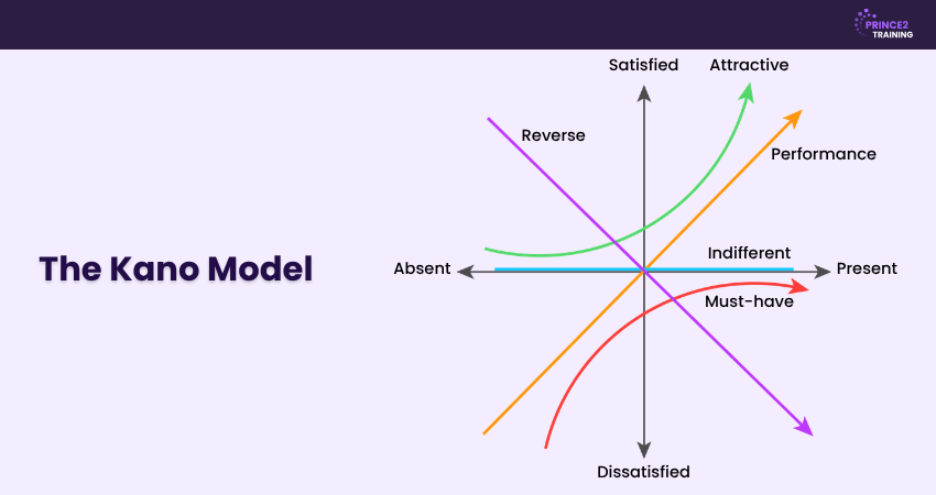
Based on the responses, features are grouped into five categories: Must-Have, Performance, Excitement, Indifferent, and Reverse. This classification helps teams understand which features are essential, which improve satisfaction, which can delight customers, which have little impact, and which may even cause dissatisfaction.
Teams then prioritise features by comparing customer value with the time, effort, and cost required to implement them. Regular reviews are important because customer expectations change over time, and features can shift from one category to another.
What is the History of the Kano Model?
The Kano Model was developed in the early 1980s by Noriaki Kano who was a professor of Quality Management at the Tokyo University of Science. He formally introduced the model in 1984 through his research on customer satisfaction and product quality.
At the time, businesses mainly focused on improving products by fixing issues or adding more features. However, Kano challenged this idea by showing that not all features impact customers in the same way. Through surveys and research, he identified that customer satisfaction depends on different types of features: some are basic expectations, while others can truly delight users.
This insight led to the creation of a new framework that categorises features based on how customers feel about them. Over time, the Kano Model gained global recognition and became a widely used tool in Product Development, UX Design and Quality Management for prioritising features based on customer value.
Transform complex project challenges into inspiring wins with our PRINCE2® Practitioner Course - Register now!
The Five Categories of Kano Model Features
The Kano Model groups product features into these five categories based on how customers respond to their functionality and impact on satisfaction:
1) Must-have Features
Must-have features are basic expectations that customers assume will already be included. If they are missing, customers will be dissatisfied, but their presence does not increase satisfaction. For instance, a phone should make calls, a hotel room should have basic amenities, and a car should have brakes. These features are essential, but once they meet a basic standard, further investment does not significantly improve customer satisfaction.
2) Performance Features
Performance features follow a simple rule: the better they are, the more satisfied customers become. These are often called linear or one-dimensional features because satisfaction increases in direct proportion to performance. For example, factors like internet speed, battery life or storage capacity fall into this category. The more you improve them, the happier users are. However, improving these features usually requires more resources and investment.
3) Attractive Features
Attractive features are unexpected additions that delight customers. These are not required, but when included, they create a positive and memorable experience. Think of features that surprise users or go beyond expectations, such as a smooth user interface or a smart, intuitive function. Even small enhancements in this category can significantly boost satisfaction, though excessive investment may not always be necessary.
4) Indifferent Features
Indifferent features are those that customers do not particularly care about. Whether these features are present or not, they have little to no impact on satisfaction. Spending time and resources on such features is often not worthwhile because they do not influence the overall user experience or purchasing decisions.
5) Reverse Quality
These attributes can lead to dissatisfaction when over-delivered or unnecessarily improved. Different customers have different preferences, and what delights one group may frustrate another. Excessive complexity or over-engineering can reduce usability for customers who prefer simplicity. Balancing features based on user needs is critical to avoid overwhelming or alienating certain customer segments.
Upgrade your project game with the Agile touch - Sign up for our PRINCE2 Agile® Foundation and Practitioner Course now!
How to Use the Kano Model?
Using the Kano Model involves a structured process that helps teams evaluate customer needs and prioritise features based on their impact on satisfaction. It provides a practical way to make informed product decisions rather than relying on assumptions.
Step 1: Identify Customer Needs and Potential Features
Start by gathering a list of possible features from customer feedback, market research, support tickets, or stakeholder suggestions. The goal is to understand what customers expect and what improvements could enhance their experience.
Typical sources include:
a) Customer surveys and feedback
b) Product reviews and complaints
c) Competitor analysis
d) Internal brainstorming sessions
Step 2: Design Kano Survey Questions
Create a short survey for each feature using two key questions:
a) Functional question: How do you feel if the feature is available?
b) Dysfunctional question: How do you feel if the feature is not available?
Customers usually respond using options such as:
a) I like it
b) I expect it
c) I am neutral
d) I can tolerate it
e) I dislike it
This approach helps capture true customer expectations and emotional reactions.
Step 3: Categorise Features into Kano Categories
Analyse survey responses and place each feature into one of the five categories:
a) Must-Have: Essential features customers expect
b) Performance: Features that improve satisfaction as performance increases
c) Excitement: Features that delight customers unexpectedly
d) Indifferent: Features that have little impact on satisfaction
e) Reverse: Features that may frustrate customers
This classification provides clarity on which features deliver value and which do not.
Step 4: Prioritise Features for Development
Once features are categorised, compare their customer value with implementation effort, cost, and resources. This helps teams decide what to build first and what to postpone or avoid.
Common prioritisation actions:
a) Deliver Must-Have features immediately
b) Improve Performance features to boost satisfaction
c) Introduce Excitement features strategically
d) Reduce focus on Indifferent features
e) Avoid or redesign Reverse features
Step 5: Monitor and Update Regularly
Customer expectations evolve over time, so teams should revisit the Kano analysis periodically. A feature that once delighted customers may eventually become a basic expectation.
Example:
Online order tracking was once an exciting feature, but it is now considered a must-have in many industries.
Lay the groundwork for unparalleled project success with our PRINCE2® Foundation Course - Register now!
Strengths of the Kano Model Analysis
The Kano Model offers several important advantages for product teams. Here are the major ones:
1) Customer-centric Prioritisation
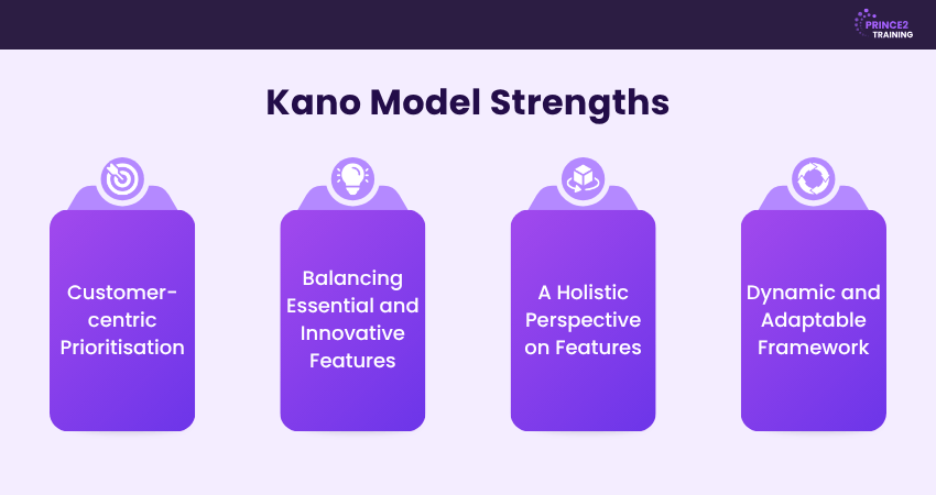
One of the biggest strengths of the Kano Model is its strong focus on customer needs. It helps teams understand how customers use a product and what they expect for a good experience. By directly collecting customer feedback, teams can make informed decisions that improve satisfaction and retention.
2) Balancing Essential and Innovative Features
The model helps Product Managers maintain the right balance between basic features that customers expect and the innovative features that can differentiate the product. This ensures that essential requirements are met while also creating opportunities to delight users.
3) A Holistic Perspective on Features
The Kano Model looks at both the presence and absence of features. This allows teams to understand how missing features can negatively impact users. This gives a more well-rounded view of customer expectations and helps with better prioritisation.
4) Dynamic and Adaptable Framework
Customer expectations change over time, and the Kano Model supports continuous reassessment. This makes it a flexible framework that helps teams adapt their priorities and stay aligned with evolving customer needs.
Weaknesses of the Kano Model Analysis
While the Kano Model is useful, it also has some limitations to be considered:
1) Difficulty in Prioritising Within Categories
The model helps classify features into categories based on customer perception, but it does not provide clear guidance on how to prioritise features within the same category. For example, many features may fall into the "performance" group, and additional methods are needed to decide which ones to focus on first.
2) Time-consuming Data Collection
The Kano Model relies heavily on customer feedback gathered through surveys and interviews. Collecting this data can take significant time and effort, especially for smaller teams or projects with tight deadlines.
3) Challenges in Feature Categorisation
Assigning features to the correct categories can be difficult and sometimes subjective. Since the model depends on customer opinions, differing views can lead to inconsistent results. Teams often rely on majority responses, which may not always reflect a clear or unified priority.
Situations Where the Kano Model is Useful
These are the right situations to harness the power of the Kano Model:
a) During New Product Development: When designing a new product or service, the Kano Model helps identify which features will meet basic expectations and which can create a competitive edge.
b) When Prioritising Features: It is useful when you have multiple feature ideas and need to decide which ones will deliver the highest customer satisfaction.
c) When Resources are Limited: The model helps teams make smarter decisions when time, budget, or resources are constrained.
d) When Analysing Customer Feedback: It helps organise and interpret survey data by categorising features based on customer reactions.
e) When Improving an Existing Product: The Kano Model can guide updates and enhancements to ensure the product stays relevant and competitive.
f) For Competitive Analysis: It helps identify gaps in the market and diverse opportunities to differentiate your product from competitors.
g) When Aiming to Boost Customer Satisfaction: The model helps teams understand what truly matters to customers and what will delight them.
Conclusion
The Kano Model reminds us that customer satisfaction isn't static; it evolves with every need, emotion and unexpected delight. By recognising which features matter most, which excite, and which simply maintain trust, businesses can design experiences that feel intuitive. So, embrace the model, listen closely and let customer joy guide your next breakthrough.
From planning to delivery, lead every project with confidence and conviction - Sign up for our PRINCE2® Training now!
Frequently Asked Questions
Who Created the Kano Model?
The Kano Model was developed by Professor Noriaki Kano in the early 1980s. He introduced it as a way to understand how different product features influence customer satisfaction and expectations.
What are the Limitations of the Kano Model?
The Kano Model can be time-consuming as it relies on detailed customer feedback through surveys and interviews. It may also be difficult to prioritise features within the same category and can involve subjective interpretation when categorising features.
What is the Difference Between Basic and Excitement Features in the Kano Model?
Basic features are essential requirements that customers expect by default, and their absence leads to dissatisfaction, but their presence does not increase satisfaction. In contrast, excitement features are unexpected additions that delight customers and significantly enhance satisfaction when included.



 Continue Browsing