Contact@prince2training.co.uk
 01344203999




 Back
Back


Table of Content

21-Sep-2026

Hailey Davis
Have you ever ended your day feeling busy but not truly productive? You tick off small tasks, respond to messages and attend meetings, yet the important work still gets delayed. This is where the Eisenhower Matrix becomes the real difference maker. It helps you clearly see what needs your attention now, what can be planned, what to delegate and what to eliminate.
It offers a simple way to organise your tasks, reduce stress, and focus on what really matters. By using this approach, you can make smarter decisions, stay in control of your workload, and achieve your goals confidently. In this blog, you will learn about what is Eisenhower Matrix, its quadrants, examples, benefits, and more. Let's begin!
Table of Contents
1) What is the Eisenhower Matrix?
2) What's the History of the Eisenhower Matrix?
3) The Four Quadrants of the Eisenhower Matrix
4) How to Prioritise Tasks Using the Eisenhower Matrix?
5) Examples of the Eisenhower Matrix
6) Benefits of the Eisenhower Matrix
7) Common Mistakes to Avoid
8) Conclusion
What is the Eisenhower Matrix?
The Eisenhower Matrix is a Time Management tool that helps individuals decide what to focus on and what to set aside. It provides a clear structure to decide what needs immediate attention and what can be planned, delegated, or ignored. This approach allows you to focus on meaningful work rather than simply staying busy.
It divides tasks into categories based on urgency and importance. This helps you to act on high-priority work, schedule important tasks, delegate less critical activities, and eliminate tasks that add little value. Over time, this leads to better productivity, clearer priorities and more effective use of time.

What's the History of the Eisenhower Matrix?
The concept behind the Eisenhower Matrix comes from Dwight D. Eisenhower, who was known for his ability to manage complex decisions under pressure. During his time as an Army general, Supreme Allied Commander of North Atlantic Treaty Organisation (NATO) forces, and President of the United States, he focused on distinguishing between what was urgent and what was truly important. This principle helped him handle multiple high-stakes responsibilities effectively.
After a couple of years, Stephen Covey brought this idea into the mainstream through his book "The 7 Habits of Highly Effective People." He expanded on Eisenhower's approach to prioritisation, making it simpler for individuals and organisations to apply it in everyday work. Today, the Eisenhower Matrix is widely used as a practical framework for Time Management and decision-making across industries.
The Four Quadrants of the Eisenhower Matrix
The Eisenhower Matrix helps organise tasks into four clear quadrants based on urgency and importance. Categorising each task gives better visibility, making it easier to prioritise, plan, and focus on what truly matters. Let's look at them below:
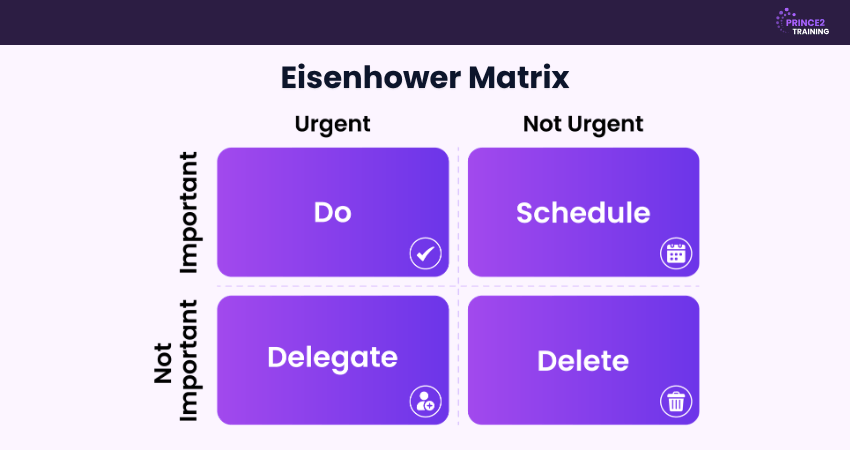
Quadrant 1: Do First (Urgent and Important)
This quadrant includes tasks that require immediate attention and directly impact your goals. These are often high-pressure activities with clear deadlines or consequences if delayed. Acting quickly on these tasks helps move work forward smoothly.
Tasks in this category are easy to identify because they demand your focus right away and often cause the most stress. Completing them promptly ensures you stay on track and avoid unnecessary issues.
Quadrant 2: Schedule (Important, Not Urgent)
This quadrant focuses on tasks that are important for long-term success but do not need any immediate action. These activities contribute to growth, planning, and improvement. Giving time to these tasks helps you build a strong foundation for future success.
Since these tasks are not urgent, you can schedule them for later and allocate dedicated time to complete them. Prioritising this quadrant helps you stay proactive and supports consistent progress toward your goals.
Quadrant 3: Delegate (Urgent, Not Important)
Tasks in this quadrant need to be completed quickly, but do not significantly contribute to your long-term objectives. They are often routine or administrative in nature. Handling them efficiently ensures that urgent needs are met without disrupting your focus on high-value work.
Since these tasks do not require your specific expertise, they can be delegated to others. Delegation reduces your workload, empowers your team to develop new skills, and takes ownership of responsibilities.
Quadrant 4: Delete (Not Urgent and Not Important)
This quadrant includes tasks that do not add value and do not require immediate action. These activities are distractions that consume time without contributing to your goals. Identifying and removing such tasks is key to maintaining focus.
By removing unnecessary work, you can dedicate more time and energy to tasks that truly matter. This leads to better Time Management and more meaningful results.
Balance Agile speed with PRINCE2® precision by joining the
PRINCE2 Agile® Foundation and Practitioner Training
now!
How to Prioritise Tasks Using the Eisenhower Matrix?
The Eisenhower Matrix follows a systematic process that helps you organise tasks clearly and take the right action at the right time. By following these steps, you can move from a cluttered to-do list to a well-structured plan. Let's look at them below:
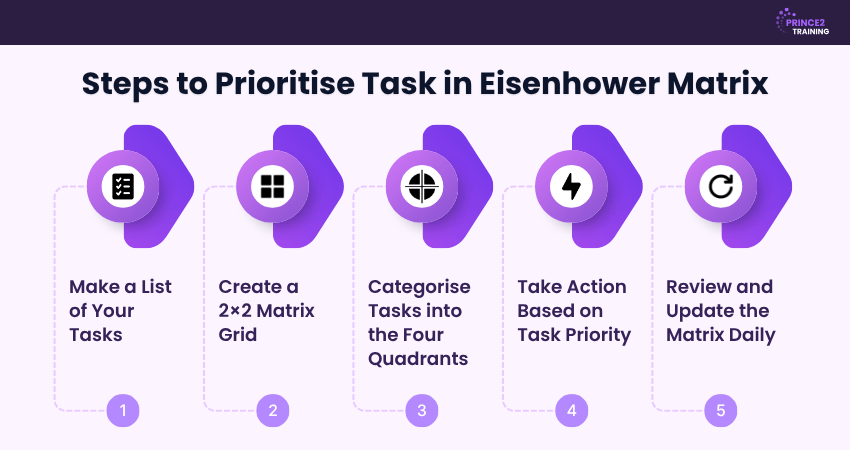
1) Make a List of Your Tasks
Begin by listing the tasks you require to complete. This includes both urgent and non-urgent activities, big or small. Having everything in one place gives you a clear overview of your workload and helps you avoid missing important or urgent tasks.
2) Create a 2×2 Matrix Grid
Next, draw a simple 2×2 grid on paper or use a digital tool. Label the columns as "Urgent" and "Not Urgent," and the rows as "Important" and "Not Important." This structure forms the foundation of the Eisenhower Matrix and makes categorisation tasks easier.
3) Categorise Tasks into the Four Quadrants
Now, place each task into the most suitable quadrant based on its urgency and importance. Add urgent and important tasks to Quadrant 1, schedule important tasks in Quadrant 2, delegate less important urgent tasks in Quadrant 3, and eliminate tasks in Quadrant 4.
4) Take Action Based on Task Priority
Once your tasks are organised, act accordingly. Complete Quadrant 1 tasks immediately, plan and schedule Quadrant 2 tasks, delegate Quadrant 3 tasks to others, and remove Quadrant 4 tasks to free up time. This step ensures your efforts are directed towards what truly matters.
5) Review and Update the Matrix Daily
Lastly, review your matrix regularly to keep it updated. Priorities can change, so it is important to reassess tasks daily. Make sure you give enough attention to Quadrant 2 tasks, as this helps prevent them from becoming urgent later.
Start your Project Management journey strong with globally recognised PRINCE2® skills by joining the
PRINCE2® Foundation Training
today!
Examples of the Eisenhower Matrix
Understanding the Eisenhower Matrix becomes easier when you see how it applies to real-world roles. Let's look at some examples below:
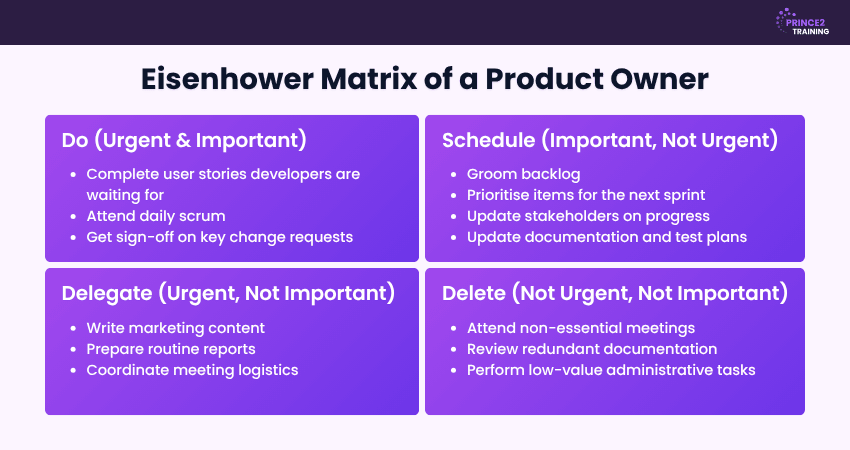
1) Product Owner
Product Owners balance product vision with team execution. The Eisenhower Matrix helps them prioritise tasks that directly influence sprint outcomes. It ensures their time is spent on enabling team progress rather than getting stuck in low-value activities.
Example:
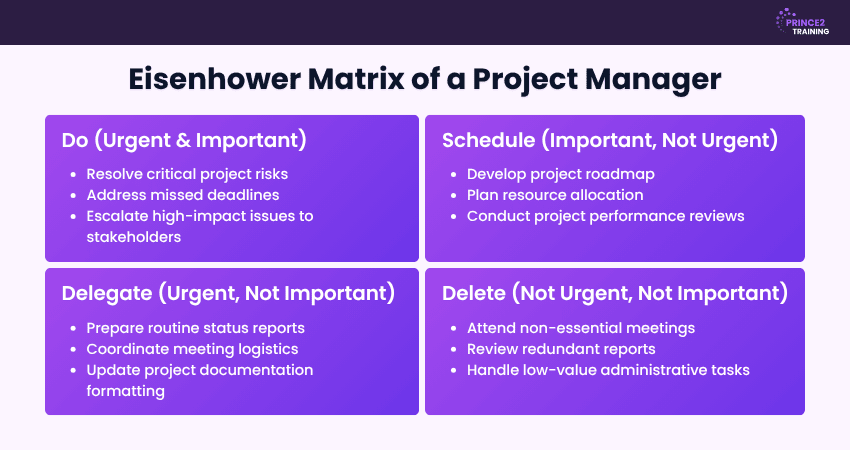
2) Project Manager
Project Managers coordinate tasks, teams, and project timelines. The Eisenhower Matrix allows them to focus on critical decisions. This helps them maintain control over project progress without being overwhelmed by daily demands.
Example:
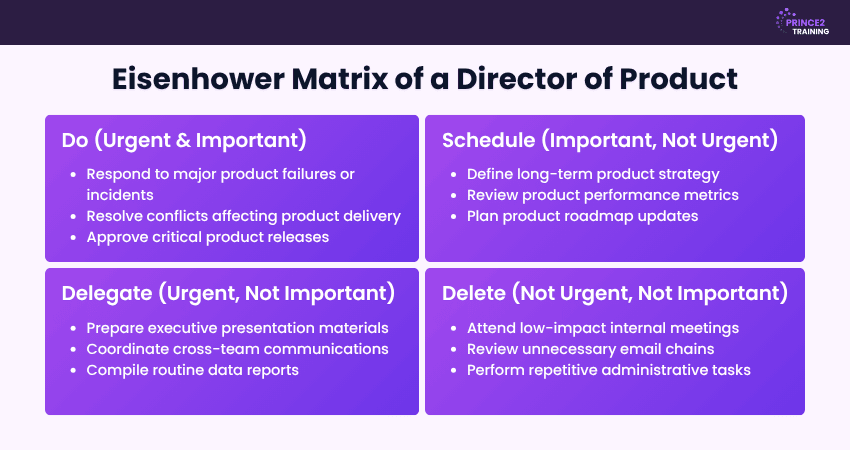
3) Director of Product
Directors of Product focus on strategy and team direction. The Eisenhower Matrix helps them spend more time on leadership and less on operational distractions. It supports better decision-making by highlighting what truly drives product success.
Example:
Benefits of the Eisenhower Matrix
The Eisenhower Matrix provides a simple and effective way to manage time, reduce stress, and improve productivity. Let's look at its key benefits below:
1) Prioritise Tasks Effectively: The Eisenhower Matrix helps you clearly identify which tasks should be handled first. By separating urgent and important work, you ensure your time is spent on high-priority activities, reducing confusion and improving clarity.
2) Avoids Unnecessary Urgency: The matrix helps you recognise the difference between urgent and non-urgent tasks. It prevents you from reacting to every request and encourages thoughtful decision-making.
3) Remove Time Wasters: The matrix makes it easier to spot tasks that do not contribute to your goals. By delegating or eliminating such activities, you can create space for meaningful and productive work.
4) Keeps You on Track: The Eisenhower Matrix helps you stay aligned with your long-term goals. It encourages consistent progress and prevents you from getting sidetracked. Over time, this leads to better results and improved Time Management.
Lead complex projects with confidence and control with PRINCE2® Practitioner Training – Sign up now!
Common Mistakes to Avoid
While the Eisenhower Matrix is simple to use, certain mistakes can reduce its effectiveness. Let's look at some common mistakes to avoid below:
1) Eliminate Tasks Before Prioritising
Do not rush to categorise every task. Start by removing tasks that are unimportant or unnecessary. This declutters your list and makes it easier to focus on what truly matters. This leads to better decisions and prevents wasted effort on low-value work.
2) Avoid Overloading Quadrant 1
Quadrant 1 should only include urgent and important tasks. If you place too many tasks here, everything starts to feel urgent, making it harder to prioritise effectively. This can lead to stress, confusion, and constant firefighting.
3) Do Not Combine Personal and Work Tasks
Combining personal and work tasks in one matrix can create confusion. It may give a false sense of balance. Keeping separate matrices helps maintain clarity, improves focus, and ensures each area of your life gets sufficient attention.
Conclusion
Managing your time effectively is about doing the right ones at the right time. The Eisenhower Matrix gives you a clear and practical way to prioritise, reduce stress, and stay focused on what truly matters. By applying this approach, you can work smarter, make better decisions and achieve your goals with confidence and clarity.
Deliver successful projects with proven PRINCE2® methods by registering for the PRINCE2® Training – Join now!
Frequently Asked Questions
What are the Three Ds of Prioritising?
The three Ds of prioritising are:
a) Do: Act on urgent, important tasks.
b) Delegate: Assign less critical tasks.
c) Defer or Delete: Delay or remove low-value tasks.
Is the Eisenhower Matrix a Good Idea?
The Eisenhower Matrix is a simple and effective tool for improving productivity and reducing procrastination. It helps you focus on high-impact work and eliminate distractions, making it a practical approach for better Time Management.
What is the Difference Between Urgent and Important Tasks?
Urgent tasks require immediate action and are driven by deadlines or external demands. Important tasks focus on long-term goals and meaningful outcomes. Urgent tasks are reactive and time-sensitive, while important tasks are proactive and require planning for future success.



 Continue Browsing