Contact@prince2training.co.uk
 01344203999



 Back
Back


Table of Content


05-Oct-2026

Maria Thompson
Have you ever wondered how businesses keep up with constant change while still delivering quality solutions on time? The answer often lies in Agile frameworks, and one of the most trusted is the Dynamic Systems Development Method (DSDM). Known for its collaboration, flexibility, and speed, DSDM helps teams deliver real business value without losing focus.
In this blog, we’ll explore what is DSDM, its principles, benefits, and why it continues to empower Agile teams worldwide. So read on and ensure speed in your dynamic projects without sacrificing quality!
What is the Dynamic Systems Development Method?
The Dynamic Systems Development Method (DSDM) is an Agile framework that helps teams deliver projects quickly and effectively. It focuses on involving users throughout the process, working in short cycles, and making sure the most important requirements are completed first. This approach keeps projects on time, within budget, and aligned with business needs.
For example, instead of trying to finish every detail of a project before showing it, teams deliver the most useful parts first. This avoids long delays and makes sure the solution meets real business goals. Unlike traditional methods, DSDM allows changes as the project grows, making it easier to respond to new needs.

Key Principles of Dynamic Systems Development Method
Like any structured approach, Dynamic Systems Development Method is guided by a set of core principles that ensure consistency and flexibility across the entire product lifecycle. Here are the key principles:
1) Focus on the Business Need
DSDM places a strong emphasis on delivering outcomes that directly support business objectives. Close collaboration with stakeholders helps clarify priorities and ensures that every feature delivers measurable value.
2) Deliver on Time
Timeboxing is central to DSDM as it sets fixed periods for development activities. This approach encourages teams to focus on high-priority features while maintaining disciplined planning and progress tracking for meeting agreed-upon deadlines.
3) Collaborate
Ongoing stakeholder involvement is essential. Continuous collaboration promotes transparent communication, shared understanding and faster, well-informed decision-making across teams.
4) Never Compromise on Quality
Quality is embedded throughout the development process through continuous testing and validation. Maintaining high standards helps prevent technical debt, reduces future maintenance effort, and strengthens stakeholder confidence.
5) Build Incrementally From Firm Foundations
Development begins with the core components that establish a stable technical baseline. Additional functionality is then introduced through controlled iterations, thus helping teams manage complexity and support long-term scalability.
6) Iterative Development
The work progresses through repeated development cycles which allow regular testing, refinement and feedback. This iterative approach supports continuous improvement and the early identification of issues.
7) Continuous Communication
Open and transparent information flow is essential to keep teams and stakeholders aligned. Regular communication encourages timely feedback and the swift resolution of concerns.
8) Demonstrate Control
Clear governance and monitoring mechanisms are used to track progress, manage risks, and ensure outcomes remain aligned with business goals throughout the project lifecycle.
5 Phases of the DSDM Life Cycle
Dynamic Systems Development Method typically includes the following five major phases:
1) Feasibility
a) Review the project requirements to assess achievability
b) Evaluate goals against budget, Project timelines and available technology
c) Rework the plan if the constraints prevent successful delivery
2) Business Study
a) Assess the project’s alignment with organisational objectives
b) Evaluate its competitiveness within the industry
c) Confirm if it addresses the user needs and supports business goals
3) Functional Model Iteration
a) Develop a prototype based on the defined requirements
b) Test and evaluate its functionality against specifications
c) Refine and repeat iterations until the prototype is fit for final development
4) Design and Build
a) Refine the prototype to improve its performance and efficiency
b) Add or adjust components to resolve issues and boost functionality
c) Conduct thorough testing to ensure its usability, reliability and responsiveness
5) Implementation
a) Deploy the product into its live operational environment
b) Gather user feedback and assess its real-world effectiveness
c) Refine or revisit earlier stages based on feedback to address new challenges
Start Agile Project Management Foundation (Agile PM®) Training and build your Project Management foundation now!
How to Implement DSDM?
Teams, deadlines, and tools must all be in line with business objectives when DSDM is implemented using a methodical but adaptable approach. Here's how to begin each of the process's essential steps:
1) Identify Overall Project Objective
Start by outlining the project's goals in detail. This goal should give the team a common vision and be in line with business requirements. A clear objective sets the stage for development that is value-driven and targeted.
2) Assign Team Members to Roles
Dynamic Systems Development Method outlines specific roles like Business Ambassador, Solution Developer, and Project Manager. Assigning the right people to these roles ensures accountability and smooth collaboration. Each role contributes uniquely to the project’s success.
3) Set the Deadline
Establish a realistic but firm deadline early in the process. DSDM emphasises timeboxing, so setting clear time constraints helps manage scope and expectations. This keeps the team focused and delivery on track.
4) Select Core Method
Choose the core Agile practices and tools that best support your team and project. DSDM is flexible and integrates with other methods like Kanban or Scrum. The key is to maintain consistency and clarity across the team.
5) Ensure Four Critical Success Factors
DSDM highlights four essentials: effective collaboration, empowered teams, frequent delivery, and clear business focus. Ensuring these are in place boosts the chances of project success. Without them, even the best plans can fall short.
Advantages of DSDM
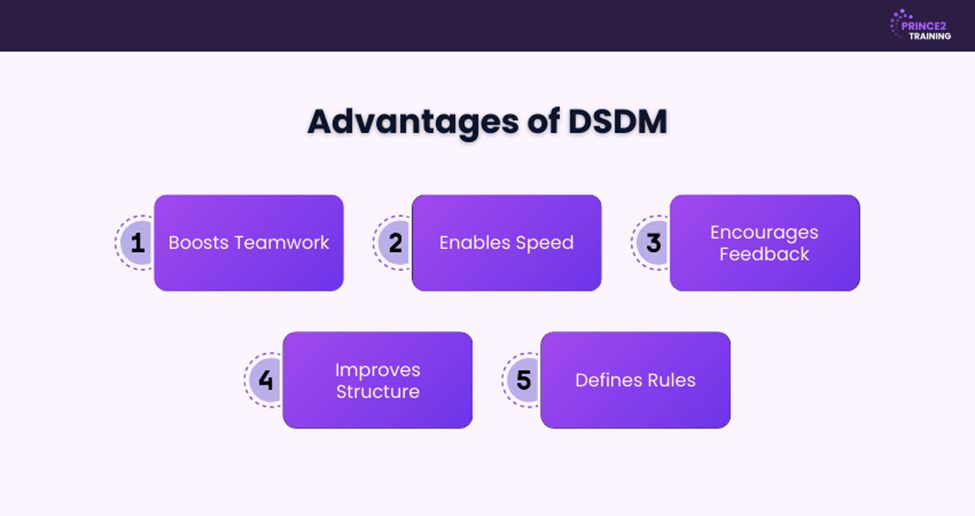
The Dynamic Systems Development Method (DSDM) offers a balanced Agile approach that aligns speed with structure. Its core principles foster an environment where collaboration and clarity lead to project success. Here are some of the examples:
1) Boosts Teamwork
Active user participation and tight coordination between Developers and stakeholders are highly valued in DSDM. This open dialogue makes sure that everyone is on the same page regarding the objectives of a project. Additionally, it cultivates a sense of shared accountability and ownership, which boosts team engagement and morale.
2) Enables Speed
With timeboxing and iterative development, DSDM allows teams to deliver working solutions quickly. Each phase is structured with fixed durations, promoting consistent progress and avoiding delays. This approach is ideal for organisations needing fast delivery without sacrificing quality.
3) Encourages Feedback
A key component of Dynamic Systems Development Method is user feedback and regular reviews. This guarantees that the solution being developed will meet the needs of the business and the expectations of the users. Changes can be made early, and expensive revisions can be avoided later by promoting input throughout the lifecycle.
4) Improves Structure
Unlike some flexible Agile frameworks, DSDM provides a well-defined process model with clear roles and responsibilities. This structure helps teams stay organised and aligned. It also supports better planning, Risk Management, and overall project governance.
5) Defines Rules
Eight guiding principles form the foundation of DSDM and influence team dynamics and decision-making. These guidelines establish a common understanding of the expectations and how the team will operate. This clarity aids in controlling stakeholder expectations and keeping the project on track.
5) Defines Rules
DSDM is built around eight guiding principles that shape team behaviour and decision-making. These principles provide a shared understanding of expectations and how the team should operate. This clarity helps manage stakeholder expectations and keeps the project aligned with its objectives.
Disadvantages of DSDM
While Dynamic Systems Development Method ensures control and rapid delivery, it has limitations. These challenges can affect team creativity, flexibility, and resource usage.
1) Resource-intensive
a) Requires full-time commitment from key stakeholders, especially business users
b) Smaller teams may struggle to meet resource demands
c) High involvement can strain availability and productivity in other areas
2) Creativity-limiting
a) Strong focus on business needs may restrict innovation
b) Emphasis on strict timelines and requirements can limit experimentation
c) Creative flexibility often takes a back seat to process adherence
3) Structure-oriented
a) Heavily dependent on formal roles, documentation, and process
b) May feel rigid compared to other Agile methods
c) Limits flexibility for teams that prefer adaptive or leaner workflows.
Learn project success strategies with our Agile Project Management Practitioner Upgrade (Agile PM®) Course – Join today!
DSDM Techniques
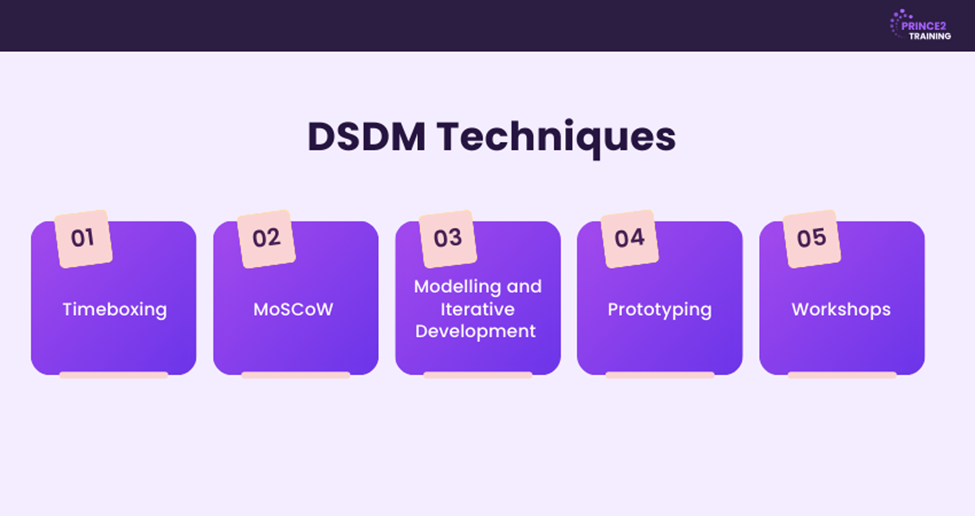
DSDM employs a range of techniques that help teams manage time, prioritise effectively, and engage stakeholders throughout the development process.
1) Timeboxing
involves setting fixed durations for specific tasks or phases of work. It encourages discipline, ensures steady progress, and helps manage expectations. This approach keeps teams focused on priorities and prevents scope from expanding unnecessarily. It also supports predictable delivery by balancing time, cost and quality constraints.
2) MoSCoW
MoSCoW stands for must have, should have, could have, and won’t have. It’s a prioritisation technique that helps teams focus on delivering the most critical features first. This method supports informed decision-making when time or resources are limited. It ensures essential requirements are delivered while maintaining flexibility for future enhancement.
3) Modelling and Iterative Development
Modelling is used to visualise business processes, system behaviours, or data flows. Combined with iterative development, it allows for early validation and refinement of ideas. This approach reduces misunderstandings by making concepts easier to review and discuss. It also enables continuous improvement through regular feedback and testing cycles.
4) Prototyping
Prototyping involves building quick, functional models of the final product. It helps validate ideas, test usability, and gather feedback before full-scale development. Early prototypes highlight design or functionality issues at a low cost. This reduces chances of rework and improves overall solution quality.
5) Workshops
Workshops are structured, collaborative sessions used to gather requirements, resolve conflicts, or plan work. They promote active user involvement and shared understanding. These sessions accelerate decision-making through direct communication. They also strengthen stakeholder commitment and alignment across the project.
Conclusion
The Dynamic Systems Development Method offers a practical and structured way to deliver projects with speed and control. By embracing user involvement, timeboxing and clear prioritisation, teams can stay on track in delivering real business value. It brings clarity, agility, and structure to your delivery process. So, if you're ready to improve how your team builds solutions, DSDM might just be the framework you need.
Learn to lead project with confidence with our
Agile Training - Agile Project Management Training.
Frequently Asked Questions
Who Writes Test Cases in Agile?
In Agile, test cases are typically written by QA Testers or Test Engineers, but they often collaborate with Developers, Product Owners, and Business Analysts. Since Agile promotes cross-functional teams, everyone contributes to quality, including writing or refining test scenarios based on user stories and acceptance criteria.
How to Manage Risks in Agile Projects?
Manage risks in Agile by identifying them early during sprint planning, prioritising by impact, and using timeboxed iterations. Regular retrospectives, continuous feedback, and open communication help detect and address risks quickly, keeping the project on track.
What is the Life Cycle of Agile Testing?
The Agile testing life cycle runs at the same time as development in each sprint. It includes steps like planning, creating test cases, running tests, fixing bugs, and getting feedback. Testing is continuous, so quality is checked and improved at every stage.



 Continue Browsing