Contact@prince2training.co.uk
 01344203999




 Back
Back


Table of Content


05-Oct-2026

David Walter
Have you ever finished a task in a project but still heard someone ask, “Is this really done?” In Agile teams, this often happens when expectations are unclear. Without clear standards, work may appear complete but still need fixes, testing or approvals. This is where the Definition of Done helps teams understand when a task is truly finished.
In this blog we will explore what is the Definition of Done (DoD), its importance in Agile projects, and how teams use it to maintain quality and consistency. Let’s explore it further to understand how it supports Agile teams!
What is the Definition of Done?
Definition of Done (DoD) is a set of criteria that ensures all quality parameters are met for a project release. This set of criteria focuses on high-quality, reduced risk, improved team alignment and monitored progress in Project Management. It is defined collaboratively by the development team, Scrum Master, and Product Owner to establish when a specific Product Backlog Item (PBI) is considered complete. These criteria are formed and agreed upon by the entire team for a successful project release.
The Definition of Done (DoD) follows the standard practices of clear and precise expressions, pre-defined dependencies and pre-approvals from the stakeholders. It can be adaptive for both Kanban and Scrum approaches to Agile. The work defined in the DoD is reviewed, tested and updated by the team members in advance. It is a pre-declared criterion that fully focuses on a smooth project release. This enables transparency during the execution of the project.

Why is the Definition of Done Important?
Definition of Done (DoD) ensures the quality of the product that can be readily delivered, because it emphasises an item when it is marked complete and ready to be added to the product increment list. Checking every product increment under DoD will promote robust quality in the Product Development cycle. It also reduces risks, and there is no room for rework. It clearly defines what criteria a product item should follow before marking ‘done’.
It allows the team to stay aligned during the whole project development cycle. It values customer satisfaction, thus allowing the teams to focus more on the requirements in every sprint planned. It also allows us to monitor the progress of the sprints to map any setbacks in the project. A well-crafted DoD stands as a strong feature for any Project Manager.
Steps to Creating an Effective Definition of Done
Here, we can unlock the steps behind creating an effective DoD:
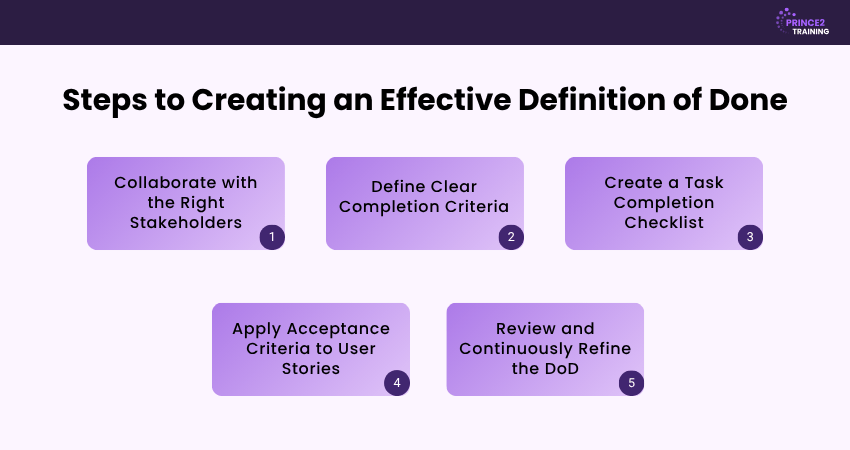
1) Collaborate with the Right Stakeholders
The stakeholders are the key decision-makers when it comes to framing a DoD. Hence choosing the right stakeholder will be the basic need of this whole process. A well-defined DoD should be framed by the right stakeholders who are aware of the whole need of the project.
2) Define Clear Completion Criteria
DoD should remain clear and well-crafted for the complete execution of a project. First, list down all parameters that entitle project completion. Then add more specifications which result in precise outcomes and are customer-focused.
3) Create a Task Completion Checklist
Create a task completion checklist that remains the foundation for the protocols enlisted in the project completion cycle. This checklist should be suitable for smooth project completion and delivering high-quality results.
4) Apply Acceptance Criteria to User Stories
Acceptance Criteria (AC) are the criteria that allow the user stories to become acceptable to customers. This is a separate set of criteria formed more specifically for user stories or features. It functions like DoD, but it focuses on the completion of the specific user stories. Backlog refinement can help the team clarify these user stories and their acceptance criteria before development.
5) Review and Continuously Refine the DoD
Since the project is dynamic in nature, constant reviewing and refining are needed in the DoD at the end of every sprint. It generally helps to fix the bugs or errors found in the specific sprint. This ensures the relevancy of the project during the development and execution cycle.
Start your Agile journey and manage projects effectively with Agile Project Management Foundation (Agile PM®) Training – Join now!
Who is Responsible for Creating the Definition of Done?
The Definition of Done is created by the Scrum Team to make sure a shared understanding of quality. If an organisation has a standard DoD, teams must follow it as a minimum. The key roles involved are outlined below:
1) Developers:
Define the technical and quality standards required to ensure the work is functional, tested, and ready to be released.
2) Product Owner:
Ensures the Definition of Done aligns with business goals, customer expectations, and product requirements.
3) Scrum Master:
Facilitates the discussion, removes ambiguity, and ensures the team follows Agile practices while maintaining the agreed standards.
4) Multiple Teams: When several teams work on the same product, they usually follow a shared and consistent Definition of Done to maintain product quality across all teams.
Key Terminology Around the Definition of Done
The clarified terms below have a very common and precise meaning in the dynamic large-scale Agile framework called Large Scale Scrum (LeSS). Let us glide into the terms for a better understanding.
Potentially Shippable
The entire activity list that should be performed before shipping the product. Shipping may or may not occur at the end of the sprint, as new functionality may be incorporated via multiple sprints before being shipped, and it is moreover considered as a business decision.
Definition of Done
A set of criteria is declared between the teams and the product owner by which the project completion is carried out. A Definition of Done (DoD) is accurate when it is equal to potentially shippable. It indicates when a backlog item is ready for development in the next sprint.
Undone Work
Undone Work is something which is not completed, but at the same time, it doesn’t mark incompleteness. Moreover, it can be counted as the excluded work from the sprint. Basically, the difference between DoD and potentially shippable is that there is no undone work.
Work That’s Incomplete or Not Done
Work that is incomplete or not done is basically the unfinished work during the specific sprint. It is not related to Undone Work. The teams can plan to complete the incomplete work by aligning it with the upcoming sprints or extending the deadline according to the team's decisions.
Areas That Need to Be Covered in a Definition of Done
A Definition of Done (DoD) sets the standards a task must meet before it is considered complete. It typically covers key areas such as code quality, testing, documentation, and integration. The main areas are outlined below:
1) Code Quality:
The code should follow agreed coding standards and be reviewed by team members to ensure it is clean, functional, and maintainable.
2) Testing:
All required tests, such as unit tests and integration tests, should be completed and passed to confirm that the feature works as expected.
3) Documentation:
Relevant documentation, such as user guides or technical notes, should be updated so that others can understand and maintain the feature.
4) Integration and Deployment:
The feature should be successfully integrated into the system and prepared for deployment without causing issues in the existing environment.
Take your Agile Project Management skills further with Agile Project Management Practitioner Upgrade (Agile PM®) Training – Register now!
Benefits of a Definition of Done
The Definition of Done has substantial benefits over project completion. We will discuss the perks to understand the scope of these criteria:
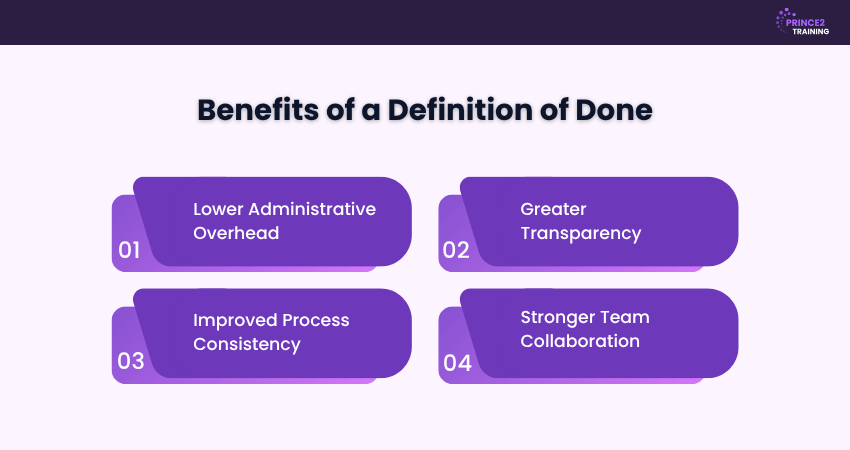
Lower Administrative Overhead
The team focuses more on the unique aspects of a backlog item, rather than spending less time documenting routine processes. This leads to reduced administrative burdens.
Greater Transparency
The primary focus of a well-defined DoD is to maintain transparency by showcasing the level of work that has been done for each Product Backlog item.
Improved Process Consistency
DoD enables teammates to figure out the ups and downs in their progress, therefore it standardises their expectations and gives scope to work consistently.
Stronger Team Collaboration
The clear expectations lead to a space where the team members can collaborate and focus on problem-solving.
Real-world Examples of a Definition of Done
A sample DoD for Product Release is presented below:
Product Backlog Item 1 - Product Release
1) Final code is completed
2) Suitable environment ready for release (production/staging)
3) Acceptance criteria satisfied
4) QA testing completed
5) Bugs fixed and verified
6) 'To-do' annotations cleared
7) Team approval obtained
8) Check for any undone or unintegrated work in development/staging
9) Verify all integrations are tested and functioning correctly
Product Backlog Item 2 – Sprint for Production
1) All user-stories completed
2) All unit tests passed
3) Product backlog updated
4) Project deployed on the test environment, identical to the production platform
5) Tests on devices/browsers listed in the documentation passed
6) Tests of backwards compatibility passed
7) Performance testing is successfully completed
8) All identified bugs have been resolved
9) The sprint is approved by the Product Owner for production deployment
Definition of Done vs Acceptance Criteria
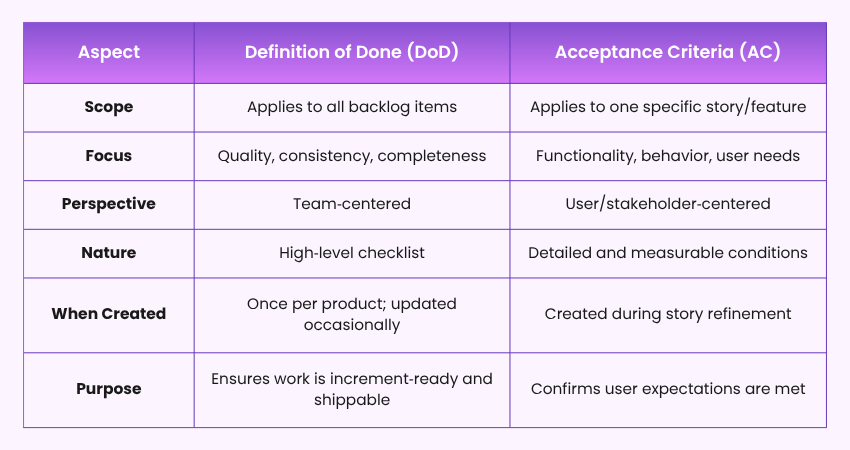
The Definition of Done and Acceptance Criteria both ensure quality in Agile projects but serve different purposes. The Definition of Done confirms that work is complete and ready for delivery, meeting standards such as testing and code review.
Acceptance Criteria, however, define the specific conditions a user's story must meet to satisfy stakeholder requirements and guide the development process before development begins. In the table below, we’ll see the differences between Definition of Done and Acceptance Criteria in detail:
Difference Between Definition of Done and Definition of Ready
Here are the differences between the Definition of Done and the Definition of Ready:

Conclusion
The Definition of Done is more than just a checklist; it's a commitment to quality and alignment in Agile Project Management. By setting clear expectations, DoD ensures that every project increment meets high standards, reduces risks, and promotes smooth collaboration. Embrace DoD to elevate project success.
Elevate your knowledge in Agile Project Management with our Scrum Master Training - Join now!
Frequently Asked Questions
What are DoR and DoD in Agile?
Definition of Ready (DoR) defines when a user story is clear, well-understood, and prepared for development. Definition of Done (DoD) defines when the work is fully completed, tested, and ready for delivery, ensuring it meets the team’s quality standards and acceptance requirements.
What are the Three Main Purposes of the Definition of Done?
The three main purposes of the Definition of Done are to ensure quality, clarity, and consistency. It helps teams confirm work meets standards, creates a shared understanding of completion, and ensures features are delivered reliably.
What is the Aim of the Definition of Done?
The aim of the Definition of Done (DoD) is to ensure that work meets agreed quality standards before it is considered complete. It helps teams maintain clarity, consistency, and readiness for delivery in Agile projects.



 Continue Browsing