Contact@prince2training.co.uk
 01344203999




 Back
Back


Table of Content

05-Oct-2026

Veronica Davis
Change is inevitable but managing it effectively requires clarity. While numerous aspects of Change Management vs Project Management overlap, they serve distinct purposes within an organisation. One focuses on guiding people through transitions, while the other ensures tasks and deliverables are completed efficiently.
Understanding the differences between Change Management vs Project Management can help organisations achieve smoother transformations and better outcomes. In this blog, we break down their key distinctions, helping you align strategy and people for successful business change initiatives. So read on!
What is Change Management?
Change Management is an approach used by organisations to help people with the changes, new processes, technologies or ways of working. It allows teams to prepare for what's coming, transition and ensure that change becomes part of everyday operations. This also considers people's experience during the shift, that is, their concerns and expectations. It also helps people access the resources they need to work confidently and effectively after the changes.
Key elements of Change Management include:
1) Clear communication
2) Readiness planning
3) Training support
4) Feedback loops
Benefits of Change Management
Change Management benefits organisations in various ways, such as improving employee engagement, boosting overall efficiency and achieving strategic goals. Here are the key pros:
1) Improve Employee Engagement: It makes people understand the reason behind the change and how it impacts their work. This makes them feel more involved.
2) Boosts Overall Efficiency: This process gives you a clear plan to optimise your business in different aspects. This helps organisations to benefit sooner, as everyone knows the changes implemented.
3) Achieve Strategic Goals: Changes that are made need to be communicated. This helps to achieve the desired outcome.
4) Reduced Resistance: Minimises confusion and opposition by addressing concerns and providing clear guidance.
What is Project Management?
Project Management is all about the process required to meet the project requirements. This involves planning and execution with the aim of achieving it in a given timeframe and budget. This ensures effective and efficient delivery of the product with standard quality. This involves stakeholders in the process throughout the project. Also provides a clear idea of a desired outcome by breaking work into steps, coordinating with people, and tracking the progress.
Core components of Project Management:
1) Planning
2) Coordinating
3) Tracking
4) Managing risks
Benefits of Project Management
Project Management plays an important role in delivering a successful project. Here are the main advantages of Project Management:
1) Manage Budgets and Timelines: It helps to manage tight budgets and timelines by creating a strategy that supports the project.
2) Improve Productivity & Quality: Gives a clear Project roadmap that guides the project and helps to perform based on priority. This helps in improving the overall quality of the work.
3) Mitigate Project Risks: Helps to mitigate risks by analysing the project. Communicating the risk and prioritising the risk areas of the project.
4) Higher Success Rate: Increases the likelihood of delivering projects on time and within budget.
Smarter Project Management is just a click away. Sign up for our PRINCE2® Training today!
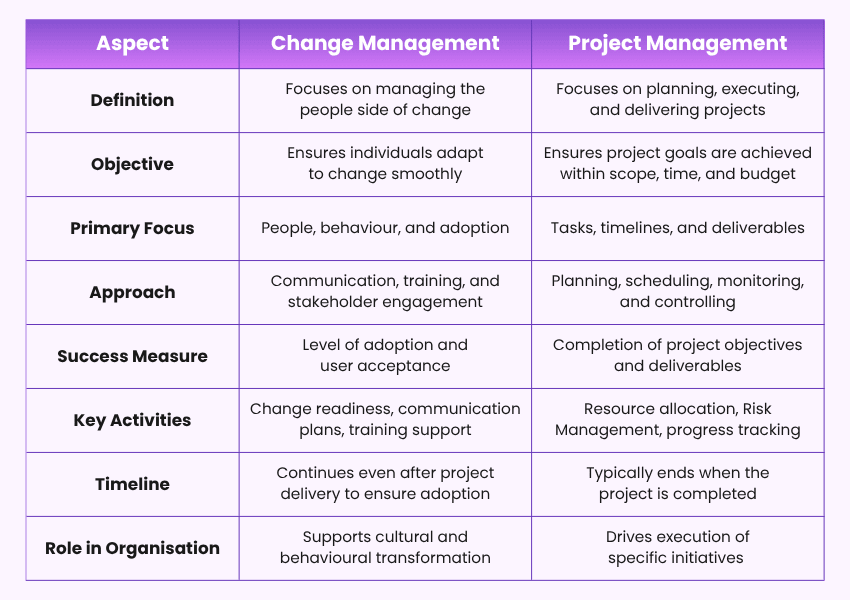
Difference Between Change Management and Project Management
Even though Change Management and Project Management go hand-in-hand, they serve two different purposes.
Similarities Between Change Management and Project Management
Both Change Management and Project Management aim to lead a successful organisation's initiative through stakeholder engagement, Risk Management, communication and collaboration, and planning and control.
1) Stakeholder Engagement
Both Change Management and Project Management need to identify stakeholders who are either affected or involved in the project or the change. Two-way communication plays an important role in both understanding and managing expectations and resolving issues. Input from stakeholders is necessary for both to address the issues. Strategies were developed to mitigate the risks.
2) Risk Management
Risk Management is used by both Change Management and Project Management to analyse, identify, and mitigate risks. Systematic processes were used by both to identify the similarities and the impact of identified risks. Many strategies and plans were developed by both to reduce the impact of threats and to anticipate future challenges, which include technical, financial, or human.
3) Communication and Collaboration
Communication and Collaboration play an important role in both Change Management and Project Management for successful outcomes. "WH" questions have to be discussed by both before any initiative for shared understanding and alignment. Both involve teams and end-users throughout the process to identify their needs. They work together to identify and address risks that are from technical issues to human resistance.
4) Planning and Control
Both Change Management and Product Management follow structured processes from initiation to results. Performance has been tracked continuously against plan and objectives. Adjustments and corrections will be made based on the feedback. Obstacles will be addressed collaboratively to keep the project on track.
Lay the groundwork for smarter project delivery with our comprehensive PRINCE2® Foundation Training - Register now!
Conclusion
Ultimately, Change and Project Management are two sides of the same coin. The key distinction between Change Management vs Project Management is that one drives execution and the other ensures people embrace the outcome. When aligned properly, they transform ideas into lasting success. By balancing these two, organisations can create sustainable change that truly makes an impact.
The symbiosis of agility and structured governance is the key to elevating project skills – Sign up for PRINCE2 Agile® Practitioner Course now!
Frequently Asked Questions
What is Another Word for Change Management?
Change Management is often referred to as organisational change, Transformation Management or change leadership. These terms all focus on guiding individuals and teams through transitions effectively.
Can a Project Manager Also be a Change Manager?
Yes, a Project Manager can also take on the role of a Change Manager, especially in smaller organisations. But each role has a distinct focus. Project Managers handle the delivery, while Change Managers’ focus is on people, adoption and behavioural shifts.
What is the Role of PMO in Change Management?
The Project Management Office (PMO) helps with Change Management by providing structure, governance and standardised processes. It makes sure that the change initiatives align with organisational goals. It ensures consistency, unfailing progress tracking and improving overall project and change outcomes.



 Continue Browsing