Contact@prince2training.co.uk
 01344203999




 Back
Back


Table of Content


09-Sep-2026

Veronica Davis
Are you curious about enhancing your project delivery? Then you are in the right place. Explore the benefits of PRINCE2 Agile today. This approach merges the structure of PRINCE2 with Agile’s speed, giving you the best of both worlds. Envision managing projects that are not only efficient but also flexible to change. PRINCE2 Agile allows for this seamless integration. Keep reading this blog to understand the full potential of the benefits of PRINCE2 Agile in your Project Management practices.
Table of Contents
1) What is PRINCE2 Agile?
2) Benefits of PRINCE2 Agile
3) Disadvantages of PRINCE2 Agile
4) Conclusion
What is PRINCE2 Agile?
PRINCE2 Agile fuses the structured approach of PRINCE2 with the nimbleness of Agile methodologies, enhancing Project Management with a focus on adapting PRINCE2 to fit agile working styles. This synergy is credited for delivering superior governance and heightened efficiency.
The strength of PRINCE2 Agile lies in its dual capacity: it inherits Agile’s agility and PRINCE2’s robust framework. Designed to meet the demands of upper management, this framework equips PRINCE2 Agile practitioners with the necessary structure and oversight to guide projects effectively, alongside the agility to respond swiftly in a fast-evolving business milieu.
PRINCE2 Agile doesn’t adopt an adaptive lifecycle; rather, it views Agile as a set of behaviours and practices. Consequently, the manual offers broad guidelines for typical Agile behaviours, steering clear of a direct merger between the PRINCE2 process model and the Agile lifecycle. This ensures a versatile application across various project scenarios.

Benefits of PRINCE2 Agile
PRINCE2 Agile has several benefits. Some of them are mentioned below:
1) Enhanced Teamwork: PRINCE2 Agile breaks down barriers, encouraging unity among teams, stakeholders, and clients.
2) Greater Adaptability: It provides the flexibility to shift with the project’s changing needs and outputs, vital in a swiftly evolving business landscape.
3) Quicker Market Entry: Agile methodologies like iterative development and ongoing delivery expedite your product’s journey to the consumer.
4) Robust Risk Handling: With risk management at its core, PRINCE2 Agile aids in early risk detection and mitigation during the project’s duration.
5) Defined Roles: It assigns explicit roles and responsibilities, minimising confusion and fostering stronger accountability.
6) Adaptable to Any Scale: This method is scalable, fitting projects large or small, simple or complex.
7) Superior Quality: Agile’s testing and continuous enhancement practices ensure the high quality of project deliverables.
8) Transparent Oversight: PRINCE2 Agile ensures stakeholders have a clear view of the project’s progress through defined governance and reporting.
9) Optimised Efficiency: Agile’s focus on prioritisation and time management boosts project productivity and curtails unnecessary efforts.
10) Streamlined Communication: It stresses the importance of clear communication and aligning all project participants.
11) Fostering Creativity: The methodology supports innovative thinking with room for trial and adaptability in project planning.
12) Customer Contentment: Agile’s customer-centric practices, like user stories and feedback loops, cater to client needs throughout the project.
13) Job Satisfaction: It promotes a culture of collaboration, enhancing job satisfaction and employee retention.
14) Evolving Excellence: PRINCE2 Agile is committed to ongoing improvement through regular retrospectives and feedback mechanisms.
Enhance your understanding of the core principles of PRINCE2® Foundation & Practitioner Training – Register now!
Disadvantages of PRINCE2 Agile
PRINCE2 Agile, a popular Project Management approach that merges PRINCE2’s structure with Agile’s flexibility, does present some challenges. These drawbacks can differ based on the organisation’s context and needs, but with the right training and leadership, they can often be overcome. Here are the main drawbacks of PRINCE2 Agile:
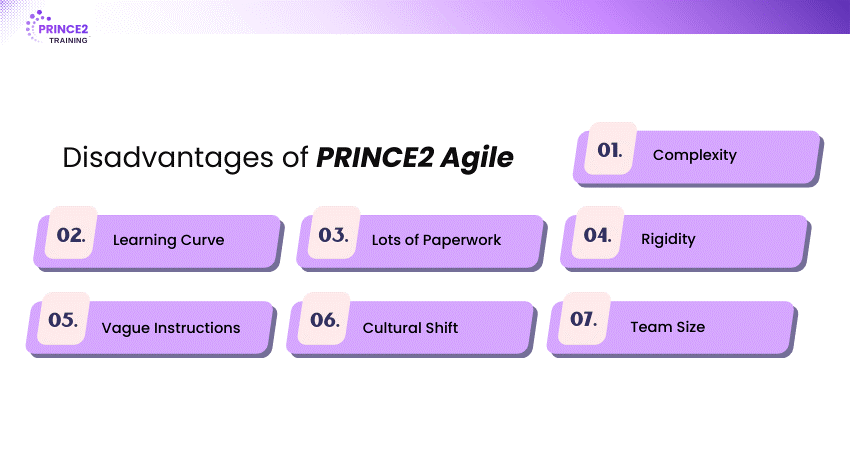
1) Complexity: PRINCE2 Agile is detailed and can be tough to learn. It has many parts and steps that can be too much for those new to Project Management.
2) Learning Curve: It takes a lot of training to get used to PRINCE2 Agile because of its complexity. This might slow down how quickly it can be put to use.
3) Lots of Paperwork: The method asks for a lot of documents, which can be a lot to handle and keep up with.
4) Rigidity: PRINCE2 Agile tries to be flexible, but some think it’s still too close to the traditional, step-by-step project methods, which might not work well in very fast-moving situations.
5) Vague Instructions: While it gives a general structure, PRINCE2 Agile doesn’t give detailed steps on how to use Agile techniques, which might mean teams need more help or training.
6) Cultural Shift: Moving to PRINCE2 Agile can mean big changes in how an organisation works, which can be hard for teams used to more traditional ways.
7) Team Size: PRINCE2 Agile might be better for bigger projects with bigger teams. Smaller teams might find it too complex and not practical.
Attain in-depth knowledge about PRINCE2® principles, themes, and processes with our PRINCE2® Foundation Course!
Conclusion
The Benefits of PRINCE2 Agile make it a strong choice for managing projects. It brings together good planning and the ability to change when needed. Teams work better together, and projects can adjust to new demands quickly. Products can be ready and out faster. Risks are spotted and dealt with early. Everyone knows their job, which helps things run smoothly. It works for any project size and leads to high-quality work. All this means happy customers and teams, and projects that keep getting better.
Get certified as a PRINCE2 Practitioner and lead projects with confidence with our PRINCE2® Training!
Frequently Asked Questions
Which Aspect of PRINCE2 Benefits Most From Blending With Agile?
The planning and control aspects of PRINCE2 benefit greatly from Agile’s adaptability, enhancing responsiveness to change without sacrificing project oversight.
Is PRINCE2 Agile Worth it?
Yes, for organisations seeking structure and flexibility, PRINCE2 Agile is worth it. It offers a balanced approach, aligning detailed Project Management with Agile’s responsiveness.
Is PRINCE2 Agile Better Than PRINCE2?
PRINCE2 Agile isn’t necessarily better; it’s more context dependent. It excels in environments that require both rigorous Project Management and the capacity to adapt quickly to changes.



 Continue Browsing