Contact@prince2training.co.uk
 01344203999



 Back
Back


Table of Content

15-Jun-2026

Veronica Davis
Let's say that you have a tool that tracks every customer's interaction, personalises your service, and even anticipates their needs; this is the power of Customer Relationship Management (CRM). But what are the real Benefits of Customer Relationship Management, and how can it transform your business? From strengthening customer relationships to streamlining operations, CRM can boost loyalty, efficiency, and growth.
In this blog, we'll explore the top Benefits of CRM, showing you how it can take your business to the next level. With practical insights, you'll see exactly how CRM can help you build stronger customer connections and drive long-term success.
Table of Contents
1) What is a CRM?
2) Benefits of Customer Relationship Management
a) Improved Customer Service
b) Increased Customer Revenue
c) Better Marketing
d) Analytics
e) Increased Profitability
f) Visualising Data
g) Streamlined Sales Processes
h) Enhanced Customer Segmentation
i) Data Security and Privacy
j) Scalability and Flexibility
3) Conclusion
What is a CRM?
A Customer Relationship Management (CRM) system is software that helps businesses manage interactions with customers, leads, and clients in one place. It streamlines tasks such as contact management, sales tracking, customer support, and marketing automation.
CRM tools improve communication, enhance customer experience, and help businesses build long-term relationships. By organising customer data and tracking interactions, companies can make informed decisions, increase productivity, and boost sales growth while ensuring better collaboration between teams across the organisation.

Benefits of Customer Relationship Management
The Benefits of Customer Relationship Management are far beyond the context of delivering superior customer service. For further understanding, let's explore the Benefits of Customer Relationship Management CRM in detail:
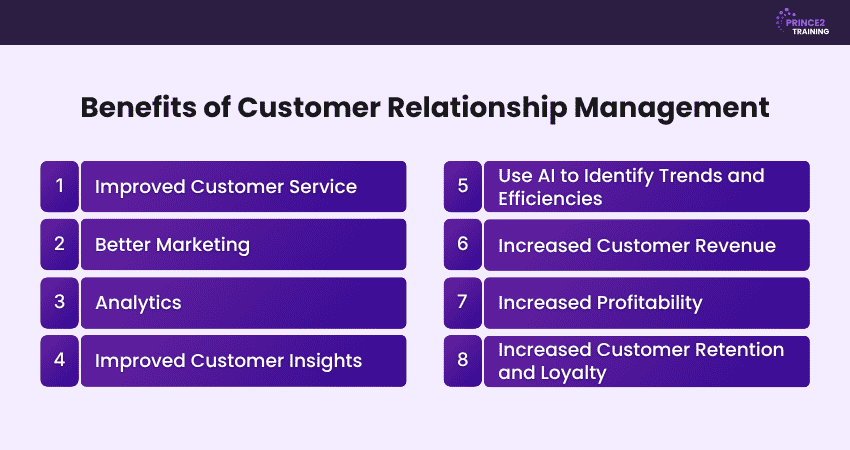
1) Improved Customer Service
CRM systems give organisations the capability to tailor their customer services according to the needs of their customers. This dynamic system is a pivotal tool that organisations use to nurture existing relationships with their customers.
Better Customer Relationship Management is directly related to the level of customer service efficiency of businesses. When active measures are taken to reach out and resolve the service issues raised by customers, it helps reduce turnaround time. Additionally, following up with customers after a purchase helps businesses foster better customer relationships.
2) Better Marketing
When businesses are equipped with data that helps them predict the needs and preference of customers, marketing becomes a smooth sail. CRM software can be used to plan targeted marketing practices. Additionally, Customer Relationship Management can be employed to utilise resources efficiently.
3) Analytics
Another essential benefit of a CRM system is that it uses customers' data to explore business opportunities. One of the core features of a CRM platform is its built-in analytics system. This feature allows it to interpret customer data to understand their behaviours. CRM systems use different metrics to determine the campaign's performance as well as identify the areas of improvement for future reference.
4) Improved Customer Insights
CRM offers an in-depth insight into buying behaviours, preferences, trends, and customer behaviours. Making it easier to predict the needs and demands of targeted customers. Businesses can use these insights to customise their offerings and sales strategies to boost revenue.
5) Use AI to Identify Trends and Efficiencies
AI-powered CRM systems help businesses improve growth, increase employee productivity, and enhance customer experiences. They support organisations by automating tasks, delivering personalised recommendations, identifying new business opportunities, and providing continuous customer support through intelligent AI-driven features and virtual assistants.
6) Increased Customer Revenue
CRM system effectively collects and analyses the customers data to plan targeted marketing campaigns. With its versatile features like sales automation, analytics, contact management, etc. Customer Relationship Management platforms aid customer retention.
Businesses also use this dynamic system to cater to the needs of different customers at different sales and after-sales stages. Thus, being able to boost their customer retention while continuously reeling in new customers.
Get equipped with Project Management essentials with Agile Project Management Foundation & Practitioner (AgilePM®) Training – Join today.
7) Increased Profitability
Good CRM software can be used to increase profitability by initiating hyper-targeted marketing ventures. Customer Relationship Management makes it easier to identify lucrative customers. It then results in reduced campaign costs, as resources are used to target their niche customers.
8) Increased Customer Retention and Loyalty
CRM system manages to systematically track and trail all the customers data, making it easier to access information. It automates customer support, making it easier to resolve conflicts before they become complaints. Businesses can use this data to boost customer satisfaction, which results in customer loyalty.
9) Boosts Cross and Upselling Efficiency
Businesses that are looking to increase their profitability tend to employ CRM tactics to meet their customers' needs and requirements. Hence, customers are satisfied with the assistance received throughout and well beyond the purchasing process. Building meaningful customer relationships boosts cross- and upselling efficiencies of the organisation.
10) Speeds Up Sales Conversions
CRM systems can support quicker customer assistance, especially when integrated with automation, chatbots, or customer support tools. It helps in appeasing customers as their queries are taken into account immediately and effectively. Alternatively, it encourages customers to make purchasing decisions, speeding up sales conversions.
11) Streamlined Sales Processes
The marketing automation feature of CRM software makes it easier to streamline sales processes. By automating sales forecasting, lead generation, and email tracking, CRM makes the sales process seamless. The data-driven approach of Customer Relationship Management boosts productivity and revenue.
12) Manage Leads, Opportunities, and Prospects Effectively
A CRM system helps organisations manage leads, opportunities, and customer interactions more effectively by providing a clear view of the sales pipeline. It enables sales teams to track prospects efficiently, prioritise high-value opportunities, and focus on activities that improve conversions and support business growth.
13) Strengthens Internal Communication
With the help of the CRM system, employees from different departments can engage in effective communication. They can access customers' data remotely and can work strategically together as a team.
14) Break Down Business Silos
A CRM system improves collaboration by allowing teams to access and share customer information through a centralised platform with real-time updates. It helps employees view customer history, previous interactions, and purchase records, enabling faster and more personalised support. Some advanced CRM systems also use AI-driven insights to recommend relevant products, identify customer needs, and improve communication across teams.
15) Scalability and Flexibility
Most CRM systems are adaptable and offer scalability options. Businesses get the option to upscale or downscale the CRM services based on their requirements. Factors such as technology integration or growth in your customer base can actively contribute towards the need for flexibility in Customer Relationship Management.
Elevate your Management game with Agile Project Management Practitioner Upgrade (Agile PM®) Course - Register now!
16) Work From Anywhere
Cloud-based CRM systems allow employees to access important customer and business data from smartphones, tablets, or laptops, supporting flexible and remote working. They provide real-time data updates across teams, ensuring everyone works with the latest information. Many CRM platforms also offer offline access, automatically syncing changes once the internet connection is restored.
17) Integration with Other Business Tools
CRM can be beneficial for your business as it is designed to facilitate seamless integration with other business tools. The integration feature helps in enhancing overall efficiencies of businesses, as it ensures secure data sharing. By merging CRM with other reliable tools, businesses can operate uniformly.
18) Data Security and Privacy
When it comes to handling sensitive customers data, a CRM platform can be a life saver. Careful handling of customer data aids in gaining customer trust and goodwill. Businesses can use CRM suits dynamic security features to build credibility.
19) Ensure Robust Data Security and Compliance
A CRM system enhances data security by providing secure user authentication and controlled access permissions. Organisations can restrict sensitive information to authorised users only, helping protect customer and business data. When employees leave the organisation, their access can be removed quickly to maintain system security and data protection.
20) Improve Products and Services
A CRM system helps organisations improve products and services by collecting customer feedback, tracking customer behaviour, and analysing purchasing patterns. These insights enable businesses to understand customer needs more effectively, identify areas for improvement, and deliver more personalised products, services, and customer experiences.
Conclusion
The Benefits of Customer Relationship Management are more than just a gamechanger; they are a blueprint for long-term success. From building stronger relationships to streamlining your operations, CRM empowers you to work smarter, not harder. Ready to take your business to new heights? Let CRM lead the way.
Learn Project Management with Agile Project Management Foundation (Agile PM®) Course – Register today!
Frequently Asked Questions
How Does CRM Improve Team Productivity?
CRM improves team productivity by centralising customer data, automating repetitive tasks, and streamlining communication. It helps teams access information quickly, manage leads efficiently, reduce manual work, collaborate better, and focus more on customer service and business growth.
Is CRM Useful for Small Businesses?
Yes, CRM is useful for small businesses because it helps manage customer data, track leads, improve communication, and automate routine tasks. It also supports better customer service, stronger customer relationships, and more organised sales processes.
What is the Difference Between CRM and ERP?
CRM focuses on managing customer relationships, sales, marketing, and customer support. ERP manages core business functions such as finance, inventory, supply chain, operations, and resource planning to improve overall organisational efficiency.



 Continue Browsing