Contact@prince2training.co.uk
 01344203999



 Back
Back


Table of Content

05-Oct-2026

Veronica Davis
Have you ever completed a project on time and within budget, only to hear people ask, 'So what did we actually gain?' That’s the trap many organisations fall into, confusing project completion with project success. In reality, true success is measured by the benefits that follow higher profits, happier customers, and streamlined processes. To ensure these benefits are realised, a Benefits Management Framework becomes essential.
It provides a structured way to ensure that initiatives create meaningful improvements that support strategic goals. Clearly defining expected benefits and tracking them throughout the project lifecycle helps organisations make better decisions, optimise resources, and achieve long-term success. In this blog, you will learn about What is Benefits Management Framework, its components, steps, and more.
What is the Benefits Management Framework?
A Benefits Management Framework is a structured method that helps organisations define, plan, track, and realise the value of projects or programmes. It connects change initiatives to strategic goals and ensures that the intended benefits are actually delivered, not just promised. Rather than simply tracking performance, it focuses on aligning project outcomes with broader business objectives to measure real impact.
Benefits Management Framework is a continuous process that starts before a project begins and extends beyond its completion. It requires clear project planning, strong ownership, and ongoing governance. When used effectively, the framework helps organisations make better use of resources, improve stakeholder satisfaction, and achieve measurable results.

Key Components of Benefits Management Framework
To manage the Benefits Management Framework effectively, organisations need to understand the core building blocks that make up a strong framework. These components serve as the foundation upon which all benefit-related activities are built.
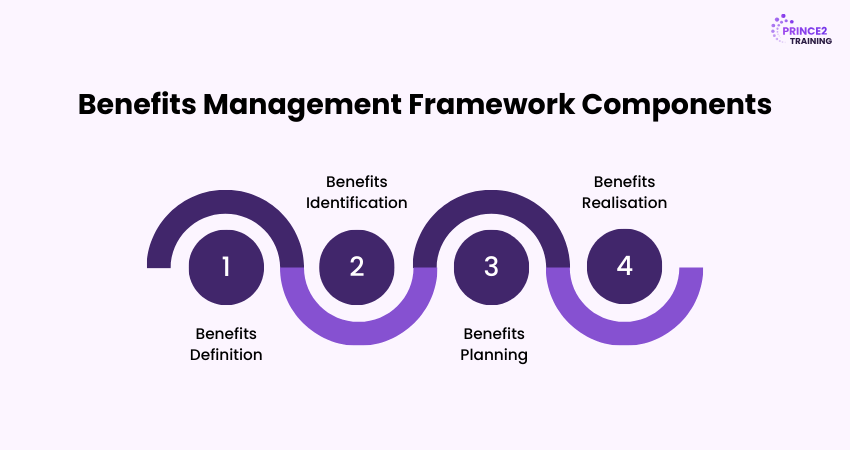
1) Benefits Definition
Before benefits can be managed, they must be clearly defined. This means articulating the specific value the project is expected to deliver. Benefits should be measurable, relevant, and aligned with organisational goals. At this stage, it’s crucial to avoid vague or overly ambitious expectations and aim for clarity and focus.
2) Benefits Identification
Once defined, the next step is identifying all possible benefits, both tangible and intangible. This involves engaging stakeholders, conducting workshops or brainstorming sessions, and creating a broad list of potential outcomes. It’s essential to consider the obvious benefits and the ones that may emerge indirectly from the project.
3) Benefits Planning
With a list of potential benefits in hand, planning focuses on prioritisation, sequencing, and ownership. Each benefit should be assigned to a responsible individual, along with project dependencies and timelines, and measurement criteria. This stage ensures resources are directed to where they’ll have the greatest impact, and delivery is logical and achievable.
4) Benefits Realisation
This is where the work pays off. Benefits realisation involves monitoring, measuring, and reporting on the delivery of benefits against the original plan. It requires tracking progress, identifying gaps, and adapting where needed. Success at this stage depends heavily on the preparation done earlier and ongoing stakeholder engagement.
Advance your expertise in real-world project environments with the PRINCE2® Practitioner Course – Join now!
Steps of the Benefits Management Framework Process
The Benefits Management Framework follows a structured and systematic process to ensure that projects deliver measurable value to the organisation. Let's look at its important steps below:
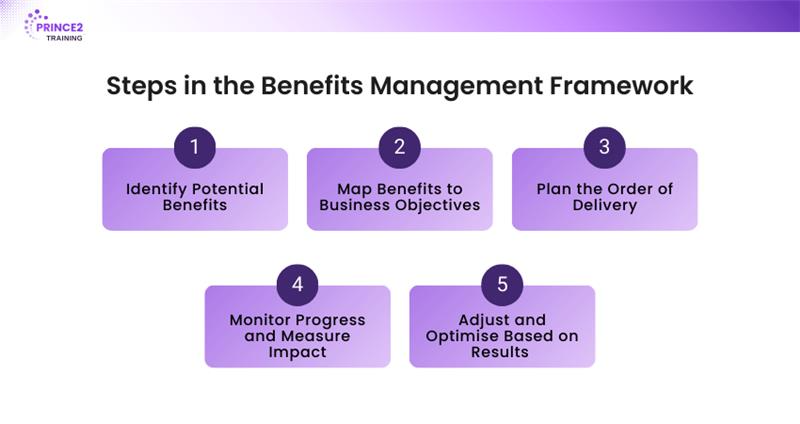
1) Identify Potential Benefits
In the Benefits Management Framework, organisations evaluate the potential benefits the project is expected to deliver. This involves conducting feasibility studies, analysing available data, and engaging stakeholders to understand expectations and priorities. The goal is to identify the positive outcomes the project should achieve, such as cost savings, improved efficiency, or enhanced customer satisfaction.
2) Map Benefits to Business Objectives
Once the benefits are identified, they must be aligned with organisational goals. This involves defining each benefit clearly, setting measurable targets, and linking outcomes to strategic priorities. Mapping benefits to business objectives ensures that projects contribute meaningful value and support long-term organisational success.
3) Plan the Order of Delivery
Now, organisations develop a structured plan to realise benefits. This includes defining actions, allocating resources, establishing Key Performance Indicators (KPIs), and setting timelines. Planning the sequence of delivery ensures that benefits are achieved efficiently and that responsibilities and expectations are clearly understood.
4) Monitor Progress and Measure Impact
During implementation, progress must be tracked regularly to ensure benefits are being realised. Organisations must monitor performance using defined metrics, review results, and assess if targets are being met. Measuring the impact helps to maintain accountability and provides insight into how effectively the project is delivering value.
5) Adjust and Optimise Based on Results
Benefits Management Framework is an ongoing process that requires flexibility. Organisations need to review outcomes, identify gaps, and make necessary adjustments to improve performance. Also, continuous evaluation and optimisation help maximise value, address potential challenges, and ensure that benefits are sustained.
Combine Project Management with Agile flexibility to deliver faster, smarter, and more adaptable with the PRINCE2 Agile® Practitioner Course – Sign up now!
Challenges and Solutions of Benefits Management
Many organisations find the Benefits Management Framework difficult to implement because of common and avoidable mistakes during execution. Let us examine these challenges and how to overcome them:
1) Lack of Clear Benefit Ownership
Challenge: Without a clearly assigned owner, benefits become everyone’s responsibility and no one’s main priority. This leads to weak accountability and difficulty in measuring outcomes.
Solution: Assign a dedicated benefit owner during the planning stage. They must belong to the area of the business receiving the benefit and have the authority to drive changes when required.
2) Launching Too Many Projects at the Same Time
Challenge: When organisations launch too many projects simultaneously, delivery teams become overloaded with tasks. This leads to burnout, key roles become bottlenecks, and benefits are delayed.
Solution: Prioritise projects based on strategic value and available capacity. Use realistic capacity planning to sequence project starts and maintain manageable workloads.
3) Treating Benefits Management as Additional Admin Work
Challenge: Teams sometimes view Benefits Management as additional paperwork and set it aside under pressure. This reduces visibility of value and limits informed decision-making.
Solution: Integrate benefits tracking into existing governance processes to make it a standard for project delivery. Keep tools simple and integrate monitoring into routine reporting to make the process efficient.
4) Focusing Only on Financial Benefits
Challenge: A sole focus on financial return can undervalue important outcomes, such as customer satisfaction, compliance, safety, sustainability, and strategic alignment.
Solution: Define both financial and non-financial success measures in the very beginning. Work alongside stakeholders to establish meaningful metrics that reflect the organisation’s priorities.
5) Ending Benefits Tracking at Project Closure
Challenge: Once a project is completed, benefits may begin to decline if they are not being actively monitored. Without any ongoing tracking, erosion of value goes unnoticed.
Solution: Integrate benefits tracking into business’s usual reporting. Also, conduct regular post-delivery reviews, such as quarterly assessments during the first year, to monitor performance.
Learn the entire PRINCE2® Agile journey and lead high-performing Agile projects with ease with PRINCE2 Agile® Foundation and Practitioner Course – Sign up today!
Benefits Management Framework Best Practices
Having a framework is one thing; using it well is another. These best practices help enhance your approach and improve outcomes.
Involve Stakeholders
Stakeholder engagement should start early and continue throughout. By involving those who benefit from and deliver the outcomes, you ensure alignment, gather insights, and gain support for necessary changes. It also builds transparency and trust.
Involved stakeholders are more likely to champion the project, contribute to benefit delivery, and support changes when needed.
Track and Monitor Benefits
Benefits aren’t static; they evolve. Regular tracking helps identify what’s working and what’s not. Use dashboards, reports, and reviews to maintain visibility. Automate data collection where possible to reduce manual effort.
Consider creating a benefits register and updating it regularly. This makes it easier to compare planned vs actual performance and to take timely action.
Refine and Enhance the Framework
No framework is perfect. Over time, you’ll learn what works best for your organisation. Use feedback loops, project reviews, and post-implementation evaluations to refine the process. The more adaptable your framework, the more effective it becomes.
Regular training sessions and knowledge-sharing activities can also help spread best practices and build organisational capability in Benefits Management.
Set Clear Goals and Expected Benefits
Clarity is power. When everyone understands what success looks like, teams can align their efforts more easily. Setting Specific, Measurable, Achievable, Relevant, Time-bound (SMART) goals gives the framework structure and direction.
Clear goals act as a guiding star, ensuring the project team, benefit owners, and stakeholders stay focused on outcomes that matter.
Conclusion
The Benefits Management Framework ensures that projects create measurable outcomes that support organisational success. Clearly identifying, planning, tracking, and realising benefits helps organisations make smarter business decisions, optimise resources, and stay aligned with strategic goals. When applied properly and consistently, this framework strengthens accountability, improves performance visibility, and ensures investments translate into real business impact.
Gain globally recognised Project Management skills with PRINCE2 Training – Register today!
Frequently Asked Questions
What is the Benefits Framework for a Project?
A Benefits Framework for a project is a structured approach to identify, define, plan, track, and realise the value a project delivers. It connects project outputs to business outcomes, ensuring initiatives provide value. This framework ensures projects deliver real business value aligned with organisational strategic objectives.
Who Creates a Benefits Management Plan?
A Benefits Management Plan is created and owned by the Project Sponsor or Senior Responsible Owner (SRO). They are accountable for delivering the project’s value and business outcome. However, the Project or Programme Manager develops and maintains the plan, working closely with sponsors, stakeholders, and end users.
What is the Difference Between Benefits Management and Benefits Realisation?
Benefits Management is the process of identifying, planning, tracking, and measuring expected benefits through a project’s lifecycle. In contrast, Benefits Realisation focuses on ensuring those planned benefits are delivered and sustained.



 Continue Browsing