Contact@prince2training.co.uk
 01344203999




 Back
Back


Table of Content


17-Sep-2026

Richard Harris
Once upon a time, using AI in Project Management sounded like a sci-fi dream. Robotic assistants planning sprints, tools predicting risks before they happen, and dashboards updating themselves in real time. Fast forward to today, and that future isn’t distant anymore - it’s already here. AI is a bold new way of running projects smarter, faster, and with fewer late-night coffee-fuelled panics.
But for every perk, there’s a pitfall waiting to trip you up. In this blog, we’ll unpack the real benefits, the challenges hiding behind the tech, and practical ways to bring AI into your workflow, without losing the human touch. Keep reading!
Table of Contents
1) What is AI in Project Management?
2) Types of AI Solutions in Project Management
3) Benefits of AI in Project Management
4) Challenges of AI in Project Management
5) How to Use AI in Project Management?
6) Best Practices for AI in Project Management
7) The Future of AI in Project Management
8) Conclusion
What is AI in Project Management?
AI in Project Management refers to the use of Artificial Intelligence tools and technologies to enhance project planning, execution, and decision-making. It helps automate repetitive tasks like scheduling, reporting, and assigning responsibilities, saving time and reducing human error. AI can also analyse large amounts of project data to predict risks, delays, and resource shortages before they occur.
With smart scheduling, Natural Language Processing (NLP), and predictive analytics, Artificial Intelligence helps Project Managers make faster decisions. It boosts productivity, optimises resource use, and delivers real-time insights, serving as a supportive assistant rather than a replacement.

Types of AI Solutions in Project Management
AI is transforming how Project Managers lead, plan, and deliver results. From scheduling tasks to analysing data, AI tools offer intelligent solutions across every stage of the project lifecycle. Below are four key types of AI-powered solutions used in modern Project Management:
Task and Time Management
AI automates task allocation, sets smart deadlines, and keeps projects on track. By analysing workload, team availability, and past performance, it suggests optimal timelines and priorities. If a deadline is at risk, Artificial Intelligence can issue alerts or adjust dependent tasks automatically, ensuring efficient use of time and minimising delays.
Risk Management
AI tools identify potential risks before they escalate. By learning from past projects, they predict issues such as budget overruns, missed milestones, or resource constraints. Features like risk scoring, scenario planning, and mitigation recommendations help Managers take proactive steps, making outcomes more reliable and less reactive.
Team Collaboration
AI supports smoother collaboration through communication and coordination tools. Chatbots can answer queries, send reminders, and track progress. AI also suggests suitable task assignments based on skills and availability, improving teamwork and reducing miscommunication, especially in remote or hybrid teams.
Data Analysis and Insights
AI analyses vast amounts of project data to reveal trends, patterns, and opportunities. Dashboards powered by AI summarise real-time progress, performance indicators, and risks in a single view, making decision-making quicker and more informed.
Learn from the Introduction to Project Management Course, improve delivery, influence outcomes - Join us now!
Benefits of AI in Project Management
AI is reshaping the Project Management landscape by streamlining operations, improving team performance, and driving better outcomes. Below are the key benefits of integrating AI into project workflows:
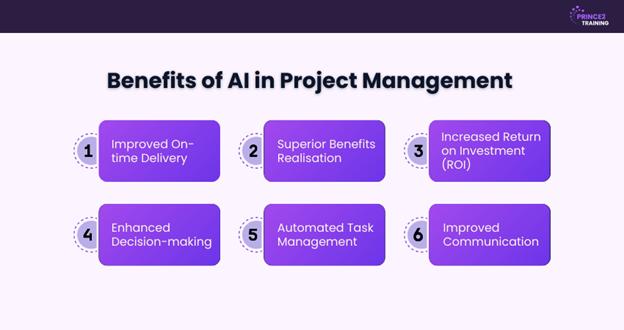
1) Improved On-time Delivery
AI helps projects stay on schedule by optimising timelines and highlighting potential delays early. This enables proactive decision-making and faster adjustments.
Tracks task progress in real-time
Predicts bottlenecks before they impact delivery
Suggests optimal timelines based on workload
Helps teams prioritise urgent activities
2) Superior Benefits Realisation
AI ensures that projects not only meet deadlines but also deliver the intended business value. It keeps a clear focus on goals, outcomes, and stakeholder expectations.
Aligns project goals with business objectives
Monitors benefits throughout the project lifecycle
Flags activities that don’t add value
Supports post-project evaluations
3) Increased Return on Investment (ROI)
By minimising waste and improving efficiency, AI contributes to better use of time, money, and resources, leading to higher ROI.
Reduces delays and budget overruns
Optimises resource allocation
Automates repetitive work, saving labour costs
Enhances overall project productivity
4) Enhanced Decision-making
AI provides data-driven insights to help Managers make smarter, faster decisions. It reduces guesswork and improves planning accuracy.
Offers predictive analytics for planning
Uses historical data to forecast outcomes
Visualises risks and opportunities
Supports strategic thinking with real-time insights
5) Automated Task Management
AI handles routine admin tasks, freeing Managers to focus on high-impact activities. It ensures nothing is missed and workflows move smoothly.
Auto-assigns tasks based on skills and availability
Sends reminders and status updates
Tracks deadlines and milestones
Reduces human error in scheduling
6) Improved Communication
AI enhances collaboration by keeping everyone informed and aligned. It acts as a bridge between team members, especially in remote environments.
AI chatbots provide instant updates and answers
Generates clear project summaries and reports
Encourages timely feedback and approvals
Minimises miscommunication across teams
Elevate your career - Learn from the PRINCE2® Foundation Course and lead projects confidently!
Challenges of AI in Project Management
While AI offers powerful advantages in Project Management, it also presents several challenges that teams must navigate carefully. These include issues with data quality, ethics, trust, security, and integration.
1) Misinformation and Bias
AI relies on the data it's trained on. If that data is flawed, biased, or incomplete, the AI may deliver inaccurate or unfair recommendations.
1) Decisions may reflect past human bias
2) Poor data can lead to misleading outcomes
3) May unfairly prioritise or exclude tasks or resources
2) Security Concerns
AI systems often access sensitive project data. Without robust security, they may be vulnerable to breaches or misuse.
1) Risk of data leaks or cyberattacks
2) Concerns around access control and data sharing
3) Requires strong encryption and compliance measures
3) Lack of Interpretability
Many AI systems act as a “black box,” making decisions without clear explanations, making it hard for Managers to understand the logic behind them.
1) Reduces transparency in decision-making
2) Difficult to justify AI recommendations
3) Limits user trust and adoption
4) Ethical and Social Concerns
AI must be used responsibly, considering its impact on people and decision-making processes.
1) Raises concerns about fairness and equality
2) Can reduce human input in critical decisions
3) May inadvertently sideline certain team members
5) Errors and Lack of Accountability
When AI makes mistakes, it's not always clear who is responsible. This can lead to confusion and blame in project teams.
1) No clear ownership of AI-generated errors
2) Mistakes can delay or derail project timelines
3) Lack of human review can worsen outcomes
6) Overreliance on AI Recommendations
While helpful, AI should not replace human judgement. Too much dependence can weaken critical thinking and responsiveness.
1) May discourage human oversight
2) Teams may blindly follow AI suggestions
3) Risks ignoring project-specific nuances
7) Integration and Adoption Challenges
Bringing AI into existing project tools and workflows isn't always smooth. It requires time, training, and change management.
1) Compatibility issues with legacy systems
2) Resistance from teams unfamiliar with AI
3) Requires investment in training and onboarding
8) Dependency on Quality and Quantity of Data
AI is only as effective as the data it processes. Poor-quality or limited data reduces accuracy and usefulness.
Inaccurate inputs produce unreliable outputs
1) Data collection and cleaning require effort
2) Projects with limited historical data may not benefit fully
3) Unlock structured project excellence - Start PRINCE2® Practitioner Training today for better results!
How to Use AI in Project Management?
Using AI in Project Management can significantly improve efficiency, decision-making, and risk prediction. However, to get the best results, certain steps must be taken before and during AI implementation.
Availability of Accurate Project Data
AI relies on data to work effectively. Without accurate and up-to-date project data, the insights and recommendations generated by AI tools can be misleading or incorrect.
It’s important to ensure that task details, timelines, budgets, team availability, and past project records are properly recorded and regularly updated to make the AI reliable.
Proper Data Preparation and Management
Before feeding data into an AI system, it must be clean, organised, and relevant. This means removing duplicates, correcting errors, and structuring information in a way that AI tools can process.
Good data management ensures that AI models can identify patterns accurately, forecast risks, and make smart resource allocations throughout the project lifecycle.
Correct Interpretation of AI Outputs
AI can provide useful insights, but it's up to Project Managers to understand and apply them correctly. Not every suggestion should be followed blindly. Human judgement is essential to interpret AI-generated outputs in the right context.
Evaluating their relevance to the current project and making informed decisions that combine both data and experience.
Best Practices for AI in Project Management
To make the most of AI in your projects, it's important to go beyond just using smart tools. Success depends on thoughtful setup, team involvement, and maintaining data integrity. Here are some best practices to follow:
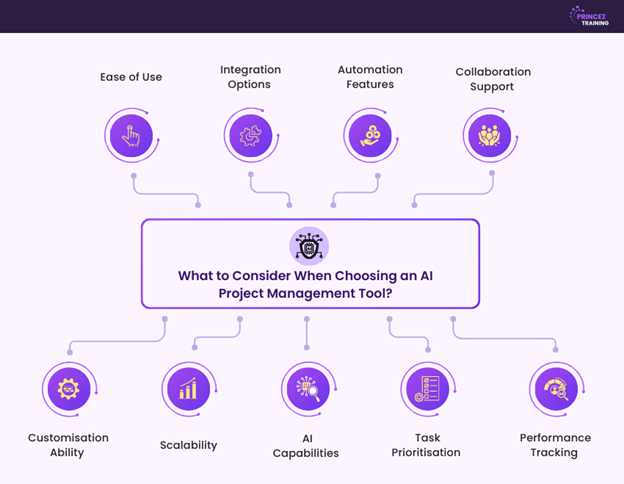
Choose the Right Tools
Not all AI tools suit every project or team. Select solutions that align with your project goals, size, and workflow. Look for features like predictive analytics, task automation, or real-time dashboards. Also, ensure the tool integrates well with your existing systems and is user-friendly for your team.
Provide Adequate Training
Your team needs to understand how to use AI tools effectively. Offer simple, hands-on training that covers the basics and helps users feel confident. When people know how the system works and what to expect, they’re more likely to trust it and use it correctly.
Encourage Collaboration
AI should support teamwork, not replace it. Encourage open communication between human teams and digital tools. Use AI to improve transparency, simplify task allocation, and keep everyone updated. When teams understand how AI supports their work, collaboration becomes smoother and more productive.
Maintain High Data Quality and Security
Since AI depends heavily on data, keeping it clean, accurate, and secure is essential. Regularly update records, remove errors, and set permissions to control who can access sensitive information. Strong data governance not only improves AI performance but also protects the organisation from risk.
Advance your skills in Agile Project Management – join the PRINCE2 Agile® Practitioner Course now!
The Future of AI in Project Management
The future of AI in Project Management is set to be transformational. As AI tools become more advanced and accessible, they’re not just assisting Managers, they’re reshaping how projects are planned, executed, and monitored. In the coming years, AI is expected to take on a more proactive role, shifting from support to strategic collaboration.
AI will increasingly be used for predictive planning, helping Managers forecast project risks, costs, and timelines with much greater accuracy. Real-time analytics will allow project leads to make faster, data-driven decisions, while Machine Learning algorithms can adjust plans on the fly as situations change. Tasks like resource allocation, budgeting, and scheduling will become even more automated and precise.
Conclusion
AI is transforming how we plan, manage, and deliver projects. With the right tools and approach, it can save time, reduce risks, and boost team performance. While challenges exist, they can be managed with clear strategies and strong data. Embracing AI in Project Management today sets you up for smarter, more efficient projects tomorrow.
Discover Project Management power with PRINCE2 Training - Turn projects into success stories!



 Continue Browsing