01344203999



 Back
Back


Table of Content


19-Oct-2026

Maria Thompson
Choosing the right Project Management approach can feel like picking between a speedboat and a cruise ship; both get you across the water, but in very different ways. Agile and Waterfall are two of the most prominent approaches. While Agile thrives on flexibility and rapid adjustments, Waterfall marches forward with structured precision and upfront planning.
Understanding the difference between Agile Vs Waterfall is the key to delivering successful projects.
In this blog, we'll break down their core differences along with their key benefits and drawbacks, so you can decide which path best suits your goals. So read on and keep your projects at peak performance!
What is Project Management?
Project Management involves applying knowledge, skills, tools and techniques to plan, execute and control project activities in line with the defined requirements. It is a vital discipline that helps structure work, allocate resources, manage timelines and achieve clear objectives.
From developing new products to running marketing campaigns or events, Project Management offers a structured approach to reduce risks, improve efficiency, and deliver successful, measurable outcomes.
What is Agile Project Management?
Agile is a flexible Project Management approach ideal for fast-paced project environments. It breaks large projects into smaller, manageable tasks, thus making progress easier to track and allowing teams to respond quickly to changing requirements.
Agile emphasises people over processes, focusing on collaboration and team contribution rather than rigid tools. By delivering work in smaller increments, teams maintain steady momentum, clearer expectations and manageable workloads.
1) The Advantages of Agile Methodology
Agile works particularly well for self-driven teams and offers several key benefits including:
a) Faster delivery through short development cycles
b) Higher product quality supported by continuous testing
c) Rapid improvements through frequent feedback
d) Easier adaptation by revisiting and refining work regularly
2) The Disadvantages of Agile Methodology
Despite its flexibility, Agile is not suitable for every team or project. Its success depends heavily on team capability and organisational readiness. Key challenges include:
a) Greater demand on Project Management due to the absence of fixed schedules
b) Dependence on highly self-motivated, independent teams
c) Ongoing changes to timelines and requirements
d) Careful budget control needed because of the fluid project structure
What is Waterfall Project Management?
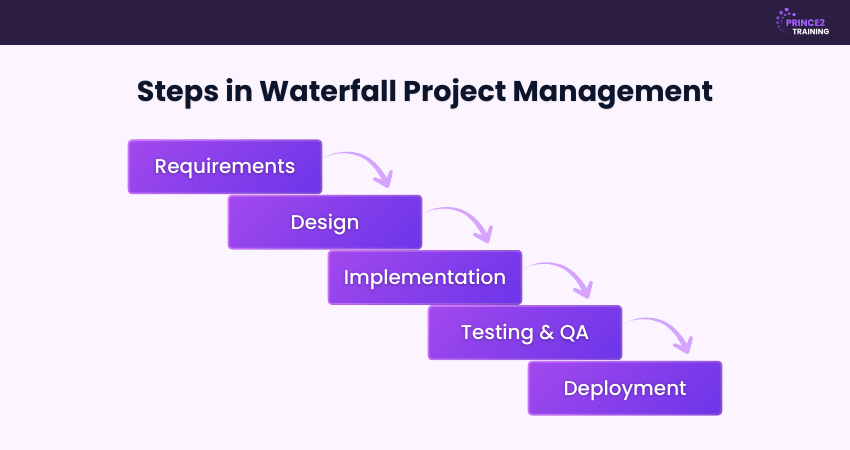
Waterfall Project Management follows a structured, linear approach where each project phase must be completed and formally approved before the next begins. Once a phase is closed, returning to it is often costly and time-consuming.
Waterfall works best for projects with predictable, repeatable requirements and clearly defined outcomes. The model's fixed time blocks often create a "use it or lose it" mindset, which encourages stakeholders to maximise allocated time due to limited opportunities for iteration.
1) The Advantages of Waterfall Methodology
Here are the main benefits of employing the Waterfall approach:
a) Clear, sequential phases reduce the need for constant coordination.
b) Well-defined stages help identify and manage Project dependencies.
c) Project costs can be estimated once requirements are finalised.
d) Strong emphasis on documentation and detailed planning.
e) A structured design phase ensures clarity before development begins.
From foundation to leadership, take the big leap with our comprehensive
Agile Project Management Practitioner Upgrade (Agile PM®) Course
- Register now!
2) The Disadvantages of Waterfall Methodology
Here are some drawbacks of the Waterfall Project Management approach:
a) Work is harder to divide due to strict phase sequencing and specialised roles.
b) Delays in one phase can lead to significant time loss overall.
c) May require additional hiring for specialised teams rather than cross-functional ones.
d) Increased communication overhead during phase handovers.
e) Lower product ownership and engagement compared to Agile, as focus remains on the current phase only.
The Difference Between Agile and Waterfall Project Management
Here are the key distinctions between Agile vs Waterfall Project Management:
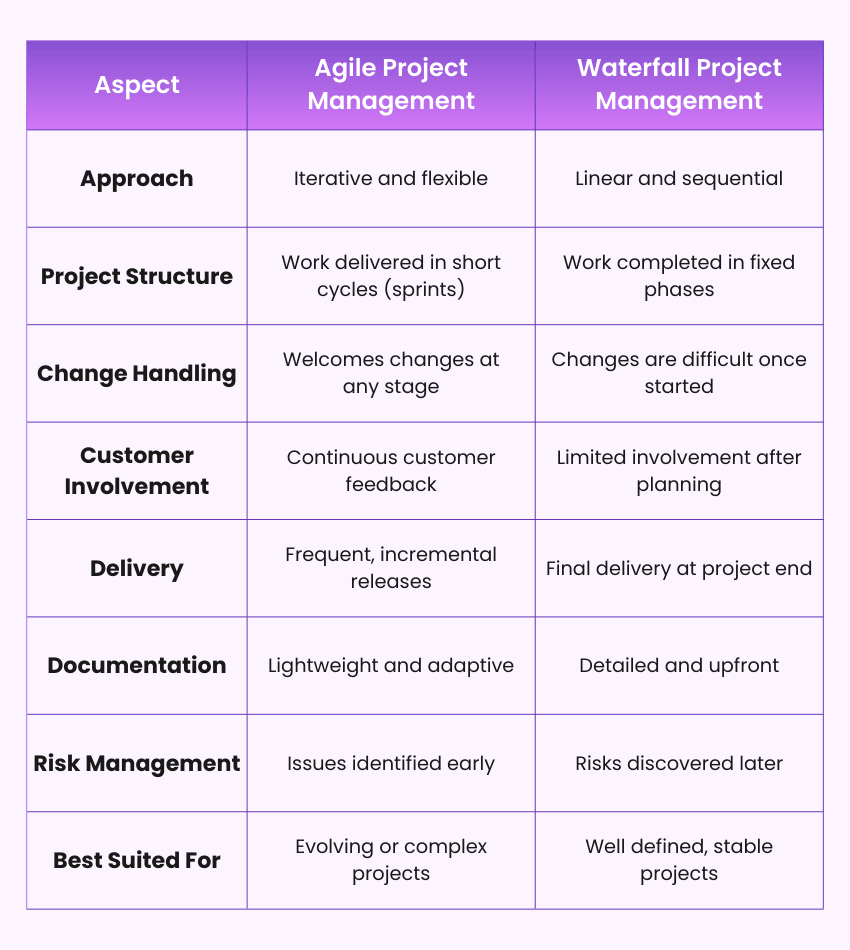
Let's explore these differences in more detail:
1) Project Flow
a) Waterfall:
A linear, step-by-step process where each phase must be completed before the next begins. This approach offers structure but limits opportunities for iteration or early improvement.
b) Agile:
An iterative approach that breaks work into short sprints, allowing continuous improvement. Progress is reviewed frequently to refine outcomes and adapt quickly.
2) Changes and Flexibility
a) Waterfall:
Changes are difficult, costly, and disruptive once a phase is completed. Even small adjustments may require formal change control and rework.
b) Agile:
Changes are welcomed at any stage, with flexibility built into the process. Teams can respond to evolving priorities without major disruption.
3) Customer Involvement
a) Waterfall:
Customer input is mainly gathered at the start and end of the project. This can increase the risk of misalignment with expectations.
b) Agile:
Customers are involved regularly, providing feedback after each iteration. Ongoing collaboration ensures the product stays aligned with real needs.
4) Documentation
a) Waterfall:
Heavy upfront documentation covering all stages in detail. This helps clarity early on but can slow down progress.
b) Agile:
Minimal documentation, prioritising working deliverables over paperwork. Documentation evolves as the product develops.
5) Handling Problems
a) Waterfall:
Risks and issues are planned for early; late discoveries are costly. Fixes near the end can significantly delay delivery.
b) Agile:
Issues are identified and resolved continuously in small cycles. Early detection reduces risk and rework.
6) Timeline and Delivery
a) Waterfall:
Fixed timeline with a single final delivery at the end. Delays in one phase often affect the entire schedule.
b) Agile:
Fixed sprint timelines with a flexible overall schedule and frequent releases. Stakeholders receive value throughout the project lifecycle.
7) Teamwork
a) Waterfall:
Teams work in specialised groups with top-down direction. Limited collaboration can create handoff delays.
b) Agile:
Cross-functional teams collaborate closely and self-organise. Daily communication improves alignment and accountability.
8) Best For
a) Waterfall:
Projects with clear, stable requirements and strict guidelines. It's commonly used in regulated or low-change environments.
b) Agile:
Projects with evolving requirements, high complexity and a need for frequent feedback. It's ideal where innovation and customer collaboration are priorities.
Equip yourself and your team for lasting real-world success in project delivery with our
Agile Project Management Foundation & Practitioner (AgilePM®) Course
– Sign up now!
How to choose between Agile and Waterfall Methodologies?
Choosing between Agile and Waterfall is about deciding which methodology best fits your project, team, and organisation. The ideal approach depends on factors such as project requirements, stakeholder involvement, team capabilities, and organisational culture.
1) Understand Your Project's Nature
a) Waterfall is suitable when requirements are clearly defined from the outset and unlikely to change.
b) This approach works well when the final outcome is well understood before development begins.
c) Agile is more effective when requirements are uncertain, evolving or expected to change during delivery, as its iterative structure supports ongoing refinement.
d) Waterfall fits projects with a fixed and clearly agreed scope. Agile works better when scope can be adjusted, refined, or discovered through regular feedback.
e) Waterfall can manage large projects with stable requirements, while Agile is often better for complex initiatives, breaking work into smaller iterations that reduce risk.
2) Assess Stakeholder and Client Involvement
a) Waterfall usually involves stakeholders at the beginning and end of the project.
b) Agile depends on continuous stakeholder engagement, with frequent feedback ensuring the solution evolves in line with changing needs.
c) Agile provides regular visibility into working deliverables and allows early course correction.
d) Waterfall focuses on progress against a plan, with a working product often visible only in later stages.
3) Evaluate Your Team's Characteristics
a) Waterfall suits teams that prefer clear hierarchies, defined responsibilities and linear workflows.
b) Agile is better for self-organising, cross-functional teams comfortable with collaboration, autonomy and continuous improvement.
c) Agile's emphasis on frequent communication can be challenging for highly distributed teams without strong collaboration tools and processes in place.
4) Consider Your Organisational Culture and Resources
a) Waterfall aligns well with structured, risk-averse environments that value detailed upfront planning.
b) Agile requires a culture that supports adaptability, team empowerment and learning throughout the project lifecycle.
c) Agile relies on consistent access to dedicated team members and engaged product owners across all iterations.
5) Risk Management Philosophy
a) Waterfall focuses on identifying and addressing risks early in the project to avoid later disruption.
b) Agile manages risk continuously, tackling issues in short cycles and enabling faster responses to emerging challenges.
Conclusion
Agile and Waterfall each offer distinct strengths, and the right choice depends on your project's goals, team dynamics and appetite for change. By understanding the key Agile vs Waterfall differences, you can select an approach that boosts collaboration, manages risk effectively and delivers meaningful results. The smartest projects succeed not by following trends, but by choosing the method that truly fits their needs.
Lay the groundwork for long-term project success with our Agile Project Management Foundation (Agile PM®) Course - Sign up now!



 Continue Browsing