Contact@prince2training.co.uk
 01344203999




 Back
Back


Table of Content


24-Sep-2026

Maria Thompson
Have you ever worked on a project where different teams were moving in completely different directions? One team is waiting for approvals, another is changing priorities, while deadlines keep getting closer. This is exactly the kind of challenge an Agile Release Train (ART) is designed to solve by bringing multiple Agile teams together under one shared plan and delivery approach.
An Agile Release Train helps organisations improve team alignment, collaboration, and continuous value delivery. From PI Planning to daily stand-ups, it strengthens coordination across Agile teams. This blog explores the key principles, roles, responsibilities, and advantages of an ART. Let's explore how it works!
What is an Agile Release Train (ART)?
An Agile Release Train (ART) is a long-lived, cross-functional team of Agile teams that plan, commit, and deliver value together on a shared cadence. Introduced in the Scaled Agile Framework (SAFe), it typically consists of 5 to 12 teams, around 50 to 125 people, including developers, Product Owners, Scrum Masters, and supporting roles, all aligned to a common mission and program backlog.
The ART operates on a fixed Program Increment (PI) cycle of 8 to 12 weeks, creating a predictable rhythm for planning, execution, and delivery. By aligning teams around shared PI objectives, it helps large organisations deliver continuous value at scale like a train running on a reliable schedule.

Key Principles of Agile Release Train
An Agile Release Train follows several principles to improve alignment, collaboration, and continuous value delivery across Agile teams. These principles help teams work efficiently while staying focused on business goals and customer needs:
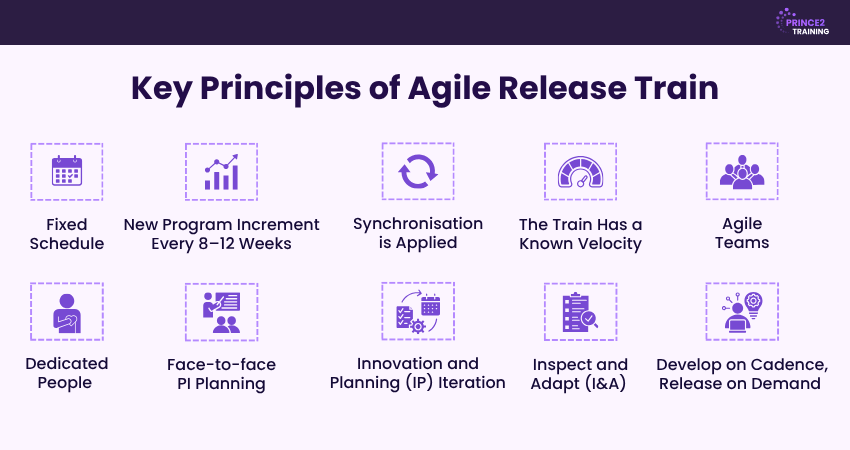
1) Fixed Schedule
An Agile Release Train works on a fixed timeline called a Program Increment (PI). This schedule helps teams plan activities, coordinate tasks, and manage dependencies more effectively across multiple Agile teams working together on shared objectives.
A fixed schedule also improves predictability and delivery consistency. Teams can align their work, stakeholders can monitor progress easily, and organisations can release updates regularly without creating confusion or delays in the development process. This consistency helps build trust among stakeholders and ensures smoother long-term planning.
2) New Program Increment Every 8–12 Weeks
A Program Increment (PI) usually lasts between 8 and 12 weeks, during which teams plan, develop, test, and deliver features. This structured timeframe helps maintain focus and ensures continuous progress toward business and customer goals.
Regular Program Increments also encourage better planning and collaboration. Teams can review completed work frequently, gather feedback, and make improvements before starting the next increment, which supports continuous learning and value delivery.
3) Synchronisation is Applied
All teams in an Agile Release Train follow the same Sprint timelines, planning sessions, and review cycles. Synchronisation helps teams stay aligned and ensures work progresses smoothly across different functions and departments within the organisation.
This shared rhythm improves communication and reduces dependency-related delays. Teams can collaborate more effectively, resolve issues faster, and integrate their work continuously, which increases efficiency and supports better product delivery outcomes.
4) The Train Has a Known Velocity
Velocity refers to the amount of work teams can complete within a Sprint or Program Increment. ART uses known velocity to estimate workloads, improve forecasting accuracy, and create realistic delivery expectations for stakeholders.
Understanding velocity also helps teams manage resources and priorities more effectively. By analysing previous performance, teams can make informed decisions, avoid overcommitment, and maintain a sustainable pace throughout the development lifecycle.
5) Agile Teams
An Agile Release Train consists of multiple cross-functional Agile teams with skills in development, testing, design, operations, and Business Analysis. These teams collaborate closely to deliver customer value and achieve shared organisational goals continuously.
Agile teams encourage flexibility, accountability, and collaboration. Since teams are self-organised, they can adapt quickly to changes, solve problems efficiently, and improve delivery speed while maintaining quality throughout the development process. Their cross-functional nature reduces handoffs and accelerates value delivery.
6) Dedicated People
People working in an ART are usually dedicated full-time to the train and its objectives. This dedicated involvement improves focus, reduces distractions, and allows teams to work more efficiently on shared priorities.
Dedicated people also strengthen collaboration and accountability across teams. Since members consistently work together, they develop stronger communication, coordination, and a deeper understanding of business goals, customer needs, and technical requirements.
7) Face-to-face PI Planning
Program Increment Planning is an important event where all teams, stakeholders, and leaders meet to discuss objectives, priorities, dependencies, and risks. Face-to-face collaboration improves communication and creates alignment across the entire Agile Release Train.
This planning session also encourages teamwork and transparency. Teams gain a clear understanding of expectations, identify challenges early, and build stronger relationships that support smoother execution throughout the Program Increment.
8) Innovation and Planning (IP) Iteration
The Innovation and Planning Iteration gives teams dedicated time for innovation, technical improvements, learning activities, and future planning. It allows teams to explore new ideas without the pressure of immediate feature delivery requirements.
The IP Iteration also supports continuous improvement and preparation for the next Program Increment. Teams can resolve technical debt, improve processes, conduct training, and strengthen overall productivity and solution quality. This ensures long-term sustainability and continuous innovation within the ART.
9) Inspect and Adapt (I&A)
Inspect and Adapt is a continuous improvement event conducted at the end of each Program Increment. Teams review performance, analyse results, identify problems, and discuss ways to improve future workflows and delivery processes.
This principle encourages learning and transparency across the Agile Release Train. By regularly evaluating successes and challenges, teams can improve quality, reduce inefficiencies, and strengthen collaboration for future Program Increment activities.
10) Develop on Cadence, Release on Demand
Agile Release Trains develop solutions on a regular schedule while releasing features whenever the business or customers require them. This approach combines stable development practices with the flexibility to respond quickly to market demands.
Developing on cadence improves coordination and predictability, while release on demand increases customer responsiveness. Together, they help organisations deliver value efficiently without disrupting ongoing development and operational activities.
Develop strong Project Management foundations with industry-recognised PRINCE2® Foundation Training – Register now!
Key Roles in an Agile Release Train
Several roles support the success of an Agile Release Train (ART) by improving coordination, delivery, and collaboration across teams. The following are the key roles in an ART:
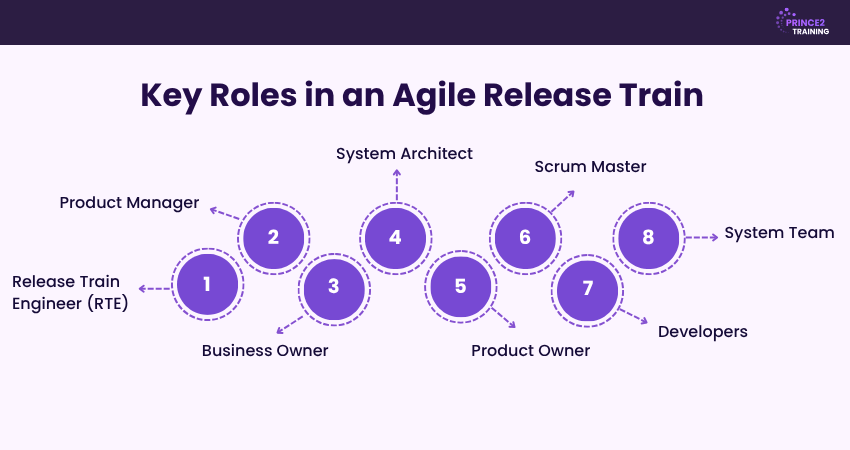
1) Release Train Engineer (RTE)
The Release Train Engineer acts as the leader and facilitator of the ART. They coordinate teams, manage dependencies, remove obstacles, and ensure all activities align with Program Increment goals and business priorities.
The RTE also supports communication and collaboration across teams and stakeholders. By monitoring progress and resolving issues quickly, they help maintain smooth workflows and improve overall ART performance and delivery efficiency. They also act as a servant leader, ensuring teams remain focused, aligned, and continuously improving throughout the Program Increment.
2) Product Manager
The Product Manager is responsible for defining business priorities and managing the Program Backlog. They ensure the Agile Release Train delivers valuable features that align with customer needs and organisational objectives.
Product Managers also collaborate with stakeholders, Product Owners, and teams to clarify requirements and prioritise work. Their decisions help maximise customer value while supporting strategic business goals and long-term product success. Their role is critical in balancing customer expectations with business strategy and market demands.
3) Business Owner
Business Owners represent key stakeholders and provide guidance on business priorities and expected outcomes. They ensure the work delivered by the Agile Release Train supports organisational strategies and customer expectations effectively.
Business Owners also participate in Program Increment Planning and important review activities. Their involvement helps teams understand business value, make informed decisions, and maintain alignment with organisational objectives throughout development.
4) System Architect
The System Architect provides technical guidance and defines the overall architecture for the solution being developed. They ensure technical standards, integration strategies, and design practices support scalability, quality, and long-term system stability.
System Architects also collaborate closely with Agile teams to resolve technical challenges and improve system performance. Their expertise helps maintain consistency across teams and supports efficient development and delivery processes. They also guide technical decisions that impact long-term system sustainability and performance.
5) Product Owner
The Product Owner manages the Team Backlog and works closely with Agile teams to define, prioritise, and clarify user stories. They ensure the team focuses on delivering features that provide maximum customer and business value.
Product Owners also communicate regularly with stakeholders and Product Managers to align priorities and expectations. Their role helps improve transparency, streamline development activities, and maintain focus on customer requirements.
6) Scrum Master
The Scrum Master supports Agile teams by facilitating Agile practices and helping teams follow Scrum principles effectively. They remove obstacles, encourage collaboration, and ensure teams can work productively without unnecessary interruptions.
Scrum Masters also promote continuous improvement and healthy team dynamics. By guiding meetings, resolving issues, and supporting communication, they help teams maintain focus and improve overall delivery performance.
7) Developers
Developers are responsible for designing, building, testing, and maintaining the solution delivered by the ART. They work collaboratively within Agile teams to ensure features meet technical and business requirements.
Developers also participate in planning, reviews, and continuous improvement activities. Their technical expertise and teamwork help ensure reliable, high-quality solutions are delivered consistently throughout the Program Increment.
8) System Team
The System Team supports integration, testing, deployment, and infrastructure activities across the Agile Release Train. They help maintain development environments and ensure technical systems operate smoothly throughout the delivery process.
The System Team also assists Agile teams in resolving technical issues and improving system stability. Their support helps reduce delays, improve quality, and maintain continuous integration and delivery practices effectively. Their contribution ensures seamless integration and stable delivery across multiple teams.
Build advanced Project Management expertise using industry-recognised PRINCE2® Practitioner Training – Join now!
Responsibilities of an Agile Release Train (ART)
An ART helps Agile teams stay aligned and deliver value continuously. To support this, it follows several key responsibilities, including:
1) Delivering Value: The ART delivers high-quality solutions regularly to meet customer needs and support faster responses to changing market demands.
2) PI Planning: The ART participates in Program Increment (PI) Planning to align goals, prioritise work, identify dependencies, and prepare teams for upcoming activities.
3) Inspect and Adapt (I&A): The ART conducts Inspect and Adapt workshops to review performance, identify improvements, and enhance future delivery processes and team efficiency.
4) Alignment: The ART ensures all teams and activities remain aligned with organisational objectives, business priorities, and customer expectations.
5) Dependency Management: The ART manages dependencies between teams and systems to reduce delays, improve coordination, and maintain smooth workflows.
6) Backlog Refinement: The ART refines and prioritises backlog items to ensure features and user stories are clear and ready for development.
7) Collaboration: The ART promotes collaboration between teams, stakeholders, and leadership to improve communication and achieve shared goals effectively.
8) Problem-solving: The ART supports teams in resolving challenges, removing impediments, and improving workflows to maintain continuous progress.
9) Customer Focus: The ART gathers customer feedback regularly to ensure that delivered solutions provide maximum business and customer value.
10) Economic Prioritisation: The ART prioritises work based on business value, cost, and expected outcomes to improve resource utilisation and delivery impact.
Advantages of Implementing an Agile Release Train
Implementing an ART helps organisations improve alignment, coordination, and value delivery across Agile teams. Some key advantages of an ART include:
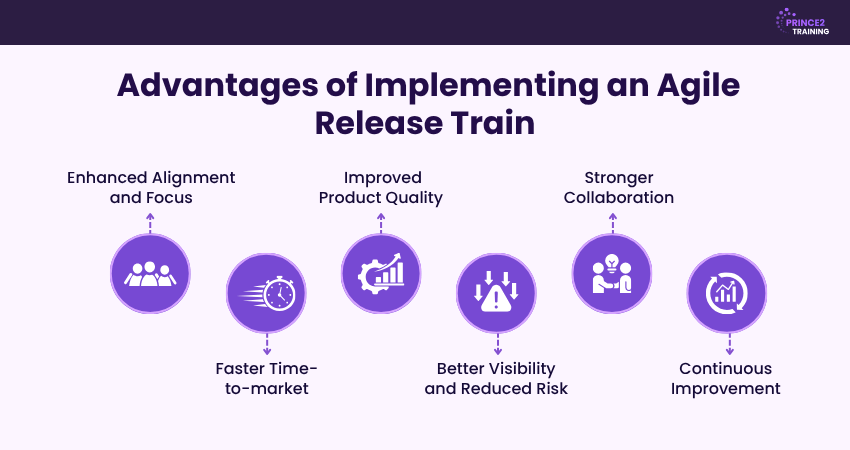
1) Enhanced Alignment and Focus: The ART aligns Agile teams around shared goals and timelines, improving coordination and business focus across the organisation.
2) Faster Time-to-market: The ART supports quicker feature delivery through continuous development, dependency management, and regular release cycles.
3) Improved Product Quality: Continuous testing and integration help teams identify issues early and maintain reliable, high-quality solutions.
4) Better Visibility and Reduced Risk: The ART improves transparency and helps teams identify and address risks early through regular planning and review activities.
5) Stronger Collaboration: The ART encourages collaboration between teams and stakeholders, improving communication and overall delivery efficiency.
6) Continuous Improvement: Inspect and Adapt (I&A) workshops help teams improve workflows, productivity, and future delivery performance continuously.
Strengthen Agile project delivery with the PRINCE2 Agile® Foundation and Practitioner (Version 2) Training – Join now!
Major ART Events, Ceremonies, and Workflow
Agile Release Train (ART) follows structured events and ceremonies to maintain alignment, improve collaboration, and support continuous delivery. Key ART events and workflows include:
1) PI Planning: PI Planning helps teams align objectives, plan work, identify dependencies, and prepare for the upcoming Program Increment.
2) Development Iterations: Teams work in short iterations using Scrum or Kanban practices to develop and deliver features continuously throughout the Program Increment.
3) ART Sync: The ART Sync is a regular meeting where teams review progress, discuss risks, and manage cross-team dependencies.
4) Product Owner (PO) Sync: The PO Sync helps Product Managers and Product Owners review priorities, track progress, and address delivery risks.
5) Scrum of Scrums (SoS): The Scrum of Scrums helps Scrum Masters and teams coordinate work, resolve conflicts, and manage dependencies effectively.
6) System Demo: The System Demo allows teams to showcase completed work and gather stakeholder feedback at the end of each iteration.
7) Inspect and Adapt (I&A): Inspect and Adapt workshops help teams review performance, identify improvements, and enhance future delivery activities.
8) Innovation and Planning (IP) Iteration: The IP Iteration provides time for innovation, planning, learning, infrastructure work, and completing unfinished tasks.
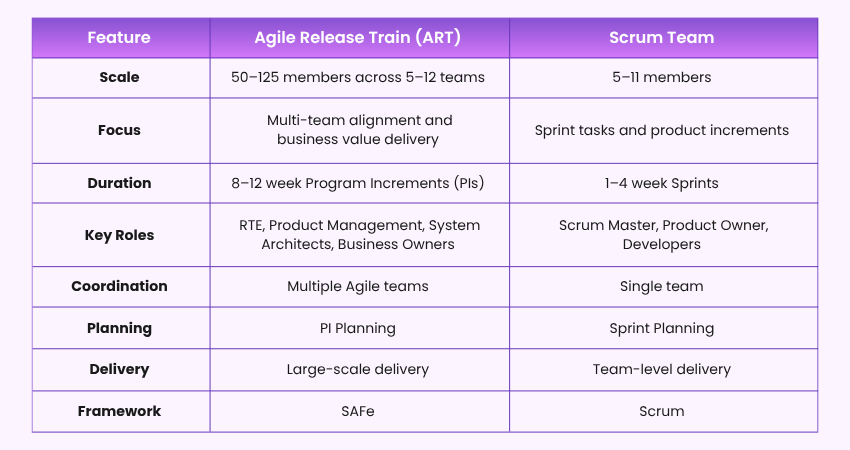
What is the Difference Between an ART and a Scrum Team?
An Agile Release Train (ART) and a Scrum Team both follow Agile principles, but they differ in size, scope, and responsibilities. An ART coordinates multiple Agile teams for large-scale delivery, while a Scrum Team focuses on delivering work within a single team.
Conclusion
Agile Release Train (ART) helps organisations align teams, improve collaboration, and deliver value faster at scale. By combining structured planning, continuous improvement, and shared business goals, ARTs create a more connected and efficient Agile environment. Understanding how ARTs work can help organisations manage complex projects with greater flexibility and confidence.
Strengthen project leadership skills with industry-recognised PRINCE2® Training – Join today!
Frequently Asked Questions
How Many Teams Make up an Agile Release Train?
An Agile Release Train (ART) typically consists of 5 to 12 Agile teams, with each team having 5 to 11 members, making the total ART size roughly 50 to 125 people working together toward a shared mission.
What is the Agile Release Train Flow?
The ART Flow follows a PI cadence of 8–12 weeks. It starts with PI Planning, followed by 2-week iterations for building and testing. Regular ART Syncs manage dependencies. Each iteration ends with a System Demo, and the PI closes with Inspect & Adapt for continuous improvement.
Is RTE Higher Than Scrum Master?
Yes, the RTE operates at a higher level than the Scrum Master. The Scrum Master coaches one team, while the RTE acts as the chief Scrum Master for the entire ART, coordinating across all teams, facilitating PI Planning, managing risks, and driving ART-level continuous improvement.



 Continue Browsing