Contact@prince2training.co.uk
 01344203999




 Back
Back


Table of Content


07-Sep-2026

Veronica Davis
Imagine you're cooking up a project—like a gourmet meal. Each theme in PRINCE2 is like a secret ingredient that adds flavour and finesse. These PRINCE2® Themes are processes that should be revisited throughout the project's lifecycle to ensure they remain relevant to its goals.
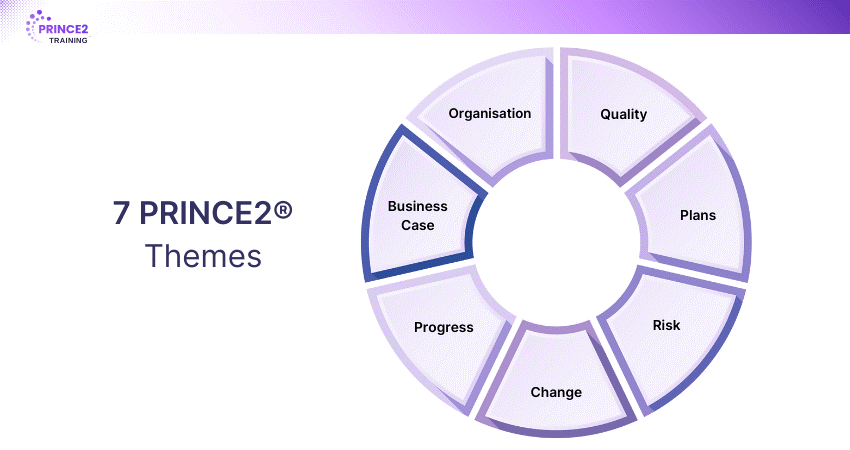
These themes offer a guide for handling any project and enhancing its success. Some well-known categories are Business Case, Organisation, Quality, Plans, Risk, Change, and Progress.
Each theme encompasses a control domain essential to the overall initiative and management of complex projects. Knowledge of these themes assists Project Managers in following a definite and standard approach when managing projects to achieve the right quality, time, and cost.
Table of Contents
1) 7 PRINCE2® Themes
a) Business Case
b) Organisation
c) Quality
d) Plans
e) Risk
f) Change
g) Progress
2) Conclusion
7 PRINCE2® Themes
Let's look at the 7 important PRINCE2® Themes to help you in your future Project Management activities:
1) Business Case
The Business Case theme is one of the fundamental Themes of PRINCE2. It aims to assess the sustainability and relevance of the project to the business in every stage of its existence. It offers the rationale for the project, possible advantages, potential drawbacks, and possible schedule and cost. Annual review and updating are essential parts of the business case to consider all changes and the stakeholder-management-proposition of the project.
This theme assists decision-making by ensuring that available resources are efficiently used and benefits will be gained after project completion. It is also helpful for the stakeholders to support the project as required, thus acting as a basis to justify its inception and sustenance.
2) Organisation
The Organisation theme defines the sets and frames the authorities and obligations within a given project to avoid the complexity of some other structures. It provides a working model for the project to be defined by the Project Board, Project Manager, and Team Managers, among others.
This theme helps ensure that all the stakeholders know their roles and the part they play for it to succeed. The Organisation theme also plays a crucial role in defining roles and responsibilities where all the processes contribute toward efficient communication, decision-making, and conflict-solving. This way, it contributes to having leadership that governs the project and support that drives the proper execution of the project.
3) Quality
Quality represents an overarching concept related to attaining the project's objectives regarding the quality of the final outputs and outcomes. It entails developing specifications concerning what quality will be delivered, deciding how it will be offered, and ensuring that what was promised is delivered.
This theme focuses on customer focus and meeting specifications by underlining customer satisfaction as a primary concern. It incorporates quality planning, inspection control, and quality assurance. This theme emphasises ensuring that the final product is delivered with the required quality levels that meet or exceed the stakeholders' expectations, contributing to the project's credibility and success in both PMBOK and PRINCE2.

4) Plans
The Plans theme explains how the project's objectives will be met and the method by which the needed products will be produced. It entails developing elaborate frameworks that outline or describe activities, resources, timeframes, and roles required to accomplish a project.
This theme ensures everything concerning the project has been planned and is on the same page. It comprises product-based planning tools that outline what has to be done, who will do it, and when to do it. Planning is essential to control time, cost, and quality; this theme outlines the guidelines for creating, updating, and monitoring project plans.
5) Risk
The Risk theme is concerned with identifying, evaluating, and controlling risks inherent in a project. It also guarantees that risks and opportunities are dealt with effectively before they harm or benefit the company. This theme entails formulating a risk management plan, risk identification, risk analysis, risk assessment, and response management.
This theme also aids in sustaining project stability and attaining goals in the presence of risk by systematically managing it. It includes constantly checking the risk status, ensuring everyone is aware of the risks and what measures are being taken to counter them.
6) Change
The Change theme deals with the practical and controlled management of project scope and deliverables changes. It has procedures for recognising, quantifying, and authorising alterations while ensuring they are correctly recorded and disseminated. This policy ensures any change is warranted, assessed for its impact on time, cost, and quality, and incorporated properly in the project plan.
This policy ensures that any changes are warranted, assessed for their impact on time, cost, and quality, and appropriately incorporated into the project plan. This theme ensures that the project is on track by managing changes appropriately.
7) Progress
The Progress theme oversees the project and the various activities to maximise achieving the set goals. The final element includes establishing performance expectations, defining outcomes, and comparing the actual outcomes with planned expectations. This theme ensures that any deviations are detected prior to corrective action being taken on time.
Frequency reporting/review can be suggested as transparent communication with the stakeholders and letting them know about the project's current state of affairs. The Progress theme also has mechanisms for escalating problems and decision-making when necessary to keep the project and any arising problems in check.
Conclusion
The PRINCE2® Themes are a significant focus during a PRINCE2 in-person and online course. This blog discussed these themes to equip you with the necessary knowledge for the PRINCE2 Foundation training. We hope you have learned these themes and how to use them in future endeavours.
Gain fundamental skills to become a successful Project Manager with our
PRINCE2 Agile® Practitioner Course!



 Continue Browsing